Why irrationality wins the game of chicken
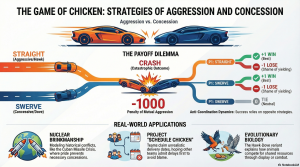
March 25, 2026 /Mpelembe Media/ — The sources and our previous conversation explore the profound implications of the Game of Chicken, a foundational concept in game theory that models conflict, resolve, and the threat of mutual destruction. Culturally linked to the morbid evolution of the “chicken crossing the road” joke and teenage driving stunts, the game describes an anti-coordination scenario where two actors must choose to either yield (“swerve”) or stay the course (“straight”). Because mutual defection results in catastrophic failure (a “crash”), the game lacks a dominant strategy; a player’s optimal move is always to do the opposite of their opponent. To win, an actor must convince their opponent that they will not yield, sometimes by irreversibly pre-committing to a dangerous path (such as visibly disabling their steering wheel) to force the other to swerve.
This strategic framework applies across a wide array of disciplines:
Geopolitics and Brinkmanship: Philosopher Bertrand Russell famously likened Cold War nuclear standoffs to a game of chicken. Strategist Thomas Schelling defined brinkmanship as manipulating the shared risk of war, where states use “threats that leave something to chance” to coerce adversaries into backing down. In the modern era, the integration of AI and automated command systems in warfare risks acting as an algorithmic pre-commitment (a “Doomsday Machine”), removing human agency and dangerously escalating nuclear brinkmanship. The game also models international resource disputes, such as nations playing chicken over who will pay for the maintenance of a shared dam.
Evolutionary Biology: Biologists John Maynard Smith and George R. Price adapted this concept into the Hawk-Dove game to explain why competing animals typically engage in ritualized displays rather than fighting to the death. The model demonstrates how an Evolutionarily Stable Strategy (ESS) emerges, naturally balancing aggressive (Hawk) and submissive (Dove) phenotypes in a population based on the value of a contested resource versus the lethal costs of combat.
Economics and Management: In microeconomics, the model illustrates non-cooperative conflicts like destructive corporate price wars. In project management, it manifests as “Schedule Chicken,” a toxic scenario where delayed sub-teams refuse to admit their deadlines are unachievable, each hoping another team will confess first and absorb the blame. Managers are urged to change organizational incentives to prevent these standoffs and their resulting collateral damage.
Social and Psychological Dynamics: The temporal aspect of the game is frequently modeled as a War of Attrition, where courage is quantified by how long an actor can endure ongoing costs before conceding. Players also factor in social utility, often risking catastrophic physical outcomes to build a long-term reputation for resolve and avoid the shameful stigma of being labeled a coward.
Why You’re Playing a Game of Chicken (And How to Win Without Crashing)
Imagine two cars speeding toward each other on a single-lane bridge. If both drivers hold their course, a fatal head-on collision is certain. If one swerves, they are branded the “chicken”—an object of contempt—while the other wins the bridge and the glory. If both swerve, they face the minor sting of shared retreat.This is the “Chicken Game,” also known in biology as Hawk-Dove or in economics as the Snowdrift game. It is a model of conflict where the absolute worst outcome is mutual defiance. We see this play out in nuclear brinkmanship , territorial disputes, and even corporate project management. Understanding the math of “swerving” isn’t just a theoretical exercise; it is essential for surviving high-stakes standoffs where your opponent’s move is the Strategic Substitute for your own.
The Strategic Power of Tying Your Own Hands
The most counter-intuitive tactic in Chicken is “pre-commitment.” In the classic car scenario, a driver might ostentatiously throw their steering wheel out the window in full view of the opponent. By reducing their own options to zero, they transform a choice into a certainty. This shifts the entire burden of avoiding catastrophe onto the other player. If the opponent is rational, they must swerve because you have physically removed your ability to do so.This logic powers several real-world maneuvers:
Physical Constraints: A protester handcuffs themselves to an object. By making it impossible to move, they force the opposition to either concede or escalate to force, as verbal threats are now mathematically irrelevant.
The “Doomsday Machine”: In strategic theory, a device that triggers annihilation automatically—removing human “swerving” from the loop—serves as the ultimate deterrent.As Bertrand Russell famously observed regarding nuclear policy:Since the nuclear stalemate became apparent, the governments of East and West have adopted the policy that Mr. Dulles calls ‘brinkmanship’… The moment will come when neither side can face the derisive cry of ‘Chicken!’ from the other side. When that moment comes, the statesmen of both sides will plunge the world into destruction.
The “Schedule Chicken” Trap in Project Management
In software development, Chicken manifests as “Schedule Chicken”—a systemic failure masked by individual silence. This occurs when multiple teams claim they can deliver features by an unrealistic date. Each team knows they are behind, but they assume other teams will fail even sooner, providing a convenient excuse for the overall project slip.This ensures a contagious schedule slip where no one wants to be the “first bearer of bad news.” The pretense follows a predictable, destructive progression:
The Denial Phase: Teams ignore early warnings and telemetry during initial development, hoping for a “miracle” or an opponent’s failure.
The Checkpoint Pretense: Status reports remain “Green” through project milestones to avoid the social stigma of being the primary bottleneck.
The Integration Phase Breakdown: The crash occurs when dependencies are finally tested, and the lack of functionality makes further deception impossible.In this environment, “Hawks” (those who hide delays) hope “Doves” (those who admit they are behind) will take the reputational hit for the collective failure.
The “Spiral of Fear” and Payoff Uncertainty
Conflict often escalates not because players are inherently aggressive, but because they suffer from Payoff Uncertainty . As analyzed by economists Baliga and Sjöström, players struggle to identify their opponent’s true “hostility parameter.”You may not be aggressive, but if you cannot rule out that your opponent is a “Dominant Strategy Hawk”—someone who will always attack regardless of the cost—you may feel compelled to act aggressively in self-defense. This creates a “Spiral of Fear”:
Coordination Types: These players want to match their opponent’s actions (playing Dove if the other plays Dove).
Opportunistic Types: These players drive the Strategic Substitutes logic—they want to play Hawk only if they expect the other to play Dove.In this spiral, an “almost dominant strategy hawk” acts aggressively not out of malice, but because they are terrified. Their “defensive” aggression triggers fear in the opponent, leading to a self-fulfilling prophecy of conflict. Because Chicken is a game of Strategic Substitutes , your incentive to be a Hawk increases as you become more certain the other side will be a Dove—but uncertainty forces everyone to lean toward the “crash” outcome.
Why “Ownership” is Biology’s Way of Breaking the Symmetry
In biology, the Hawk-Dove game models how animals compete for resources. If two animals always play Hawk, they risk constant injury; if they always play Dove, they waste time in endless posturing. The solution to this sub-optimal Nash Equilibrium is “Uncorrelated Asymmetries”—roles that break the symmetry of the game and reduce Payoff Uncertainty .Nature typically solves this through the convention of “Ownership”:
The Owner-Hawk, Intruder-Dove Convention: The established owner of a territory plays Hawk, and the intruder plays Dove. This role-based signaling prevents physical combat.
The Anti-Property Solution: Interestingly, the spider species Oecobius civitas uses the reverse symmetry. When an invader appears, the occupying spider yields and leaves.Whether the rule is “Owner Wins” or “Owner Leaves,” the existence of a clear social or biological role prevents the catastrophic “crash” by coordinating expectations.
The Mixed Strategy Equilibrium and the “Unpleasant Task”
When a team faces an “unpleasant task”—like an inspection or a difficult bug fix—the situation becomes an $n$ -player game of Chicken. In experimental economics, this is modeled with a €20,000 success value and a €13,000 “cost of volunteering.” If one person volunteers, they get €7,000 while everyone else gets €20,000. If no one volunteers, everyone gets €0.The math reveals a troubling “diffusion of responsibility.” As the number of players ( $n$ ) in a “universe” increases, the individual incentive to volunteer drops faster than the mathematical benefit of having more potential volunteers.Key Insight: In a symmetric mixed-strategy Nash Equilibrium , as the group size ( $n$ ) grows, the probability that at least one person volunteers actually decreases. In larger groups, the “universe” is statistically more likely to fail because everyone assumes someone else will swerve.This is exacerbated by “relative status.” If players care more about their ranking than their absolute payoff, they refuse to volunteer because doing so helps their competitors’ scores more than their own.
Conclusion: Steering Through the Stalemate
The game of Chicken is a delicate dance of signaling, brinkmanship , and the mastery of Strategic Substitutes . Success depends on your ability to break symmetry—whether through the role-based “Ownership” seen in biology or the high-stakes “Pre-commitment” seen in international relations.However, as we move into an era of automated systems, we face a new risk. Automation often lacks the “face-saving” nuance and “irrational” human ability to swerve at the final second. In a world governed by rigid algorithms, the Strategic Complements of cooperation may be harder to find.In your current professional standoff, are you holding the steering wheel, or have you already thrown it out the window?