U.S. politicians across the political spectrum have reacted with intense alarm to the President’s recent expletive-laden threats toward Iran, with several questioning his mental fitness for office.
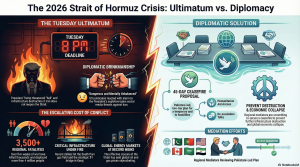
April 6, 2026 /Mpelembe Media/ — The current conflict between the United States, Israel, and Iran began in late February 2026 with joint U.S.-Israeli “preemptive” military strikes on Iran, aiming to either eliminate the country’s nuclear capabilities or force regime change. In retaliation, Iran launched drones and ballistic missiles against Israel, as well as U.S. military targets located in the Gulf States and Jordan. Now in its sixth week, the war has severely destabilized the Middle East, killing over 3,500 people across the region—including more than 1,900 in Iran and 1,400 in Lebanon—while displacing millions.
A central flashpoint of the conflict is Iran’s effective closure of the Strait of Hormuz, a critical maritime corridor that typically handles a fifth of the world’s oil supply. By disrupting cargo traffic and expanding drone and missile attacks on energy infrastructure in Kuwait, Bahrain, and the United Arab Emirates, Iran has caused global oil and gas prices to skyrocket.
Recent military escalations have been severe and destructive on both sides. Israel recently struck Iran’s massive South Pars petrochemical plant, which is responsible for half of the country’s petrochemical production. In addition, U.S.-Israeli strikes killed the intelligence chief of Iran’s Revolutionary Guards, Maj. Gen. Majid Khademi. Iran has also hit civilian targets, including a residential building in Haifa, Israel, and managed to shoot down a U.S. F-15E Strike Eagle, though American forces successfully executed a complex rescue of the two downed aviators.
The crisis has been deeply exacerbated by aggressive and unconventional diplomatic rhetoric. Over the Easter weekend, President Donald Trump issued an expletive-laden ultimatum demanding that Iran reopen the Strait of Hormuz by a Tuesday evening deadline. Trump threatened that failure to comply would result in devastating strikes on Iranian civilian infrastructure, specifically power plants and bridges. This prompted Iranian officials to accuse the U.S. of inciting war crimes, while domestic U.S. politicians condemned the President’s remarks as the ravings of an “unhinged madman”.
A highly unique dimension of this conflict is the heavy reliance on “memetic warfare” to influence public opinion and court Generation Z. The U.S. White House has published social media videos combining real strike footage with clips from SpongeBob SquarePants, Wii Sports, and Mortal Kombat to project dominance. Concurrently, Iranian agencies have circulated satirical AI-generated content and Lego-style animated propaganda to mock U.S. leadership and minimize the psychological appearance of the American threat.
Despite the intensifying violence and digital vitriol, diplomatic efforts are underway. Mediators have presented a two-tier, 45-day ceasefire proposal to both the U.S. and Iran. While Iranian officials confirmed they are reviewing the plan, they insist they will not reopen the Strait of Hormuz for merely a “temporary” ceasefire and will not bow to ultimatums. Meanwhile, international leaders, including Pope Leo XIV and the UN Secretary-General, have urgently called for an immediate de-escalation and a return to diplomatic negotiations to halt the catastrophic “spiral of violence”.
The Hormuz Spiral: Why Trump’s “Infrastructure Ultimatum” Signals the Death of Diplomatic Civility
The Hook: A World on the Edge
By April 2026, the international community has reached a state of high-alert paralysis. Five weeks into the US-Iran war, the conflict has transcended the kinetic to enter a theater of the “unhinged,” where the very architecture of global diplomacy is being dismantled in real-time. For the seasoned observer, this is more than a regional skirmish; it is a profound historical rupture—a moment where the norms governing statecraft have been replaced by a volatile, downward strategic spiral.
The “Incivility Spiral” Goes Global
To analyze the current rhetoric between Washington and Tehran, we must look through the lens of behavioral psychology. Research, such as the 2022 MDPI study on “Experienced Workplace Incivility” (EWI) and “Instigated Workplace Incivility” (IWI), highlights an “incivility spiral” where negative behavior inevitably begets further negative behavior. This phenomenon has migrated from the office to the Oval Office, manifesting as a dangerous feedback loop between the two powers.President Donald Trump’s recent Truth Social demand—“open the fuckin’ strait, you crazy bastards”—punctuated by a jarring and strategically bizarre sign-off of “Praise be to Allah,” perfectly mirrors the transition from EWI to IWI. The MDPI study identifies “stress” as the critical mediator in this process. In this volatile theater of operations, the biological stress of the Strait’s closure—which has pushed oil prices to record highs—has effectively paralyzed rational diplomatic processing. The result is a normative erosion where the logic of the “incivility spiral” dictates policy, forcing both sides to reciprocate with ever-increasing hostility.
The “Infrastructure Ultimatum”: When Rhetoric Meets War Crimes
The Trump administration has now issued an “Infrastructure Ultimatum,” setting a hard 8:00 PM EDT deadline this Tuesday for Iran to reopen the Strait of Hormuz. The threats have targeted the foundational nodes of Iranian civilian life:”Tuesday will be Power Plant Day, and Bridge Day, all wrapped up in one, in Iran. There will be nothing like it!!! Open the Fuckin’ Strait, you crazy bastards, or you’ll be living in Hell – JUST WATCH! Praise be to Allah.” — Donald J. Trump, Truth Social.This shift has drawn a sharp rebuke from EU Council Chief António Costa, who characterized the targeting of energy facilities as “illegal and unacceptable.” More critically, the Iranian Deputy Foreign Minister, Kazem Gharibabadi, has invoked Article 8(2)(b) of the Rome Statute, arguing that public threats against bridges and power plants constitute explicit intent to commit war crimes. This is not a theoretical concern; the April 3 strike on the B1 bridge in Karaj already left 8 dead and 95 injured. Furthermore, Iran is attempting to pivot the crisis into a “new legal regime” for the Strait, demanding “transit fees” as compensation for war damages—a move that signals a permanent shift in how Tehran intends to weaponize its maritime geography.
The Great MAGA Fracture: Marjorie Taylor Greene’s Radical Shift
The conflict has also triggered a significant rift within the American domestic front. What began as a minor disagreement has evolved into a total break between the President and one of his former staunchest allies, Marjorie Taylor Greene. While the public rift began as early as June 2025 following initial strikes, it has now matured into a full-scale campaign of “America First isolationism.”Greene has characterized the war as “unprovoked” and built on “nuclear lies,” demanding that administration members “beg forgiveness from God” for their complicity.”This is not making America great again, this is evil.” — Marjorie Taylor Greene.This dissent is a vital indicator of the war’s polarizing nature. By framing the conflict as a betrayal of the promise to avoid expensive foreign entanglements, Greene is tapping into a core constituency that views the current “Infrastructure Ultimatum” as a departure from the movement’s original tenets.
The CIA’s “Confusion” Tactic and the Reality of the F-15 Rescue
The recent extraction of two US pilots from Iranian territory has been framed by the White House as an “Easter Miracle.” Tactically, the operation utilized a classic CIA “confusion” tactic—spreading false reports within Iran that a pilot had already been evacuated to create indecision among local search teams. However, the mission reveals the true perils of a campaign five weeks in:
The “Easter Miracle” Narrative: Trump’s framing of a flawless mission in violent territory.
The Iranian Counter-Claim: State media footage purportedly showing downed US transport aircraft and helicopters.
The Intelligence Reality: Regional reports indicate the US military was forced to blow up two of its own transport planes following “technical malfunctions.” This move was reportedly made to prevent sensitive technology from falling into enemy hands and to “prevent further embarrassment for the President” during a sensitive news cycle.Furthermore, while the F-15 crew was recovered, an A-10 attack aircraft was also shot down , and its crew remains missing—a detail that severely undercuts the administration’s claims of air superiority and military triumph.
Why Word Choice Matters: The “Ambassador” Fallacy
In this era of diplomatic breakdown, it is helpful to look back at the historical tiers of representation. Today, we use the term “Ambassador” as a catch-all, but the United States did not appoint its first Ambassador until 1893. Historically, the term was avoided as a “monarchical” title incompatible with the “simple social democracy” of the early Republic.Representatives were instead “Ministers” residing in “Legations.” The 1815 Treaty of Vienna established this four-tier hierarchy—Ambassadors, Envoys, Ministers Resident, and Chargés d’affaires—to signal the level of sovereign respect between nations. In 1823, the US notably used this system to resist the “reactionary” status of European monarchies. Today’s degradation of diplomatic language is not merely a change in style; it is a sign that the formal “simple social democracy” has given way to a more chaotic, less structured form of global engagement.
The Long View: A Precarious Ceasefire
As the Tuesday deadline looms, a 45-day ceasefire proposal is circulating via Pakistan. However, the path to de-escalation is blocked by significant “deal-breakers.” The recent strike on the South Pars petrochemical plant—responsible for half of Iran’s production—has intensified Tehran’s demands for war reparations.Even more alarming is the warning from the IAEA. With strikes falling as close as 75 meters from the Bushehr atomic power plant perimeter, the Agency warns of a “very real danger to nuclear safety.” As the 8:00 PM deadline looms, we must ask: In an era where expletives have replaced Envoys, is there any room left for the “simple social democracy” of the past, or are we now merely spectators to a global race toward the bottom?