
Wrecking Ball Diplomacy: How ‘America First’ Tariffs and Transactionalism Alienated the World
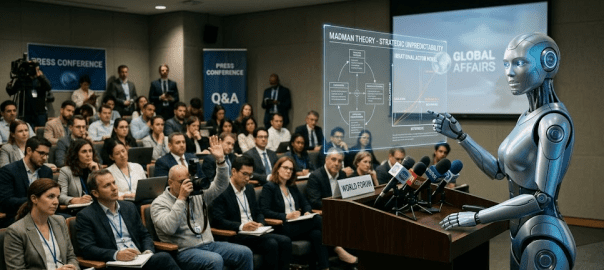
April 8, 2026 /Mpelembe Media/ — The “Madman Theory” is a concept in international relations suggesting that a leader can gain coercive bargaining leverage by appearing irrational, highly volatile, or indifferent to the costs of conflict. By cultivating a reputation for madness, a leader attempts to make otherwise incredible threats—such as initiating a nuclear war or destroying the global economy—appear credible, thereby forcing adversaries to concede to avoid a catastrophe.
Despite its theoretical appeal, the strategy frequently fails in practice due to three structural flaws: the signaling problem (adversaries misinterpret the erratic behavior), the credibility problem (adversaries recognize the madness as a calculated bluff), and the assurance problem (adversaries refuse to concede because they do not trust the “mad” leader to honor agreements). Additionally, the strategy incurs high domestic costs, as the public generally disapproves of leaders who engage in reckless brinkmanship.
Historically, the theory is most closely associated with President Richard Nixon, who secretly ordered thermonuclear-armed bombers to the Soviet border in 1969 (Operation Giant Lance) to intimidate Moscow into forcing North Vietnam to the peace table. The gambit ultimately failed, as the Soviets did not alter their policy.
Under President Donald Trump, the strategy was resurrected as “Madman Theory 2.0,” characterized by highly public, disruptive, and transactional diplomacy. Trump utilized strategic unpredictability not only against adversaries—such as his nuclear brinkmanship with North Korea and Iran—but also aggressively targeted traditional U.S. allies. A cornerstone of this approach was the April 2, 2025 “Liberation Day” executive orders, where Trump invoked emergency powers to slap a baseline 10% tariff on the world, alongside massive “reciprocal” tariffs of up to 50% on major trading partners.
While Trump’s unpredictability secured some short-term tactical wins and forced rapid peace frameworks in Ukraine and Gaza, the long-term strategic and economic consequences have been deeply damaging to U.S. hegemony. The “Liberation Day” tariffs failed to spark a domestic manufacturing renaissance, instead triggering retaliatory measures, immense trade uncertainty, and a decline in U.S. manufacturing jobs. The Supreme Court eventually struck down the tariffs as an unconstitutional abuse of executive emergency powers. Furthermore, Trump’s aggressive posture alienated allies, eroded global trust in U.S. leadership, and accelerated the transition toward a “multiplex” world order—evidenced by the rapid expansion of the BRICS bloc and a global push toward de-dollarization.
Domestic audiences typically desire leaders who are fully rational, cool-headed, and in control. Consequently, perceived “madness”—whether displayed through emotional volatility, extreme risk-taking, or a deviation from consequence-based decision-making—often triggers significant public disapproval. The public is generally risk-averse when it comes to actions that could endanger their lives, preferring the status quo over leaders making seemingly incredible threats that could spark a devastating war. Furthermore, citizens may worry that a leader’s extreme foreign policy preferences could damage the country’s global reputation and provoke other states to balance against them.
This domestic disapproval undermines the international effectiveness of the Madman Strategy in three primary ways:
Disincentivizing the Strategy: The anticipation of severe public backlash naturally discourages leaders from employing madman tactics in the first place, which explains why the strategy is rarely adopted in international politics.
Incentivizing Secrecy and Diminishing Audience Costs: To shield themselves from domestic punishment, leaders who do adopt the strategy are incentivized to keep their threats and erratic actions a secret from their own constituents. However, doing so actively undermines the strategy’s effectiveness. By keeping threats secret, leaders eliminate the “audience costs” (the political price of backing down), which ultimately reduces the credibility of the threat in the eyes of the adversary. For instance, President Richard Nixon deliberately kept Operation Giant Lance a secret from the American public to avoid domestic backlash over the Vietnam War, but this secrecy hindered his ability to convince the Soviets that his threat was credible.
Signaling Reluctance to Adversaries: If a leader chooses to adopt the strategy publicly, widespread domestic disapproval acts as a signal to foreign adversaries that the leader is unlikely to actually execute the threat. Adversaries are aware that leaders are constrained by public opinion. For example, when President Donald Trump threatened North Korea with “fire and fury,” polls showed that roughly 70 percent of Americans disapproved of the rhetoric. This high level of domestic opposition likely suggested to North Korea that Trump faced significant constraints and would not follow through on his bellicose warnings.
Ultimately, conceptualizing the Madman Strategy as a two-level game—taking place both internationally and domestically—reveals that the domestic costs of perceived madness actively serve to limit a leader’s bargaining leverage against foreign adversaries.