
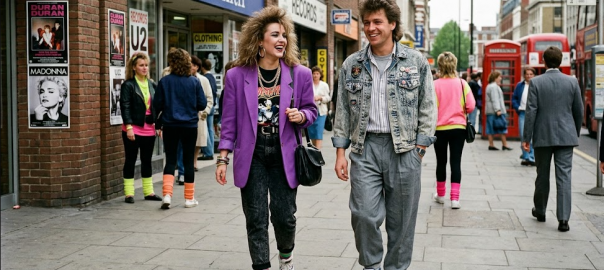
The 1980s: A Decade of Excess, Fashion, and Pop Culture
Mon, May 4 2026 /Mpelembe Media/ — This is a picture of the 1980s as a transformative era defined by conspicuous consumption, radical subcultures, and a highly performative visual aesthetic. Driven by shifting economic policies and the explosion of visual media, the decade’s culture was defined by several key themes:
The Rise of the Yuppie and Power Dressing The 1980s celebrated professional ambition and materialism, giving rise to the “Yuppie” (Young Urban Professional). This demographic measured success through status symbols like European luxury cars, Rolex watches, and brick-sized mobile phones. In the corporate world, this ambition was visually manifested through “Power Dressing.” Women entering higher management levels adopted tailored suits with exaggerated shoulder pads to project masculine authority, assertiveness, and competence in the workplace.
Subcultural Rebellion: The Blitz Kids and Hip-Hop In stark contrast to the corporate Yuppie, underground subcultures used fashion as a form of theatrical escapism. In London, the New Romantics and the “Blitz Kids”—frequenting the legendary Blitz Club—rejected the grey reality of post-industrial Britain and the deliberate ugliness of punk. They embraced androgyny, historical pastiche, and elaborate makeup, incubating future stars like Boy George and Spandau Ballet. Simultaneously, the hip-hop movement in the United States revolutionized streetwear by turning athletic wear, gold jewelry, and sneakers like the Nike Air Jordan and Adidas Superstar into high-priced luxury and status symbols.
The MTV Visual Revolution Launched in 1981, MTV fundamentally altered how music and culture were consumed by making the visual image as crucial as the music itself. The network democratized fashion trends, allowing artists like Madonna and Michael Jackson to become global style icons and inspiring youth to adopt big hair, neon colors, and leather jackets. MTV accelerated a shift toward a visually-oriented society, influencing everything from cinematic storytelling to advertising.
The Masters of the Decadent Image The aesthetic of the 1980s was immortalized by a group of visionary photographers who pushed the boundaries of the medium:
- Herb Ritts utilized natural light and stark backgrounds to capture the sculptural precision of the human body and redefine the era’s supermodels with a clean, anti-glamour approach.
- Greg Gorman became renowned for his hard-lit, high-contrast black-and-white celebrity portraits that left an air of mystery in the shadows.
- Guy Bourdin introduced surreal, highly stylized, and provocative narratives to commercial fashion (most notably for Charles Jourdan), establishing the idea that the product was secondary to the fantasy.
- Francesco Scavullo defined the glamorous, independent “Cosmo Girl” and shot iconic album covers and magazine centerfolds.
- Technical Innovations, such as the use of the ring flash for shadowless frontal illumination and highly saturated slide films (like Kodak Ektachrome and Kodachrome), provided the vivid colors, sharp contrasts, and “alien-esque” catchlights that became the hallmark of 80s commercial photography.
The Magic and the Grit: Why the 1980s Visual Revolution Never Actually Ended
The 1980s are often dismissed as a fever dream of neon spandex and aerosol hairspray, but to the cultural historian, the decade represents a far more profound technological and artistic pivot point. It was an era of “tender excess,” where the high-gloss “Power Look” of boardroom couture collided with the unpolished grit of a rising postmodern movement. This was the decade that dismantled the rigid hierarchies of taste, moving away from the curated perfection of the mid-century toward an experimental, inclusive, and visually loud architecture of beauty. It wasn’t just a time of decadence; it was the moment the world learned to weaponize the lens for self-expression.
London as the New Global North: The “Second Chance” in Fashion
In a surprising geopolitical artistic migration, the 1980s saw London replace New York as the center of the visual universe. After years of stagnation, London emerged as a global arts hub, pulling Americans across the Atlantic for its theater, cinema, and fine art. This shift was fueled by a unique blend of creative hunger and economic pragmatism.Legendary photographer David Bailey, who had already shaped the “swinging 60s,” found in the 1980s a spectacular second chance. He captured the era’s “zinging color” through playful and provocatively sexy portraits of icons like Tina Turner, David Bowie, and Grace Jones. Meanwhile, the city’s dominance was cemented by a new wave of models—Jerry Hall, Marie Helvin, and Naomi Campbell—who realized they could save their airfare by staying in London for shoots rather than migrating to the United States to work with American masters.”The magic of the 80s came as a surprise and possibly turned out to be the most amazing time in London to lead the world in fashion… It seemed like London was getting a second chance in fashion, art, theatre and cinema. After years of stagnation it had become a centre for the arts.” — David Bailey
Madonna and the Architecture of Reinvention
If Bailey provided the canvas, Madonna provided the blueprint for how to inhabit it. She didn’t merely use photography; she weaponized the lens to systematically dismantle fashion hierarchies, refusing to be “boxed in” by a single identity. Her evolution was a masterclass in the architecture of reinvention.Beginning as a “downtown New York club kid” (1980–1983), she fused punk, dance, and new wave into a singular streetwise aesthetic. By 1985’s “Material Girl” era, she was executing a strategic blend of Old Hollywood glamour and New Wave attitude—a calculated tribute to Marilyn Monroe that subverted the very icons she emulated. By the end of the decade, with “Like a Prayer” (1989), she merged pop imagery with a gothic, spiritual provocation, proving that a “Material Girl” could possess the depth of a cultural philosopher.
The Ektachrome Secret: The Technical Soul of the 80s
The vibrant, high-contrast visual identity we associate with the 1980s was the result of chemical experimentation as much as artistic vision. At the heart of this look was Kodak Ektachrome. While film technology evolved through the E-1 to E-6 processes, the “soul” of the decade’s photography often came from a specific technical hack.Photographers frequently took High Speed Ektachrome and “cross-processed” it through C-22 or C-41 color negative chemicals. This wasn’t just about achieving the iconic magenta casts; it was a functional speed hack that increased the film’s sensitivity to 250 ASA. This process created a gain in contrast with a distinct “cross-over”—red shadows and cyan highlights—that allowed photographers to extract drama from dull, flat lighting.While we often use modern motion-picture stocks like Cine Still 50D today to replicate that “dreamy, washed out” cinematic quality, it is important to remember that these are modern descendants of the Kodak Vision3 lineage. In the 80s, that look was earned through Tri-X 400 grain and the risky, high-contrast alchemy of the darkroom.
Power Silhouettes vs. Postmodern Grit: A Visual Tug-of-War
The visual landscape of the 80s was a constant struggle between two competing philosophies. On one side stood the “Power Look,” epitomized by Patrick Demarchelier and Bruce Weber. This was the era of the “Amazonian” model—figures like Kelly LeBrock who radiated an invincible, boardroom-ready status through bold silhouettes and commanding lines.On the other side was a burgeoning “Postmodern Grit.” In the late 80s, photographers like Juergen Teller and Nan Goldin began to reject these glossy ideals in favor of unretouched, intimate portraits and natural light. They championed imperfection as a new form of truth. Perhaps the most revolutionary example of this shift was David Bailey’s 1988 portrait of Diana, Princess of Wales. In a decade of excess, Bailey chose a minimalist, “no-frills” style. By capturing a “wary” and “unplugged” Diana, he stripped away her royal status to reveal a minimalist humanity—the ultimate antithesis to the era’s usual maximalism.Grace Coddington would later reflect that the most striking aspect of this period was the coexistence of “dazzling energy” and an “endearing tenderness” found in seemingly unposed, lyrical moments.
MTV and the Cinematic MTV Generation
The launch of MTV on August 1, 1981, fundamentally altered the human sensory experience, turning music from an auditory medium into a dominant visual culture. Music videos like “Video Killed the Radio Star” and “Thriller” were no longer just promotional clips; they were “mini-movies.”This era served as a laboratory for future cinematic giants. Directors like David Fincher used the music video format to pioneer a high-end cinematic quality that globalized fashion trends—leather jackets, denim, and neon patterns—overnight. Through MTV, fashion became “louder, sharper, and cooler,” and pop icons were transformed into permanent visual symbols that transcended the music itself.
The Digital Afterlife: Why We Are Still Chasing 80s Grain
In our current age of clinical, high-definition digital perfection, we find ourselves paradoxically obsessed with the limitations of the past. Modern applications like Dazz Cam are designed specifically to replicate the 1980s experience, offering “polaroid frames,” “realistic dust,” and “light leaks.”We use advanced digital processing to simulate the very chemical errors and technical “hacks” that photographers once used to overcome the limitations of film. This digital nostalgia proves that our visual vocabulary remains deeply rooted in the experimental technology of forty years ago. We aren’t just looking for a filter; we are looking for the “tender excess” that digital clarity cannot provide.
Conclusion: A Legacy of Self-Expression
The enduring legacy of the 1980s was its role in dismantling the hierarchies of taste. It reintroduced “fun” and “sex” into fashion, proving that neither were dirty words. By blending technological innovation with a fearless approach to identity, the artists of the 80s laid the groundwork for our modern age of visual diversity.As we stand in our era of high-definition digital perfection, we are left with a provocative question: why do we still crave the “tender excess” and imperfect grain of the 1980s? Perhaps it is because those imperfections remind us of an era’s unapologetic commitment to making a statement—a reminder that beauty is found not in the absence of grit, but in the magic of its presence.