Orbital Intelligence: How SpaceX and Google Are Moving AI Data Centers to Space
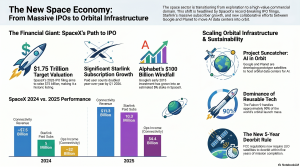
Thur, May 21 2026 /Mpelembe Media/ — The Mega-IPO and xAI Merger: SpaceX is preparing for a highly anticipated mid-2026 IPO, aiming to raise up to $75 billion at a target valuation between $1.75 trillion and $2 trillion. This historic offering follows a February 2026 merger with Elon Musk’s artificial intelligence firm, xAI, which initially established a combined private entity valued at $1.25 trillion.
The Shift to “Orbital Intelligence”: The merger marks a strategic pivot from traditional aerospace and satellite operations toward a unified “orbital intelligence” empire. SpaceX has filed plans to deploy up to one million solar-powered satellites to serve as space-based AI data centers. This ambitious move aims to leverage the abundant solar energy of space to bypass the severe power grid, real estate, and water cooling constraints currently limiting terrestrial AI data centers.
Starlink v3 and Starship Dependency: The success of this orbital infrastructure depends heavily on next-generation technologies, specifically Starlink v3 and Starship v3. Starlink v3 satellites will provide the massive optical laser “backhaul” capacity needed to process AI workloads in orbit, while the heavy-lift Starship rocket is required to deploy this network at scale.
Google’s Windfall and Strategic Partnership: Alphabet stands to earn a historic financial windfall of over $100 billion from its 2015 $900 million early investment in SpaceX, representing a massive 125x return. Beyond the financial gains, Google Cloud and SpaceX have formed a strategic partnership to place Starlink ground stations directly into Google data centers, providing low-latency edge computing and seamlessly connecting the satellite network to enterprise cloud applications.
The Trillion-Dollar Orbit: 5 Surprising Realities of the New Space Economy
For decades, space was the exclusive domain of “government-only” entities—a theater for Cold War superpowers to project national prestige through flags and footprints. Today, that frontier has undergone a radical phase shift. The vacuum of space is no longer a void but a burgeoning industrial park, becoming a strategic playground for the world’s largest tech giants and a new class of retail crypto investors.We are witnessing a transition from pure exploration to sustained orbital operations. As commercial launch cadences reach record highs and mega-constellations proliferate, the line between Silicon Valley and the stars is blurring. Space has become a critical layer of global infrastructure, essential for the next generation of artificial intelligence and the backbone of a hyper-connected economy.To understand the trajectory of this market, we must look beyond the rockets and into the ledger. Recent disclosures in the aerospace and financial sectors have revealed startling realities about the money, hardware, and regulations governing the orbit. Here are five counter-intuitive takeaways from the front lines of the new space economy that reveal where the real value is being built.
1. GOOGLE’S $100 BILLION “DIAMOND HANDS”
In 2015, Alphabet (Google) made what appeared to be a strategic side-bet: a $1 billion joint investment with Fidelity for a roughly 10% stake in SpaceX. For a decade, the true value of that position remained obscured by private market opacity. However, recent disclosures filed in Alaska have finally brought the “windfall” math into focus, revealing a return that could fundamentally alter Alphabet’s balance sheet.By the end of 2025, Alphabet held a 6.11% stake in the company. Following SpaceX’s merger with xAI in February 2026, that stake was diluted to approximately 5%. While 5% might seem modest for a venture stake, the “so what” is the scale: at a predicted SpaceX IPO valuation of $2 trillion, Google’s “incidental” investment is worth an estimated $100 billion. To put that in perspective for a venture journalist, this single position is worth nearly 5% of Alphabet’s entire market cap, effectively transforming Google into a massive holding company for the very infrastructure of the future.”According to a disclosure filed by SpaceX… by the end of 2025, Google holds a 6.11% stake in the company. If SpaceX achieves a valuation of $2 trillion or higher through an IPO, this stake would be worth $122.0 billion.” — Bloomberg/SpaceX Disclosure
2. THE CLOUD IS GOING VERTICAL (LITERALLY)
Traditionally, satellites have been restricted to “looking down” (imaging) or “bouncing signals” (communications). Project Suncatcher , a collaboration between Google and Planet Labs, is shifting the paradigm toward orbital compute. This research effort explores the feasibility of hosting the data-center-style systems required for AI workloads in Low Earth Orbit (LEO).The Logic of Space-Based Compute Earth-bound AI workloads are currently placing an unsustainable strain on terrestrial power grids and intermittent cooling systems. Space offers a unique set of engineering advantages that solve these bottlenecks:
- Near-Continuous Solar Power: Unobstructed by weather or the day-night cycle, providing a consistent energy source for power-hungry LLMs.
- Thermal Management: The ability to radiate heat directly into the vacuum, bypassing the need for the massive water-based cooling infrastructure required on Earth.
- Strategic Manufacturing: Planet Labs is expected to build and help deploy two demonstration spacecraft targeted for launch around 2027 to gather performance data.This isn’t just a science experiment; it’s a bid for a slice of a projected $26 trillion market for AI. Moving compute to orbit is the next logical step in building a resilient, global AI infrastructure that operates independently of terrestrial constraints.
3. SPACEX IS A REVENUE GIANT—WITH A BILLION-DOLLAR BURN
SpaceX’s S-1 filing and Q1 2026 data offer a rare glimpse into the unit economics of a “super-unicorn.” The company is performing a masterful “pincer maneuver”: while it burns historic amounts of cash on Starship and constellation expansion, it is aggressively optimizing the profitability of its existing fleet.The data reveals that SpaceX generated $18.7 billion in total 2025 revenue, with its “Connectivity” business (Starlink) acting as the primary engine. However, the company remains deep in a CapEx-heavy cycle. Despite massive revenue, SpaceX posted a startling net income loss of $4.3 billion in Q1 2026 alone. This massive burn is the price of admission for the $26 trillion AI TAM (Total Addressable Market) they intend to capture via orbital data centers.Key Financial Stats:
- Subscriber Growth: 10.3 million paid subscriptions in Q1 2026 (a 105% increase year-over-year).
- Revenue Mix: Connectivity revenue reached $11.3 billion, accounting for 60% of total revenue.
- Unit Economics: A 59% reduction in the average manufacturing cost of Starlink terminals since 2022.
- Total Burn: A net income loss of $4.9 billion for the full year of 2025, followed by the $4.3 billion Q1 hit.
4. CRYPTO IS BREAKING THE “ACCREDITED INVESTOR” WALL
For decades, the equity of private giants like SpaceX was a “closed game” protected by the U.S. “accredited investor” wall. These wealth-generation events were restricted to those with over $1 million in assets, leaving retail investors on the sidelines. Blockchain technology is now acting as a bridge to democratize this access through “mirror” tokens like preSPAX .Issued by Republic and hosted on platforms like Bitget’s IPO Prime, these tokens reflect the economic performance of SpaceX post-IPO. For an analyst, the pricing is the most interesting data point: the implied valuation for preSPAX is approximately $1.5 trillion—a significant “retail discount” compared to the $1.75T to $2T target for the formal IPO. However, there is a trade-off for this friction-less access.”The attempt is essentially to break down financial barriers… allowing ordinary crypto retail investors to participate in top assets with minimal friction.” — Bitget CEO GracyIt is crucial to note that holding preSPAX does not equate to holding actual SpaceX equity; these tokens carry no voting or dividend rights. Instead, they represent a shift from “PvP” (Player vs. Player) crypto trading toward using stablecoins (USDT/USDGO) as a vehicle for real-world assets (RWA) and top-tier aerospace equity.
5. THE FIVE-YEAR “EVICTION NOTICE” FOR SPACE JUNK
The rapid expansion of the space economy has created a massive sustainability crisis: orbital debris. There are currently an estimated 1.1 million objects (1–10 cm) and 36,500 pieces (>10 cm) in orbit. These fragments, traveling at high velocities, pose a lethal threat to billion-dollar infrastructure. In response, the FCC has shifted from guidelines to a “market-clearing” regulatory stance.The traditional 25-year deorbiting window has been replaced by a strict “5-year rule.” Satellites in LEO must now be removed within five years of mission completion. Furthermore, regulations now include a limit on the risk of potential human casualties caused by reentering debris, which shall not exceed 1 in 10,000. This creates a “regulatory moat,” forcing smaller players to innovate or exit.NASA Glossary of Compliance:
- Disposal: The actual removal of a spacecraft from the orbital environment.
- Deorbit: Lowering a spacecraft’s orbital altitude (also known as decay).To comply, the industry is testing “state-of-the-art” passive and active hardware. This includes drag sails like NanoSail-D2 and CanX-7, which use atmospheric resistance to accelerate decay, and active removal spacecraft that can “hook” and deorbit defunct satellites.
CONCLUSION: WHO OWNS THE ORBIT?
The transition from exploration to sustained orbital operations is fundamentally reshaping our relationship with the stars. Space is no longer just a destination for scientific discovery; it has become a ledger for crypto-equity, a data center for AI compute, and a high-stakes capital market. We are watching the birth of a new infrastructure layer that is as essential as the undersea cables that power our current internet.As the line between Big Tech and Aerospace continues to blur, the power dynamics of the 21st century are being rewritten. The “Great Powers” of the future may not be defined by their borders on a map, but by the robustness of their orbital hardware and the reach of their satellite constellations.As corporations begin to build and regulate their own orbital infrastructure, we must ask: Will the next global superpower be a nation-state, or a trillion-dollar corporation with the keys to the orbital cloud?