“Zero Tolerance”: Global Outrage Surges as Israel Blacklisted by the UN Over Sexual Violence in Conflict Zones
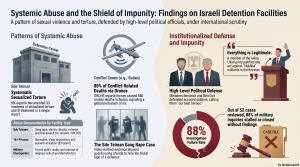
Fri, May 29 2026 /Mpelembe Media/ — A Network of “Torture Camps” and Systematic Abuse Following the outbreak of the war in October 2023, the Israeli prison system has rapidly expanded and transformed into what human rights groups like B’Tselem describe as a “network of torture camps”. The Palestinian detainee population surged to over 10,800 by late 2025, with thousands held in administrative detention without trial or access to lawyers. Prisoners are subjected to subhuman living conditions, including severe overcrowding, deliberate starvation, sleep deprivation, and extreme physical violence. Medical neglect is rampant, with makeshift field hospitals like the one at Sde Teiman frequently keeping patients blindfolded, wearing diapers, and continuously shackled to beds, resulting in routine limb amputations and untreated infections. Between October 2023 and early 2026, rights groups have documented between 84 and 98 Palestinian deaths in Israeli custody.
Sexual and Gender-Based Violence as a “Method of War” A March 2025 report by the UN Commission of Inquiry concluded that sexual and gender-based violence (SGBV) is functioning as an institutionalized “method of war” rather than isolated acts by rogue soldiers. Both male and female detainees, including children, have been subjected to horrific modalities of sexualized torture. Documented abuses include gang rape with objects, electrocution of the genitals, genital mutilation, and the use of military dogs to rape and attack prisoners. Furthermore, male detainees are frequently subjected to forced public nudity and filmed in degrading positions by soldiers who post the footage online to humiliate the wider Palestinian community. Female detainees face relentless strip searches by male guards, threats of rape, and the denial of menstrual hygiene products.
Reproductive Violence and Genocidal Acts The UN Commission also found that Israel has carried out “genocidal acts” specifically aimed at preventing births and destroying the physical and demographic infrastructure of the Palestinian people. This includes the deliberate targeting and destruction of maternal care facilities and Gaza’s main IVF clinic, the Al-Basma Centre, which resulted in the loss of thousands of embryos. Combined with the siege and starvation policies, the destruction of reproductive healthcare has led to a massive surge in maternal morbidity, miscarriages, and deaths of pregnant women and newborns.
A Culture of Absolute Impunity Domestic accountability for these crimes is virtually non-existent, fostered by the endorsement of top Israeli civilian and military leaders. In March 2026, the Israeli military dropped all charges against five soldiers accused of the videotaped gang rape of a Palestinian detainee at Sde Teiman. Right-wing mobs and government ministers, including Finance Minister Bezalel Smotrich and National Security Minister Itamar Ben-Gvir, have actively defended the accused soldiers, referring to them as “heroic fighters” and stating that abusing detainees is legitimate.
International Diplomatic Fallout Due to the overwhelming evidence of SGBV, the United Nations officially added Israel’s armed and security forces to its blacklist of entities committing sexual violence in conflict zones in May 2026. In retaliation, the Israeli Foreign Ministry cut diplomatic ties with UN Secretary-General António Guterres, dismissing the allegations as fabricated “blood libel”. Meanwhile, international bodies and the U.S. State Department have continued to demand “zero tolerance” for rape and have called for immediate, independent investigations.
Beyond the Headlines: 5 Disturbing Truths About Detention and Systemic Violence in the Israel-Palestine Conflict
In the corridors of international diplomacy, human rights violations are often shrouded in the sterilized language of “incidents,” “allegations,” and “procedural reviews.” But recent months have seen this technical veneer shattered by verified video clips and harrowing testimonies that describe a systemic erosion of the Geneva Conventions. From the graininess of security footage at the Sde Teiman facility to the comprehensive findings of the UN Commission of Inquiry, the evidence describes a landscape of violence that challenges the very definition of a rule-based international order.We are often led to believe that in high-tech military systems, such atrocities are merely the result of “rogue soldiers” or a localized breakdown in discipline. However, the data emerging from investigative reports by the UN, B’Tselem, and various international legal bodies suggests a much more unsettling truth: these acts are not a failure of the system, but a designed feature of it. This article distills five critical takeaways from these investigations, connecting disparate data points to reveal a broader architecture of state violence and the political defense of atrocity.
1. The “Tip of the Iceberg” – Systematic, Not Isolated
While high-profile incidents like the gang rape captured on video at Sde Teiman draw international outrage, investigative synthesis suggests these are merely the most visible symptoms of an institutionalized practice. An investigation by Nicholas Kristof for the New York Times provides a crucial bridge here: while there is no evidence leaders issued direct orders for rape, they have constructed a security apparatus where sexual violence has become “standard operating procedure.”This systemic design is facilitated by a lack of legal oversight. Currently, over 9,000 Palestinians are held in Israeli detention facilities; approximately 40% of these individuals are held under “administrative detention”—a practice of being held without trial or charge. Evidence from the B’Tselem report, Welcome to Hell , found that accounts of sexual abuse, starvation, and physical assault were remarkably consistent across 16 different locations, regardless of the prisoner’s age or gender.”The conditions at Sde Teiman aren’t unique. They’re just the tip of the iceberg,” says Shai Parnes of B’Tselem. “As we gathered the testimonies, we realised that every witness account was almost identical… There’s no doubt. This kind of abuse is systematic.”
2. The Strategic Attack on Reproductive Capacity
A counter-intuitive but devastating aspect of the current conflict is what the UN Commission identified as “reproductive violence.” This is an attack not just on the living, but on the future demographic viability of the Palestinian community.The most prominent example is the destruction of the Al-Basma IVF Centre, Gaza’s largest fertility clinic. The Commission verified that the building was clearly marked, yet it was struck by a large-caliber projectile—likely a tank shell. The attack destroyed the genetic bank in its entirety, erasing over 4,000 embryos and the reproductive material of thousands of families. Under the Genocide Convention, these acts, alongside the targeting of maternity infrastructure, are interpreted as “measures intended to prevent births.”Key Facilities Targeted:
- Al-Basma IVF Centre: Gaza’s largest fertility clinic, genetic bank erased by tank shelling.
- Al-Awda Hospital: A primary maternal health provider in northern Gaza, subjected to siege and sniper fire.
- Al-Emirati Maternity Hospital: Forced to cease operations or operate under extreme duress.
- Al-Shifa & Al-Nasser Maternity Wards: Systematically rendered non-functional by direct military action.
3. “Everything is Legitimate” – The Political Defense of Atrocity
Perhaps the most disturbing trend is the public, political defense of these acts by members of the Israeli establishment. When ten soldiers from Unit 100 were arrested in July 2024 for the brutal assault of a prisoner at Sde Teiman, the reaction from the political right was not condemnation, but active resistance.Government ministers and far-right mobs did not merely protest; they stormed the Sde Teiman and Beit Lid bases, actually occupying parts of the facilities. In a chilling breakdown of internal order, reserve soldiers from Unit 100—the very unit under investigation—reportedly threatened military police at gunpoint. Figures like Finance Minister Bezalel Smotrich characterized the “crime” not as the assault itself, but as the act of leaking the video footage that exposed it.”If he is a Nukhba Hamas militant, everything is legitimate to do! Everything!” — Hanoch Milwidsky, Likud Party MK, during a Knesset debate regarding the use of physical objects in sexual assault.
4. The Mirage of Military Accountability
The internal mechanisms meant to police military conduct are increasingly viewed as “procedural buffers” rather than functional judicial bodies. Data from Action on Armed Violence (AOAV) reveals a staggering Complementarity Problem : the domestic system appears active enough to block International Criminal Court (ICC) intervention, yet it is functionally ineffective at producing justice.Of 52 acknowledged internal investigations into alleged violations, only one resulted in a prison sentence. The fate of the Sde Teiman rape case is a diagnostic example: despite video evidence and physical injuries so severe the victim required surgery for a perforated rectum, fractured ribs, and had been subjected to electric shocks, military prosecutors dropped the most serious charges on March 12, 2026. This pattern suggests the system functions as a mirage, where 88% of inquiries simply stall or disappear, foreclosing accountability for even the most well-documented atrocities.
5. The Weaponization of “Feminization” Against Men and Boys
Human rights reports have identified a pattern of “gender persecution” targeting Palestinian males. This involves the use of sexualized humiliation to break social cohesion and the cultural concept of “honor.”This is evidenced by the documented practice of forced public nudity and the filming of sexualized humiliation. In one instance verified by the UN, a soldier recorded a video of boys being forced to dance in their underwear; the soldier and others “all laughed” as they recorded the humiliation. This ideological root is laid bare in graffiti left by the 9208th Infantry Battalion in Beit Lahia, which referenced the biblical story of “Dinah.” In that narrative, Dinah’s brothers murdered every man in a city to avenge their sister’s perceived dishonor. By linking modern military conduct to this ancient revenge narrative, the soldiers signal that the “honor” of the collective is restored through the sexualized subjugation and “feminization” of the enemy.
Conclusion
The evidence compiled by international bodies suggests that we are witnessing more than a series of unfortunate errors in a chaotic war zone. We are seeing a documented pattern of systematic abuse, the strategic targeting of reproductive futures, and a political environment that treats the exposure of a crime as a greater threat than the crime itself.The “Responsibility to Protect” is not merely a diplomatic catchphrase; it is a legal obligation designed to prevent exactly this type of systemic erosion. When a justice system begins to exculpate rather than investigate, and when the defense of atrocity moves from the fringes to the heart of government, the foundation of the rule of law is not just cracked—it is being dismantled.When a justice system begins to treat the exposure of a crime as a greater threat than the crime itself, what remains of the rule of law?