
Charging for Reach: How Meta is Putting Social Visibility and AI Behind a Paywall
Fri, May 29 2026 /Mpelembe Media/ — Meta has officially initiated a major shift towards a “freemium” business model by globally launching “Plus” subscription tiers for its core applications: Facebook, Instagram, and WhatsApp. While the base versions of these apps remain free, the new subscriptions aim to provide enhanced customization, analytics, and visibility.
Key aspects of this development include:
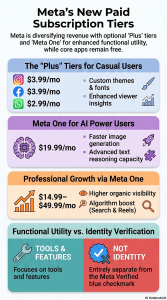
- Consumer “Plus” Plans: Instagram Plus and Facebook Plus are priced at $3.99 per month, offering features like 48-hour story extensions, anonymous story viewing, custom app icons, super reactions, and detailed audience insights. WhatsApp Plus costs $2.99 per month and provides premium stickers, custom ringtones, app themes, and extra pinned chats.
- The “Meta One” Umbrella: Meta is consolidating its subscriptions under a new framework called “Meta One”. This includes testing professional tiers for creators and businesses (ranging from $14.99 to $49.99 per month) that effectively monetize algorithmic visibility by offering higher search rankings, automatic follow invites, and optimized posting tools.
- AI Monetization & “Muse Spark”: To compete with other AI giants, Meta has pivoted away from its open-weights “Llama” strategy to release Muse Spark, a proprietary, multimodal reasoning model. Meta One AI subscriptions will cost $7.99 to $19.99 per month, unlocking higher compute queries and deeper reasoning tasks using this new model.
- Strategic Motivations: This multi-tiered subscription push is largely driven by Meta’s need to offset massive capital expenditures in AI infrastructure, which are projected to reach between $125 billion and $145 billion in 2026. Furthermore, Meta is looking to diversify its revenue streams beyond digital advertising, especially following a reported loss of 20 million users in the previous quarter.
- Public Backlash: User reaction has been overwhelmingly negative. Critics highlight that these paid tiers do not remove targeted advertising or guarantee data privacy, leading to accusations of “enshittification” and complaints that Meta is asking for money while continuing to harvest user data.
The End of “Free” as We Know It: 5 Surprising Ways Meta is Changing its DNA
For nearly two decades, the Facebook login page famously promised: “It’s free and always will be.” That slogan was the foundational DNA of the social media age, a pact where users traded data for connection. But as 2024 unfolds, that social contract is being shredded. Facing the dual pressures of a volatile ad market and the staggering “compute-heavy” costs of the AI arms race, Meta is aggressively pivoting toward ARPU (Average Revenue Per User) diversification. With the launch of individual “Plus” tiers and the unified “Meta One” ecosystem, we are witnessing the birth of a “Super-App” subscription model where the “best” version of reality is now behind a paywall.
1. Function Over Fame: Why “Plus” Isn’t “Verified”
The first mistake many analysts make is conflating Meta’s new subscriptions with Meta Verified . While the $14.99 blue checkmark remains a standalone product for identity and impersonation protection, the new “Plus” tiers are about functional utility. This is a shift from status-seeking to experience-optimization.For $2.99 to $3.99 a month, Facebook and WhatsApp users can now purchase “aesthetic friction reduction.” On Facebook Plus, this includes unique ringtones and pinned chats for efficiency; on WhatsApp Plus, users gain exclusive stickers and custom themes.Analysis: This represents Meta’s realization that personalization is a high-margin commodity. By charging for “unique ringtones” or “exclusive stickers,” Meta is effectively taxing the user’s desire for digital self-expression. It’s no longer enough to be on the platform; you must now pay to ensure your interface doesn’t look like everyone else’s.
2. The Return of Stealth: Monetizing Social Anxiety
The most strategically significant feature in the Instagram Plus ($3.99/month) package is “Ghost Mode”—the ability to preview stories without appearing on the viewer list. This is a radical departure from Mark Zuckerberg’s historical pivot toward “radical transparency.”Instagram Plus Feature Set:
- Stealth Viewing: Preview stories without a trace.
- Rewatch Stats: See how many times your own stories are being looped.
- Deep Analytics: Granular audience insights beyond the standard creator dashboard.
- Customization: Access to exclusive profile fonts and app icons.Analysis: Meta has discovered that social anxiety is a profit center. By charging users to “peek without being seen,” the company is monetizing the very surveillance culture it created. It is a cynical but brilliant move: first, they made us obsessed with who is watching us; now, they are charging us for the privilege of watching others undetected.
3. Meta One: The New Unified Powerhouse
To simplify what could easily become a fragmented mess of micro-transactions, Meta is piloting “Meta One.” This umbrella brand is designed to move the platform toward a “Super-App” model, clearly bifurcating the user base between casual consumers and “power users.” The hierarchy moves from basic AI access to professional-grade tools.| Tier Name | Price | Primary Benefit || —— | —— | —— || Meta One Plus (AI) | $7.99/mo | Expanded AI Access & Features || Meta One Premium (AI) | $19.99/mo | High-Compute Workloads & Faster Generation || Meta One Essential (Pro) | $14.99/mo | Optimized Posting Tools & Auto-Follow Invites || Meta One Advanced (Pro) | $49.99/mo | Algorithmic Prioritization & Maximum Reach |
Analysis: This structure clarifies Meta’s intent to turn the “free” user into the product, while the “Meta One” subscriber becomes the client. The distinction between individual app “Plus” plans ( $3.99) and the “Meta One Plus” ($ 7.99) is the divide between consumer fun and power-user utility.
4. Pay-to-Play: The Death of Organic Meritocracy
The “Meta One Advanced” tier ($49.99/month) is the most controversial pillar of this new strategy. Currently a professional pilot, this tier offers something once considered sacred: “higher organic visibility in search and Reels algorithms.”Analysis: We are entering the era of “algorithmic gatekeeping.” For a professional creator or a small brand, reach is shifting from a reward for high-quality content to a baseline utility expense. At $50 a month, Meta is essentially admitting that organic growth is a legacy concept. In this new ecosystem, the algorithm isn’t just a discovery engine; it’s a toll road. The “Advanced” tier marks the end of meritocracy and the beginning of a transactional “pay-to-play” reality for the creator economy.
5. Renting the Brain: The $19.99 AI Premium
The final pillar of Meta’s transformation addresses the “mounting AI infrastructure costs” mentioned in the source context. The Meta One Premium tier ($19.99/month) is aimed at users who want to “rent” Meta’s most powerful compute cycles. This tier unlocks advanced text reasoning and accelerated cross-app video/image generation.”This marks a major shift to help the company diversify its revenue beyond traditional advertising and offset mounting AI infrastructure costs.”Analysis: As Meta pivots into an AI-first company, it is passing the “compute tax” directly to the users. By gating “heavier computing capacity,” Meta is ensuring that the users who strain their servers the most—those generating endless AI-synthesized media—are the ones footing the bill for the data centers. It’s a necessary hedge against the diminishing returns of the traditional ad model.
Conclusion: The New Social Contract
Meta’s shift to paid tiers isn’t just a revenue play; it’s a fundamental redesign of the social experience. We are moving toward a tiered society where your digital footprint is determined by your monthly budget. For the casual user, the apps remain free, but they will increasingly feel like “economy class”—limited, public, and invisible to the algorithm. For the professional and the power user, the “Meta One” ecosystem offers a suite of superpowers, from AI-driven creativity to guaranteed visibility. But as reach and privacy become premium commodities, we must ask: Are we ready for a social media experience where the “truth” of your digital presence is bought rather than earned?