
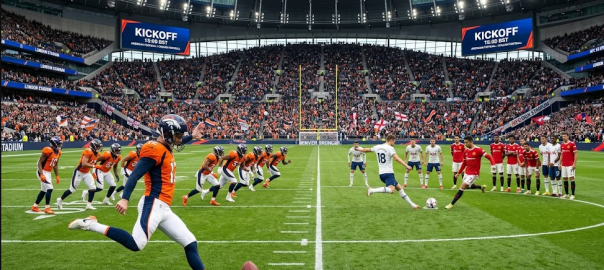
The differences between American football and English association football span across terminology, core gameplay mechanics, league structures, and fan culture.
Wed, Jun 03 2026 /Mpelembe Media/ — Terminology and Origins The most immediate difference is linguistic. What is universally known as “football” in the UK and much of Europe is called “soccer” in the United States to distinguish it from the American gridiron game. Interestingly, the term “soccer” originated in late 19th-century England as a slang abbreviation for “association football,” which was used to differentiate it from “rugby football”. Furthermore, an American “game” played on a “field” is referred to as a “match” played on a “pitch” in English soccer.
Gameplay and Flow While both sports field 11 players per team, their objectives and pacing are drastically different:
- American Football centers on advancing an oval-shaped ball down a 120-yard rectangular field by running with it or throwing it forward. The offense is given a series of four plays, known as “downs,” to advance the ball at least 10 yards. Points are primarily scored by carrying or catching the ball in the end zone for a touchdown (worth six points) or kicking it through the uprights for a field goal (worth three points).
- English Soccer focuses on kicking a round ball into the opponent’s net to score goals, with field players strictly forbidden from using their hands.
- Pacing: American football matches consist of 60 minutes divided into four quarters, but games routinely last over three hours due to frequent play stoppages between downs, timeouts, and a highly managed play clock. In contrast, English soccer features two continuous 45-minute halves where the clock does not stop; instead, the referee adds “stoppage time” or “added time” at the end of each half to account for injuries or delays.
Physicality and Equipment American football is a high-impact, full-contact sport where tackling players to the ground is a fundamental mechanic. Because of the high risk of strains, fractures, and concussions, players are required to wear extensive protective equipment, most notably helmets and shoulder pads. Soccer players require far less gear, typically wearing only a “kit” (a uniform) and “boots” with studs (referred to as “cleats” in the US).
League Governance The administrative structures of the sports reflect entirely different sporting philosophies:
- The American System: Professional American sports leagues, including MLS soccer and the NFL, operate as single-entity or franchise models. These closed leagues utilize mechanisms like player drafts and salary caps to enforce parity and prevent wealthier teams from outgrowing the competition.
- The English System: English football operates on a vast, interconnected hierarchical pyramid bound together by promotion and relegation. The most successful teams in a division are promoted to a higher league (culminating at the top in the Premier League), while the worst-performing teams are relegated to a lower tier, meaning even the smallest club theoretically has a path to the very top.
Fan Culture The match-day experience also presents a stark cultural contrast. English soccer stadiums are frequently built directly inside residential neighborhoods (such as Chelsea’s Stamford Bridge), whereas American stadiums are often massive structures located on the edges of town. Inside the stadium, English fans are known for their spontaneous, player-specific singing and chanting throughout the match, whereas American sports feature more coordinated in-stadium entertainment and music. Finally, drinking traditions differ greatly: it is illegal in England to consume alcohol in your seat or anywhere within view of the pitch, which stands in sharp contrast to the American traditions of pre-game tailgating and drinking in the stands.
The Atlantic Divide: A Comparative Analysis of American and British Football Ecosystems
1. The Historical Divergence: From Common Roots to Distinct Identities
The mid-19th-century schism in “football” rules precipitated two distinct cultural trajectories that continue to define national identities today. While both sports emerged from a shared ancestry of medieval mob games and English public school variants, the formalization of these rule sets in the 1860s and 1870s manifested as a fundamental philosophical divergence. One path prioritized a fluid, egalitarian “no-hands” model designed to unify disparate rules under a single “association,” while the other evolved into a turn-based, highly strategic tactical simulation that became a cornerstone of American collegiate and professional life.The 1863 inception of the Football Association (FA) in England was a calculated effort to standardize “association football” (later colloquially termed “assoc,” then “assoccer,” and finally “soccer”). Across the Atlantic, the evolution of the American game between 1869 and 1876 saw a transition from soccer-style rules to a hybrid system influenced by Canadian rugby. Walter Camp, the “Father of American Football,” spearheaded rule changes from 1880 onward that fundamentally altered the sport’s architecture, introducing the concepts of the snap and downs to replace the chaotic scrum.Rules of Engagement: Foundational Principles
| The Snap: Replaced the chaotic, contested scrum with an uncontested, deliberate start to play. | Fluidity and Continuous Motion: A rejection of the rugby-style scrum in favor of an open, non-stop flow of play. |
| The Concept of Downs: Established tactical modularity by limiting teams to a set number of attempts to advance. | Non-Restricted Territoriality: A rejection of prescribed set-plays for yardage, favoring organic ball movement. |
| The Line of Scrimmage: Created a static, neutral zone between units, allowing for pre-snap strategic positioning. | Strict “No-Hands” Mandate: Established a specialized style of play for outfielders, prioritizing foot-eye coordination. |
| Legalized Forward Pass: A 1906 intervention designed to reduce mass-formation violence through verticality. | The “Assoc” Standard: A unified code created to eliminate holding the ball, emphasizing technical ball control. |
The transition from rugby-style physicality to gridiron concepts transformed a contest of endurance into a strategic “game of inches.” By instituting the snap and the requirement to gain 10 yards in four downs, the American game became a series of distinct, calculated maneuvers. This stands in stark contrast to the FA’s emphasis on uninterrupted movement and technical dexterity, a distinction that would eventually dictate the organizational logic and commercial silos of their respective leagues.These divergent historical rule sets directly informed the emergence of the vastly different league structures that now govern the sport on either side of the Atlantic.
2. Structural Governance: The Pyramid vs. The Tiers
The strategic impact of league “openness” versus “closed” franchise models significantly dictates club longevity, institutional investment risk, and the nature of competitive urgency. The English model is structured as an interconnected “pyramid” that facilitates performance-based upward mobility, whereas the American system utilizes a tiered, fixed-membership model that separates professional and amateur ranks through rigid institutional boundaries and protected monopolies.The English Pyramid and the Investment Paradox The English hierarchy descends from the Premier League (Level 1) through the English Football League (Levels 2-4) and the National League System (Levels 5-10), eventually reaching Regional Feeder Leagues. With over 5,300 clubs and 7,000 teams, this structure offers a “high-risk, high-reward” model. A club’s valuation can quadruple overnight upon promotion to the Premier League, but the threat of relegation introduces a volatility absent in the U.S.The American Tiered System In contrast, the American model is defined by a hard professional-amateur divide. The NFL serves as a premier professional league with fixed franchises, supported by the NCAA (FBS/FCS) as the primary development pipeline. There is no mechanism for an elite NCAA program or a minor-league team to earn a “promotion” into the NFL, regardless of on-field success.Strategic Impacts of Relegation vs. Closed Franchise Models The existence of promotion and relegation creates a high-stakes environment that interrogates a club’s management far more aggressively than the American model:
- Financial Volatility: Relegation results in an immediate, catastrophic loss of revenue (broadcast rights and sponsorship), forcing clubs to liquidate assets or undergo radical restructuring.
- Competitive Accountability: The “trapdoor” of relegation prevents the “tanking” or late-season apathy sometimes observed in the NFL, as bottom-tier teams must maintain performance to ensure survival.
- The Protected Monopoly: Unlike the English system’s performance-based valuation, the NFL offers a “protected monopoly” with guaranteed revenue sharing and draft-pick compensation for poor performance, insulating owners from the consequences of failure.The over 5,300 clubs in the English system foster a level of regional “grassroots” loyalty that is fundamentally different from the concentrated, high-value franchise model of the NFL. These organizational structures dictate where and how stadiums are integrated into their host communities as either urban nodes or isolated destinations.
3. Urbanism and Infrastructure: Stadiums as Community Anchors
The strategic relationship between a stadium’s physical location and its accessibility is a primary driver of fan identity and match-day revenue streams. In the UK, stadiums are traditionally integrated into the urban fabric as nodes of “Transit-Oriented Development” (TOD), whereas American venues often reflect a suburban, car-centric development strategy that isolates the venue within a parking-lot ecosystem.Geographic Analysis and Urban Permeability English stadiums are frequently situated “smack in the middle of town,” characterized by high urban permeability. Stamford Bridge (Chelsea), a 42,000-seat venue, is an archetype of this; it is surrounded by residential housing and situated a mere two-minute walk from a Tube station. This integration ensures that the stadium is a neighborhood fixture. Conversely, many American stadiums are “edge of town” destinations, requiring vast parking infrastructures to accommodate the NFL’s reliance on private vehicle access.Infrastructure Design and Ancillary Spend Stadium design reflects both environmental constraints and local consumption rituals:
- Covered Seating and Climate Adaptation: Because the UK season runs from August to May, stadiums prioritize covered seating to protect against cold and rain. This creates a dense, acoustic environment that amplifies fan vocalizations.
- Open-Air Multi-Purpose Venues: Historically, American fans embrace “sitting in the sun” in multi-purpose venues, though there is a modern shift toward “soccer-specific” stadiums with an average capacity of 20,000.The proximity of a stadium like Stamford Bridge to local transit affects match-day logistics by encouraging ancillary spend at local pubs and shops—nodes in an urban network. This contrasts with the American “isolated hub” model, where the stadium parking lot becomes the primary site of pre-game activity through the tailgating culture, centering the “spend” within a closed ecosystem.The physical proximity of fans in these urban centers further influences the linguistic and behavioral rituals that define the match-day experience.
4. Cultural Syntax: Terminology and Ritualized Behavior
| English Term (UK) | American Term (U.S.) | Contextual Evolution |
|---|---|---|
| Pitch | Field | Derived from the “pitched” cricket ground vs. the open American field. |
| Match | Game | UK terminology favors the “contest of equals” vs. the American “entertainment event.” |
| Kit | Uniform | “Kit” implies a personal set of equipment; “Uniform” implies institutional identity. |
| Boots | Cleats | UK “Boots” references historical leather construction; US “Cleats” focuses on the studs. |
Fan Dynamics and Atmospheric Rituals Behavioral rituals are dictated by stadium logistics. In the UK, the “Away Fan” allocation—traditionally 10% of capacity—ensures a vocal counter-presence that precipitates spontaneous chanting and player-specific songs. In the U.S., stadium atmospheres are frequently orchestrated by scoreboard-led prompts and pre-game distractions. This distinction is often manifest in the “eerie silence” that greets away goals in MLS, as traveling supporter numbers rarely match the UK standard.Reshaping Fan Behavior: Safety and Consumption A common misconception exists regarding “hooliganism” in English football. Since the 1890s-era crackdown on fan violence, modern safety regulations have fundamentally reshaped behavior. UK law prohibits the consumption of alcohol within view of the “pitch,” creating a distinct “interval culture” where fans must consume beverages out of sight of the action. This stands in stark opposition to the American in-seat service and tailgating culture, where alcohol consumption is an integrated part of the spectator’s continuous entertainment experience.These social behaviors link directly to the final commercial layer: the strategic evolution of the spectator from a “fan” to a “high-value consumer.”
5. The Commercial Spectacle: Hospitality and Consumption
The strategic evolution of the sports spectator has seen a transition from the traditional supporter to a “high-value consumer” of sophisticated hospitality services. Both ecosystems have developed specialized methods for monetizing the match-day experience, but they operate under vastly different philosophies regarding the “product” being sold.Hospitality Precision and Regulatory Constraints English hospitality has evolved into a tier-based service model. For example, Manchester City’s 1894 Bar (East Stand, middle tier) provides halftime coffee and tea as a standard inclusion, while the Private Suites at Wembley offer a more comprehensive three-course meal. However, due to UK alcohol laws, even these high-value guests must step away from the window to consume alcohol. This creates a fragmented experience compared to the American model, where in-stadium sales and luxury suites allow for uninterrupted consumption and viewing.The Spectator Paradox: Knowledge vs. Spectacle The “So What?” of these commercial models lies in a fundamental spectator paradox:
- The English Model (Game as Product): For the British fan, the game is the product. They prioritize an uninterrupted “knowledge of the game,” frequently ignoring on-field announcers and viewing pre-game “distraction action” (such as Crystal Palace’s dance teams) as a circus-like nuisance that detracts from the tactical flow.
- The American Model (Game as Anchor): For the American fan, the game is the anchor for a multi-layered entertainment event. High-frequency concessions, sponsorship messages, and scoreboard-led prompts are integrated into the “spectacle” to ensure constant engagement during natural pauses in play.Conclusion While American and English football share a name and historical roots, they represent two distinct philosophies of community, competition, and commercialism. The English model thrives on the high-stakes drama of the open pyramid and the urban permeability of its clubs, where the game remains the primary focus. The American model excels in creating a high-value, stable commercial spectacle through a protected franchise system and a robust culture of stadium-based hospitality. Both models offer unique strategic strengths, but they ultimately serve different master goals: one is a community-anchored trial of survival, the other a sophisticated, multi-layered entertainment product.