End of the Scroll: UK to Ban Instagram, TikTok, and YouTube for Under-16s
Mon, Jun 15 2026 /Mpelembe Media/ — In June 2026, UK Prime Minister Keir Starmer announced sweeping legislation to ban children under the age of 16 from accessing social media platforms, with the restrictions set to take effect in Spring 2027. Grounded in Part 3 of the Children’s Wellbeing and Schools Act 2026, the policy aims to combat a youth mental health crisis and protect children from addictive algorithms and harmful online content.
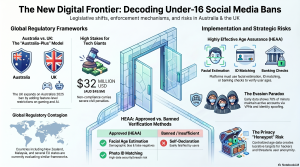
Scope of the Ban and the “Australia-Plus” Model The UK’s framework is being described as an “Australia-plus” model because it builds upon Australia’s recent ban but implements stricter, feature-level restrictions.
- Targeted Platforms: The ban disables access to “user-to-user” platforms driven by algorithms and social interaction, including TikTok, Instagram, Facebook, Snapchat, YouTube, and X. Messaging apps like WhatsApp and Signal, as well as educational platforms, are exempt.
- Additional Restrictions: The rules extend into gaming and artificial intelligence. Minors will be banned from livestreaming, sending disappearing messages, and communicating with strangers on gaming sites. Furthermore, AI “romantic companion” chatbots designed to simulate intimate relationships will be strictly age-gated for over-18s.
Enforcement via “Highly Effective Age Assurance” (HEAA) To enforce the ban, the government will mandate that tech platforms use Highly Effective Age Assurance (HEAA). Regulated by Ofcom and the Information Commissioner’s Office (ICO), approved methods include facial age estimation, photo ID matching, open banking checks, and mobile network operator checks. Simple self-declaration, such as ticking a box or entering a date of birth, will be banned as insufficient.
Public Support vs. Charity Division The legislation follows a national consultation that garnered over 116,000 responses, revealing that 90% of parents support an under-16 social media ban. Charities such as the NSPCC and Barnardo’s have welcomed the ban as a “watershed moment for child protection”.
However, a coalition of 42 organizations, including the Molly Rose Foundation, strongly oppose a blanket ban. They argue that simply removing access does not force tech giants to fix addictive algorithms or implement “safety-by-design,” and that a ban will only drive young people to unregulated, anonymous, and more dangerous corners of the internet. They also emphasize that social media is a vital lifeline for marginalized, neurodiverse, and LGBTQ+ youth seeking community support.
Privacy and Civil Liberty Concerns Civil liberties groups, most notably Big Brother Watch, warn that the ban poses a severe threat to the digital privacy of all UK citizens. Because platforms must verify that a user is over 16, they will essentially be forced to implement a de facto mandatory digital ID system, requiring adults to submit biometric face scans or government IDs to use the internet. Privacy advocates argue this will spell the end of online anonymity, severely impacting journalists, whistleblowers, and abuse victims, while creating massive databases of sensitive information that will become lucrative targets for hackers.
International Pushback from the US and Tech Giants The proposed ban has sparked diplomatic tensions. The US White House formally urged the UK not to implement the ban, arguing that “blunt regulatory instruments” and “one-size-fits-all” restrictions place a disproportionate compliance burden on American tech companies. Instead, the US advocated for robust parental controls. Tech giants like Meta, YouTube, and Snapchat also hit back, echoing concerns that isolating teens from mainstream networks will push them toward less-safe platforms. Despite this pressure, the UK government has explicitly defied the US intervention, stating it will not be swayed from doing what it believes is right for British families.
The Age-Gated Internet: 5 Surprising Realities of the Global Social Media Ban
The era of the digital wild west is coming to a structured, legislated end. Prime Minister Anthony Albanese has labeled social media a “scourge” on youth mental health, while Prime Minister Keir Starmer frames the coming restrictions as a way to “give kids their childhood back.”This cultural line in the sand marks a historical shift in how we govern the internet. Australia’s ban becomes enforceable in December 2025, with the United Kingdom’s framework following in early 2027.To a sophisticated audience, however, the headlines only tell half the story. By looking past the political rhetoric and into the primary legislative texts, we find a complex landscape of technical paradoxes and geopolitical friction.
1. The Evasion Paradox: Why 70% of Kids Stay Online
The primary goal of these bans is to exclude minors, yet early data from the Australian eSafety Commissioner suggests the legislation may be failing its first test. Despite the legal mandates, nearly 70% of children under 16 in Australia still have active accounts on restricted platforms.Former High Court chief justice Robert French described the legislative model as a “Swiss Army knife” rather than a machete, intended to adapt to a complex landscape. However, the technical community remains skeptical of its precision.The Australian ban currently restricts ten primary services:
- Snapchat
- Threads
- Twitch
- X
- YouTube
- Kick
- TikTokOver 140 Australian technology and child welfare experts have argued that the ban is “too blunt an instrument,” warning that it drives tech-savvy minors to use VPNs and “age estimation” loops to maintain access.
2. The “Checkpoint Internet”: The Privacy Cost for Adults
To exclude under-16s, platforms must structurally verify that everyone else is an adult. This creates a “checkpoint model” where regulators demand Highly Effective Age Assurance (HEAA) . To meet HEAA standards, systems must satisfy four criteria: accuracy, robustness, reliability, and fairness.Ofcom and the Australian eSafety Commissioner have identified several approved HEAA methods:
- Facial age estimation (AI analysis of live scans)
- Photo ID matching against government databases
- Open banking or credit card verification
- Mobile network operator checks
- Secure, reusable digital identity walletsThis transition creates what critics call biometric “honeypots”—massive repositories of sensitive data that are lucrative targets for hackers and hostile nation-states. For journalists and whistleblowers, this mandate effectively eliminates the possibility of online anonymity.Big Brother Watch has warned that these laws serve as a “Trojan horse” for a “de facto mandatory digital identity system” that compromises the privacy of every adult user.
3. The Safety Paradox: When Protection Becomes a Liability
The most counter-intuitive reality of the ban is the “Safety Paradox.” On mainstream platforms, parental tools like time limits and content filters require linked accounts to function. By driving minors to browse anonymously or via VPNs to evade bans, the law strips away these integrated protections.Furthermore, these restrictions threaten to sever critical lifelines for marginalized youth. LGBTQ+ and neurodiverse teenagers, particularly in regional areas, often rely on online networks for identity-affirming support that is unavailable in their physical communities.Without these digital spaces, experts fear an increase in social isolation rather than an improvement in wellbeing. Removing moderated platforms may inadvertently push vulnerable youth into unmonitored “darker corners” of the web where grooming and exploitation go unchecked.
4. Beyond the Platform: The UK’s “Australia-Plus” Feature Creep
The UK framework is being characterized as “Australia-plus” because it targets specific digital functionalities rather than just brand-name apps. This model recognizes that harm often stems from how a service is designed—such as addictive algorithms or the ability to communicate with strangers.The UK’s 2026 Act introduces several world-leading restrictions:
- Default-on Restrictions: Functionality limits remain active by default for 16- and 17-year-olds to prevent a safety “cliff-edge” upon reaching the minimum age.
- Stranger Contact: A prohibition on livestreaming and stranger communication on gaming platforms.
- AI Guardrails: A strict 18+ limit for “romantic companion” chatbots and prohibitions on sexually explicit AI roleplay.
- Hardware Mandates: Requirements for manufacturers to install on-device explicit image blocking.
5. The Geopolitical Collision: Trade Wars and Constitutional Challenges
The ban has sparked significant international friction, with the U.S. government framing these laws as “discriminatory” against American firms. Groups like the CCIA argue that the regulations impose a disproportionate compliance burden on U.S. digital exports, potentially creating a global trade barrier.This “Regulatory Contagion” is spreading rapidly, with Malaysia, New Zealand, and several EU member states considering similar frameworks. However, the legal foundation is already being contested in court.In Australia, teenagers Macy Neyland and Noah Jones have launched a High Court challenge against the ban. Their case argues that the restriction infringes upon the “implied freedom of political communication,” raising the question of whether a democratic society can legally bar an entire generation from the modern town square.The US Embassy in London issued a formal warning against “prescribed one-size-fits-all government restrictions,” urging regulators to favor robust parental tools over outright bans.
Conclusion: Reclaiming Childhood vs. Restricting the Future
As enforcement begins, it is clear that digital restrictions are only one piece of the puzzle. Policymakers are increasingly recommending that these bans be paired with massive investments in offline youth infrastructure—such as youth centers, public parks, and funded enrichment activities in sports and the arts.The goal is to address the root causes of compulsive use by restoring a healthy offline childhood. Yet, as we move toward an age-gated internet, we must ponder a difficult trade-off.Are we successfully making the internet safer for children, or are we simply making it more invisible while building a more surveillance-heavy world for everyone else?