
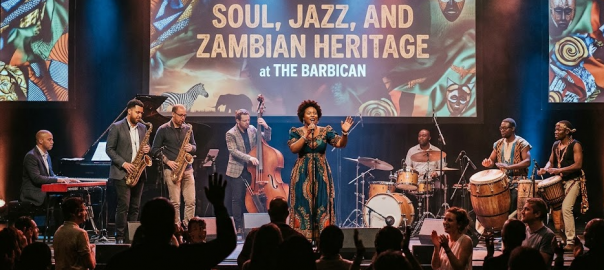
Sun, Jun 14 2026 /Mpelembe Media/ — Emeli Sandé is currently undergoing a profound professional and artistic transformation, characterized by a pursuit of independence and a deep exploration of her cultural heritage. She recently launched her own independent record label, Venus Records, which grants her complete creative control and liberates her from the commercial pressures of the major-label pop industry. Under this new label, she released her latest single, “Roots,” a moving track celebrating female empowerment, independence, and her Scottish and Zambian identity.
To reconnect with her origins for her upcoming sixth album, Sandé has relocated her recording studio back to her childhood home in Alford, Aberdeenshire, where she is composing on her very first piano. Furthermore, she has announced plans to relaunch her music career under her birth name, Adele Sandé, a name she originally bypassed in her early career to avoid confusion with the global pop star Adele.
This desire for authenticity is heavily reflected in her recent live performances, which have shifted away from stadium-sized pop toward a more sophisticated blend of jazz, gospel, reggae, and traditional African spiritualism. Her sold-out June 2026 recital at London’s Barbican Centre—part of the Summer Jazz Series—served as a masterclass in this new aesthetic. Backed by an all-Black ensemble with deep roots in church and blues traditions, she completely reimagined her chart-topping hits and proudly celebrated her Zambian lineage, even incorporating a recorded audio sample of her family gathering in Zambia into her set. A major highlight of the night was a raw, unreleased piano ballad titled “Refuge,” which earned her a powerful standing ovation. Moving forward, her 2026 tour itinerary focuses on curated, specialized events and historic venues rather than standard commercial arenas, perfectly aligning her live presence with her renewed artistic vision.
Beyond the “Heaven” Era: 5 Surprising Truths Behind the Reinvention of Emeli Sandé
In 2012, Emeli Sandé was the undisputed sovereign of British pop hegemony. Her “weapons-grade” mezzo-soprano timbre didn’t just fill the London Olympic Stadium; it defined a national moment of reflection. With over 19 million singles sold and a multi-platinum debut in Our Version of Events , she occupied a space of total commercial saturation. Yet, by 2026, the pop machine has been exchanged for the quiet of a home studio in rural Aberdeenshire. Sandé’s recent headline performance at the Barbican Hall, as part of Serious’s Summer Jazz Series, signals more than a change in venue—it marks her transition into an independent jazz archivist, meticulously deconstructing her own legacy through a lens of structural and creative self-determination.
1. The Rebirth of “Adele Sandé”
Perhaps the most startling shift in the artist’s current identity is the decision to reclaim her birth name. Born Adele Emily Sandé, she originally adopted her middle name professionally to avoid brand confusion with the global superstar Adele. After a decade of major-label pressure, Sandé has initiated a systemic relaunch of her career under her given name. This is not merely a cosmetic rebrand; it is a declaration of artistic freedom.The pivot was solidified by a serendipitous encounter with the “other” Adele at a Michelle Obama event. When greeted as “Adele” by her peer, the private reality of her identity finally harmonized with her public persona.”I really want to release something as Adele Sandé… She Adele was the most famous person in the world so I just thought of using my middle name.”
2. From Neuroscience to the Barbican
Before the charts, there was clinical rigor. Sandé spent five years at the University of Glasgow, intercalating a Bachelor of Science in clinical neuroscience in 2009. While she ultimately withdrew due to the burnout of a demanding curriculum, her medical training continues to inform her analytical bite as a songwriter. Her interest in psychiatry and the mysteries of the brain allows her to dissect the mechanics of pop celebrity with almost clinical precision.This scientific mind navigates the raw world of independent music by utilizing daily stream-of-consciousness writing. In the “independent jazz” state of 2026, this manifests as a sophisticated introspection. Her scientific training provides the empirical structure needed to explore the “why” behind human behavior, grounding her spiritual gospel chord substitutions in a profound, analyzed human experience.
3. The “Alien” in Alford: Reclaiming Cultural Geography
The sonic landscape of Sandé’s 2026 performance is deeply rooted in the specific geography of her upbringing. Raised in Alford, Aberdeenshire, she was the daughter of a Zambian immigrant father—who served as a teacher at her own school—and an English mother. Growing up in the only non-white household in a rural community fostered a sense of isolation she describes as feeling like an “alien.” Music became her primary coping mechanism, a sanctuary for navigating a complex identity within a homogenous community.Childhood Isolation to Cultural SynthesisAt the Barbican, this history was transformed from a source of loneliness into a celebratory synthesis. In a reimagined rendition of her hit “Wonder,” the familiar electronic beats were discarded in favor of a recorded audio sample of her family vibing back home in Zambia. As the traditional drumming filled the Brutalist halls of the Barbican, Sandé broke into a live, powerful Zulu-style chant. It was a sophisticated recontextualization, shifting a mainstream pop track into an archival expression of ancestral energy.
4. Structural Autonomy: The Venus Records Manifesto
The migration from major labels like Virgin and Capitol to her own independent label, Venus Records, represents a total economic reorganization. Distributed by Absolute, this shift allows her to bypass “high-gloss pop” requirements in favor of natural, acoustic-led jazz vocal styling. Central to this era is her return to the family home in Alford, where she records in a studio built around her original childhood piano—the very instrument where her “shrewd” songwriting began.| Business Model Attribute | Major-Label Era (2011–2019) | Venus Records Era (2024–Present) || —— | —— | —— || Vocal Branding | High-energy pop-soul; power belting | Acoustic-led jazz; controlled vibrato || Studio Setting | Commercial urban studios | Home studio in Alford, Scotland || Label Structure | Virgin / Capitol (Major Labels) | Venus Records (Independent) || Identity | Professional stage name “Emeli” | Reclaiming birth name “Adele Sandé” |
5. The “Refuge” of Vulnerability
Sandé’s 2026 live aesthetics prioritize a spiritual, almost liturgical charge. At the Barbican, she appeared radiant in a bright orange shirt and trousers, leading an all-Black backing ensemble that functioned more like a family than a session band. The group—featuring a keyboardist and his son on bass, both with deep Pentecostal church roots—provided a foundation of harmonic density.The emotional centerpiece was “Refuge,” an unreleased ballad performed solo at the piano. The performance was a masterclass in unguarded vulnerability, characterized by her gritty, pushed vocal quality and emotional honesty.”I know that life can be so cruel / As long as you’re by my side, I can take the storm / I don’t care anymore / I felt refuge here in your arms. / No one’s really who they seem / I’ve been hurt so many times, got to read between the lines.”As the final note hung in the air, a single man in the audience rose in spontaneous applause; the rest of the hall followed suit, culminating in a spontaneous standing ovation that felt like a collective healing.
Conclusion: The Long-Game of Authenticity
Emeli Sandé’s trajectory—from the peak of pop bombast to the nuanced autonomy of a jazz aesthetic—illustrates the refusal of a mature artist to be defined by corporate branding. Her status as an MBE, her academic role as the Chancellor of the University of Sunderland, and her marriage to classical pianist Yoana Karemova are markers of a fully realized identity.As she records her sixth album in the quiet of Aberdeenshire, Sandé’s journey raises a provocative question: Is a commercial peak worth the cost of artistic compromise, or is true success found in the structural autonomy she has finally secured? For “Adele” Sandé, the answer is found in the roots that remain.