Armed Agents, Family Surveillance, and Redracted Demands: Inside the DOJ’s Failed Campaign to Unmask Journalists’ Sources
Fri, July 24 2026 /Mpelembe Media/ — Recent legal developments and proposed legislation highlight a growing conflict between national security interests and press freedom in the United States. Following the rescission of Biden-era protections, the Department of Justice has adopted a more aggressive stance, exemplified by the subpoenaing of New York Times reporters to uncover anonymous sources. While the PRESS Act was introduced to establish a federal shield law and protect journalist-source confidentiality, it faced significant political opposition and failed to pass the Senate. Critics of these government actions argue that investigative authorities are being used to intimidate the media, creating a chilling effect on public interest reporting. Conversely, government officials defend these maneuvers as essential for identifying illegal leaks of classified information that could undermine national safety. Ultimately, these sources illustrate an environment where the lack of a federal shield law leaves journalists vulnerable to surveillance and prosecution during the news-gathering process.
The Sheep Detective and the Subpoena: 5 Shocking Realities of the New War on Press Freedom
1. Introduction: The Knock at the Door
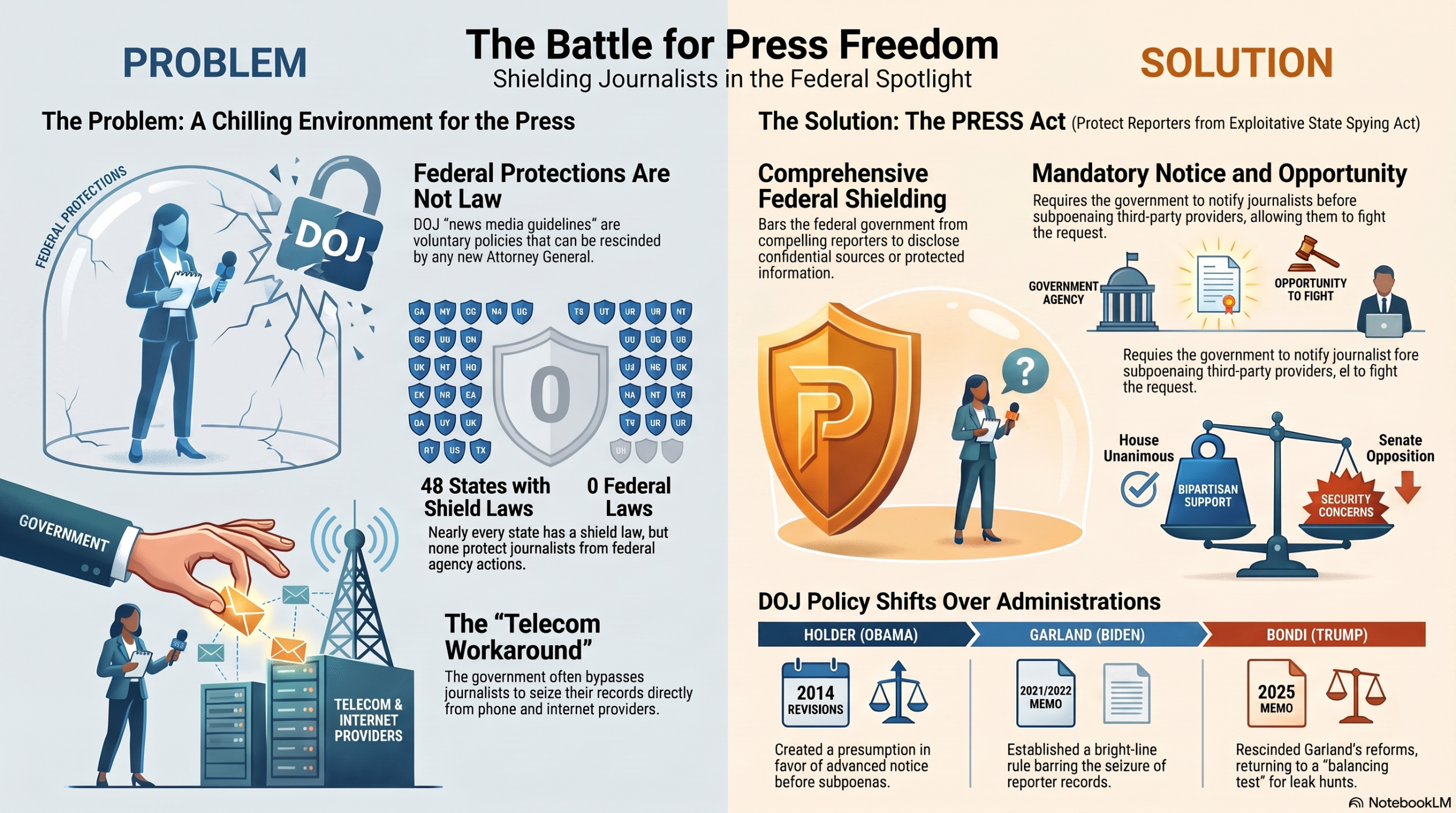
The sanctity of the home, a traditional sanctuary from state intrusion, was recently violated not for a crime of violence, but for the act of journalism. While a reporter for The New York Times was watching “The Sheep Detectives”—a family film about animals solving a murder—with his family, an FBI agent appeared at his door to serve a subpoena. The objective: to identify confidential sources who revealed security vulnerabilities regarding President Trump’s Qatari-gifted Air Force One jet.This encounter is not an isolated instance of investigative overreach; it is the opening salvo in a renewed federal campaign against the media. From the pursuit of Wall Street Journal records regarding the Iran war strategy to the search of a Washington Post reporter’s home, we are witnessing an aggressive hunt for “leakers” that has systematically dismantled the modest protections of the previous era. With the rescission of Biden-era Department of Justice (DOJ) guidelines and the targeted legislative death of the PRESS Act, the legal landscape for newsgathering has shifted from objective prohibition to unchecked prosecutorial discretion.
2. Takeaway 1: When “Last Resorts” Become First Steps
In the hierarchy of federal investigative protocols, the subpoenaing of a journalist is legally mandated to be a measure of “last resort.” However, recent proceedings in the U.S. District Court in Manhattan reveal a Department of Justice that has turned this principle on its head, treating the disruption of newsrooms as a preliminary investigative step.Judge Arun Subramanian recently upbraided the government for what he characterized as “sloppy legal work” and “inadvertent errors” in its pursuit of reporters Julian E. Barnes, Eric Lipton, Tyler Pager, and Eric Schmitt. Despite federal regulations requiring the exhaustion of all other non-media sources, the DOJ moved with a haste that the court found legally indefensible. It is profoundly counter-intuitive that the nation’s highest law enforcement agency—expected to be meticulous when constitutional rights are at stake—admitted to such “errors” only after vigorous legal opposition.”Subpoenas are the last step, not the first step, but the last step. I can’t think of anything more inconsistent with ‘Sheep Detective’ than an FBI agent showing up at your door.” — Judge Arun Subramanian
3. Takeaway 2: The Collateral Damage of the “Deep State” Hunt
The government’s “bad faith” foraging for sources has extended far beyond the targeted journalists, compromising the privacy of individuals entirely unrelated to the reporting. In the Air Force One investigation, the DOJ admitted to seizing phone records belonging to a reporter’s mother—a mental health professional—and a reporter’s spouse, who serves as the general counsel for a law firm.The implications are chilling: the DOJ’s haste compromised sensitive, confidential client-professional relationships and privileged legal communications. Furthermore, the timeframe of these subpoenas exposed the government’s true intent. The DOJ sought records dating back to January 1, months before the articles in question were published in July. This suggests the government was not investigating a specific disclosure regarding the $400 million jet retrofit, but was instead mapping the journalists’ entire source networks. The DOJ’s admission that these seizures were a “consequence of trying to move quickly” offers little comfort to those whose professional sanctuaries were breached by federal foraging.
4. Takeaway 3: The Erasure of the “Bright-Line” Protection
| Protection Feature | Garland/Biden Era (“Bright-Line”) | Bondi/Trump Era (“Balancing Test”) |
|---|---|---|
| Operational Standard | Strict prohibition on process for newsgathering. | DOJ weighs “law enforcement equities” vs. press freedom. |
| Newsgathering Definition | Includes receipt and possession of classified info. | Limited to “lawful” newsgathering only. |
| Suspect Exception | Barred if the “sole purpose” is to find a leaker. | “Sole purpose” language deleted; warrants easier to obtain. |
The insertion of the word “lawful” before newsgathering is a linguistic trap designed to neuter constitutional protections. By characterizing routine reporting—such as soliciting information from a source—as “conspiring” to violate the Espionage Act, the DOJ can reclassify journalists as criminals. Furthermore, by deleting the “sole purpose” protection, the government can now use the “suspect exception” to the Privacy Protection Act to obtain search warrants even when they have no genuine intent to prosecute the journalist, but merely wish to unmask a third-party whistleblower.
5. Takeaway 4: The Legislative Deadlock of the PRESS Act
While the executive branch erodes internal guidelines, the legislative remedy known as the PRESS Act met a sudden, politically motivated end in the Senate. The bill, which would have established a federal shield law, enjoyed overwhelming bipartisan support, passing the House unanimously and boasting 18 bipartisan cosponsors in the Senate.However, the bill was blocked by a small group of Senate Republicans following a Truth Social post by Donald Trump urging them to “KILL THIS BILL!” Senator Tom Cotton led the opposition, framing the Act as a shield for “deep-state leakers” and “America-hating” activists. Cotton’s primary objection—that the definition of a “journalist” was too overinclusive and might protect “TikTokers”—masked a deeper ideological clash. This was not a debate over definitions, but a conflict between transparency as a vital check on power and a demand for absolute loyalty to the executive branch. The failure of the PRESS Act leaves the “Fourth Branch” of government exposed to a patchwork of state laws that offer no protection against federal overreach.
6. Takeaway 5: Surveillance via Workaround
The modern investigator rarely needs to raid a newsroom when they can simply raid the cloud. The government increasingly utilizes “covered service providers”—tech and telecom giants—to seize journalist data without direct confrontation. This “workaround” allows for the seizure of emails, phone logs, and even location data from devices like Garmin watches.A visceral example of this tactic is the case of Washington Post reporter Hannah Natanson, whose home was searched by agents who seized her phone, laptops, and portable hard drives. The threat is compounded by the use of “delayed-notice” or gag orders. Under current regulations, the government can prevent service providers from notifying a journalist that their records have been seized for 45 to 90 days. This secrecy effectively blindsides newsrooms, preventing them from challenging the legality of a seizure until the “bell has been rung” and the source’s identity is already in the hands of the DOJ.
Conclusion: A Watchdog Without Teeth?
The shift from “sloppy legal work” in individual cases to the intentional dismantling of news media guidelines signals an era where investigative reporting is increasingly treated as a criminal enterprise. Whether the government is pursuing the New York Times over the Air Force One jet or the Wall Street Journal over its reporting on the risks of an Iran war operation, the objective remains the same: the neutralization of the press’s watchdog function.As we have seen in recent years, the foundation of our democracy is a vigorous press that seeks accountability. However, as the “investigative toolbox” of the reporter is emptied of its most vital tool—confidentiality—the public’s right to know is traded for executive secrecy. If routine newsgathering can be reclassified as a “conspiracy” at the whim of the Attorney General, what remains of the First Amendment?The Critical Question: In an age of escalating surveillance and rescinded protections, can the press truly serve as a check on power when the government holds the keys to the newsroom’s digital sanctuary?