
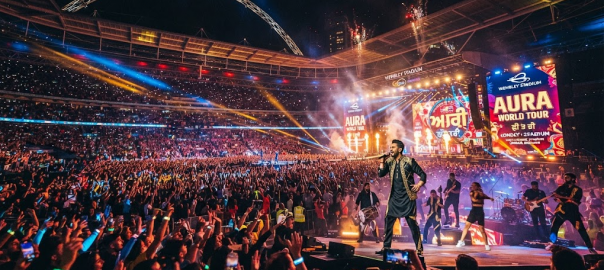
The Turbaned Tide: How Diljit Dosanjh Rewrote Global Pop History at Wembley Stadium
Sat Sep 19 2026 /Mpelembe Media/ — On September 12, 2026, Diljit Dosanjh made history as the first Punjabi artist to headline London’s iconic Wembley Stadium, bringing his global AURA World Tour to a sold-out crowd of over 90,000 fans. The performance represented a major cultural watershed, placing Punjabi music squarely on a premier international stage historically occupied by legendary acts like Michael Jackson, Prince, and Queen. Rather than diluting his artistic presentation or assimilating to meet Western crossover expectations, Dosanjh championed Punjabi language, attire, and identity throughout the show, opening with his signature exclamation “Punjabi Aa Gaye Wembley Oye!” and offering complimentary turban-tying for venue attendees.
The concert setlist synthesized high-energy contemporary hits such as “G.O.A.T.”, “Lover”, and “Born to Shine” with traditional Bhangra rhythms, alongside a cross-border qawwali tribute to Pakistani maestro Ustad Nusrat Fateh Ali Khan with “Sanson Ki Mala Pe”. Closing the historic night beneath fireworks with the anthem “Main Hoon Punjab”, Dosanjh demonstrated that uncompromised cultural retention can command elite global entertainment infrastructure. Grounded in Sikh principles of humility and divine grace (gurprasad), he reflected on his path from rural Punjab, recalling how his mother held spiritual faith in his journey before even knowing what Wembley was, while advising youth against blind celebrity worship in favor of intergenerational family wisdom.
Capping off the milestone, Dosanjh announced from the stage that the tour would next move to the 132,000-capacity Narendra Modi Stadium in Ahmedabad, constructing a direct transcontinental bridge between the global South Asian diaspora and the subcontinent. Complemented by critical accolades such as an International Emmy nomination for Amar Singh Chamkila, his Wembley performance underscores the expanding economic influence, representation, and artistic sovereignty of South Asian performers globally.
The Turbaned Tide: How Diljit Dosanjh Rewrote the Global Pop Playbook from Punjab to Wembley
1. The Unlikely Conqueror: From the Pind to the Private Jet
The image is striking: a man in a tailored black overcoat and classic dress shoes, posed with effortless gravity against the sleek backdrop of a private jet. It is the visual manifestation of a song title, Main Karda Fly Firda , but for Diljit Dosanjh, the “fly” isn’t just about aviation—it is about the physics of a cultural ascent that defies the traditional gravity of the Western pop machine.His is the quintessential “Pind to Private Jet” narrative. Not long ago, Dosanjh was the Punjabi Beeba Munda (good boy) of Dosanjh Kalan, singing devotional hymns in local gurudwaras. Today, he is a global phenomenon who recently took an official meeting with the Prime Minister in that very black overcoat. His rise raises a fundamental question about the current architecture of stardom: How does a regional artist—one who refuses to dilute his language, his faith, or his aesthetic—manage to conquer the world’s most storied stages? The answer lies in a paradoxical truth: the more fiercely local he remains, the more universal his appeal becomes.
2. Outshining the Legends: The 92,000-Strong Wembley Takeover
On September 12, 2026, the famous Wembley arch wasn’t just a London landmark; it was a gateway for the global Punjabi movement. As part of his “Aura World Tour,” Diljit Dosanjh became the first Punjabi artist to headline the venue. While the stadium’s official capacity is 90,000, The Times of India reported a staggering turnout of nearly 92,000 fans—a figure that effectively places him in the pantheon of the gods of pop.”Punjabi Aa Gaye Wembley Oye!”To understand the magnitude of this, one must look at the data. Diljit’s single-night turnout reportedly surpassed the individual night audience figures of Michael Jackson’s 1988 Bad Tour and Queen’s 1986 residency, both of which drew approximately 75,000 per show. While Jackson’s seven-night run totaled 504,000 attendees, the fact that a Punjabi-language artist can now outdraw the King of Pop’s single-night peak speaks to a radical shift in the global cultural metropole.Yet, the evening wasn’t just a numbers game; it was a display of artistic depth. Amidst the high-octane Bhangra anthems like G.O.A.T. and Lover , Dosanjh pivoted to the soulful. He performed Sanson Ki Mala Pe , a qawwali famously associated with the legend Nusrat Fateh Ali Khan. In that moment, the stadium’s energy shifted from a party to a prayer, connecting the modern superstar to a centuries-old musical lineage that resonated through the London night.
3. The Turban as a Global Statement: Identity as the Ultimate Swagger
For Diljit, the turban ( Pagg ) is not just an accessory; it is his superpower. From the Coachella desert to the high-fashion red carpets of New York, he has proved that staying rooted provides a level of “swagger” that no luxury brand can manufacture. At the MET Gala, he stood as a “Maharaja of Patiala” for the modern age, draped in layered emeralds reminiscent of the legendary Cartier necklace and wearing his heritage literally on his back via a cape embroidered with Gurmukhi script.His cultural leadership is communal, not just personal. At the Wembley show, the “Aura” experience extended into the stands, where fans were offered complimentary turban-tying services. This transformed the audience into a sea of shared identity, a “Global Singh” aesthetic that bridges the gap between traditional virsa and street-style edge.The Anatomy of the Global Singh Style:
- Sculpted Turbans: Often featuring a side turla to celebrate traditional Punjabi silhouettes within a modern context.
- Technical Fusion: A sophisticated blending of utility vests, harness bags, and tailored jackets with traditional tambas.
- The Desi Footwear Play: Unapologetically pairing high-end, limited-edition sneakers with traditional kurtas to create a refined “desi gangster” look.
- Monochromatic Grace: Utilizing head-to-toe white or black to allow the silhouette and the turban to command the spotlight.
4. From Slain Legend to Emmy Contender: The Amar Singh Chamkila Impact
Dosanjh’s ability to pivot between the stadium stage and the cinema screen is what separates him from the mere pop star. His performance in the Netflix film Amar Singh Chamkila , directed by Imtiaz Ali, offered a haunting look at the “Elvis of Punjab”—the slain folk legend whose raw, provincial lyrics made him both a hero and a target.This transition from singer to “Emmy-nominated actor” (following his 2025 International Emmy nomination for Best Performance by an Actor) validates his artistic range. He approaches acting with the same authenticity he brings to his wardrobe; he doesn’t “play” Punjabi, he inhabits it. As he noted of the critical acclaim, “It’s all because of Imtiaz Ali sir,” yet it is Dosanjh’s inherent truth as an artist that brought the tragic folk hero back to life for a global audience.
5. The “Dreamer’s Paradox”: Success Beyond Local Understanding
Despite a North American tour that grossed $32 million and a historic takeover of London, Diljit remains anchored by a groundedness he calls the “Dreamer’s Paradox.” This is best illustrated by his relationship with his mother, who remains blissfully unaware of the Western metrics of success.When he told her he was headlining Wembley, the name meant nothing to her—it was just another venue where her son would sing. Yet, it was her provincial wisdom that fueled his journey. He recalls her telling him: “Whenever you have a problem, something good happens.” This philosophy has allowed him to navigate the “problems” of being a regional artist in a global market, turning every barrier into a bridge.”I want our people to be happy and say, yes, we can do this too.”His motivation has evolved from personal ambition to communal blueprint. He isn’t just performing for his own legacy; he is performing so the next generation of South Asians views the world’s largest stages as their birthright.
6. The 132,000-Seat Vision: Why Ahmedabad is the Next Frontier
Wembley, for all its prestige, was never the final destination. From the stage in London, Dosanjh announced the next milestone of the Aura World Tour: a performance at the Narendra Modi Stadium in Ahmedabad on November 21, 2026 .The symbolism is profound. Moving from the most iconic stadium in the UK to the largest stadium in the world—with a capacity of 132,000—Dosanjh is making a strategic statement about the shift in global power. His logic is as sharp as it is simple: “If the world’s biggest stadium is in India, how could a Punjabi not perform there?” It is an assertion that the center of the world is wherever the art is most vibrant.
7. Conclusion: The Anthem of Identity
As the Wembley show reached its crescendo, Diljit performed “Main Hoon Punjab” ( I Am Punjab ) while fireworks lit up the London sky. It was a moment of absolute synthesis: a regional identity projected onto a global canvas, a village boy commanding the metropole.Diljit Dosanjh’s “Born to Shine” philosophy suggests that his ascent is not an outlier, but a forecast. As he moves toward the 132,000-seat horizon in Ahmedabad, he leaves us with a question that the music industry is still scrambling to answer: In an increasingly connected world, is the most powerful thing an artist can be is exactly who they were when they started? For Dosanjh, the arch of Wembley was just the beginning; he didn’t just arrive on the world stage—he brought the pind with him.