
“AI Slop” Backlash: How Player Outrage is Forcing Developers to Put Human Artists First
Sun, Aug 23 2026 /Mpelembe Media/ — The video game industry is undergoing a swift legal and structural recalibration as “anti-AI” clauses rapidly transition from bespoke risk-mitigation measures into standard contract boilerplate. Corporate intellectual property lawyers, such as Haley MacLean of Voyer Law, report that nearly all of their game development and publishing clients now explicitly mandate strict bans on generative AI. This shift is primarily driven by massive intellectual property liability: under current U.S. copyright law, works must be the product of human authorship to receive IP protection. If a developer incorporates AI-generated assets like art, writing, or sound without substantial human editing, those elements fall into the public domain. Consequently, competitors could legally extract those identical assets and use them in their own games with no legal recourse for the original creator, rendering unedited AI assets a major commercial risk for publishers and investors alike.
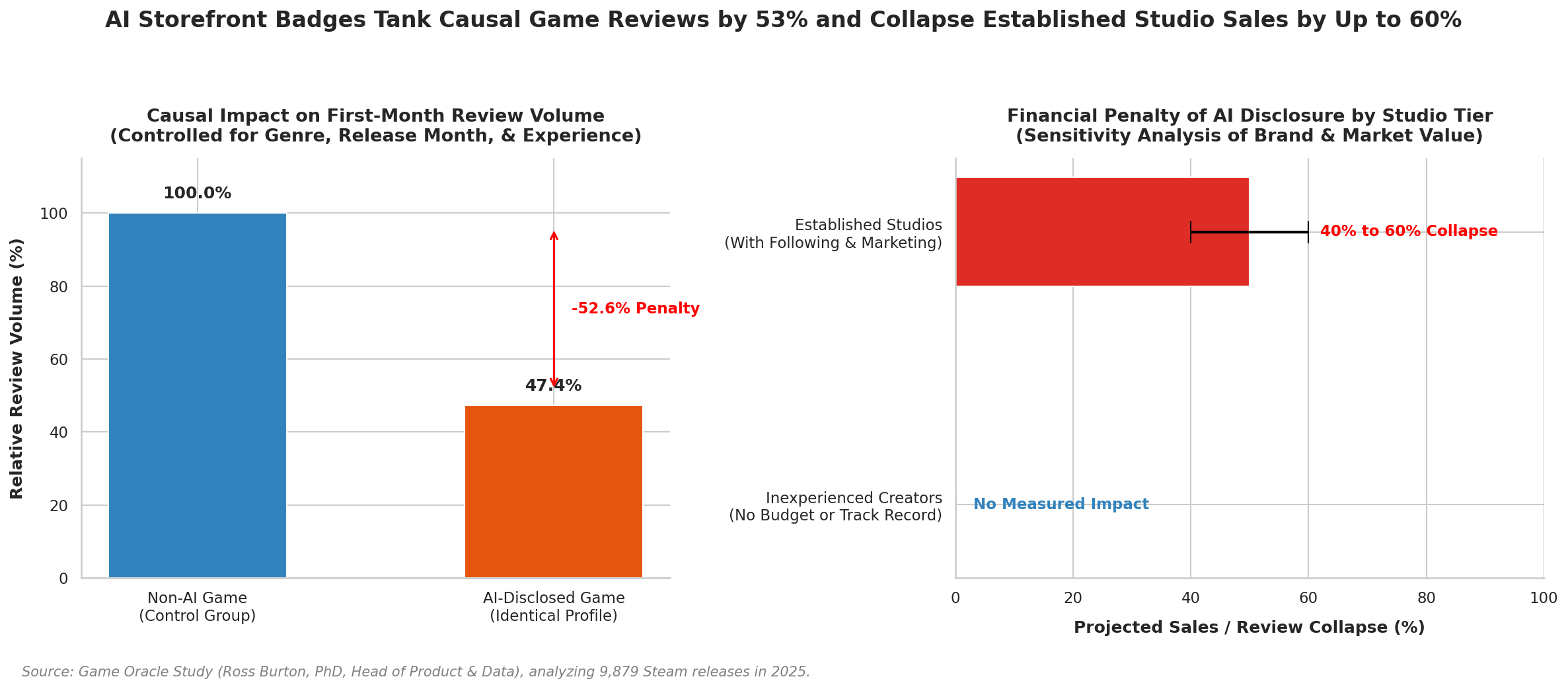
Beyond legal hurdles, integrating generative AI carries a heavy financial penalty due to intense player pushback. A statistical study by Ross Burton, PhD, Head of Product and Data at Game Oracle, analyzed nearly 10,000 Steam games released in 2025 and quantified a severe “AI Stigma”. The research revealed that games carrying a mandatory AI disclosure badge experienced an average 53% reduction in first-month reviews (a critical industry proxy for sales) compared to statistically identical non-AI games. While this stigma has little to no impact on inexperienced, low-resource developers who already lack discoverability, established and reputable studios face a catastrophic 40% to 60% collapse in projected sales if they experiment with generative AI. Prominent titles and franchises, such as Call of Duty: Black Ops 7 and Jurassic World Evolution 3, have already suffered severe public relations crises and player refund requests upon the discovery of AI-generated materials.
The risk of utilizing generative tools during development is further amplified by “operational contamination,” where temporary placeholder assets created during early prototyping accidentally slip into final shipped code. This vulnerability was dramatically highlighted by Sandfall Interactive’s critically acclaimed debut JRPG, Clair Obscur: Expedition 33. Although the game went on to sell over 8 million units and win nine Game Awards trophies (including Game of the Year), it was stripped of both its “Game of the Year” and “Debut Game” awards at the Indie Game Awards. The disqualification occurred after players spotted a couple of generative AI placeholder newspaper textures that slipped through quality assurance at launch—despite the developers patching them out within five days. This severe fallout underscores a growing industry zero-tolerance policy against generative AI in creative competitions and showcase regulations.
To manage these anxieties, storefronts and labor organizations have built rigid compliance frameworks. Steam’s AI disclosure policy, updated in January 2026, forces developers to publicly disclose pre-generated and live-generated AI content on their store pages, with non-disclosure constituting a material breach of contract that can trigger permanent banishment. Notably, Valve’s guidelines officially exempt background “efficiency tools” like code autocompleters (e.g., GitHub Copilot) or internal concept art, reserving disclosures for player-facing content. Concurrently, organized labor has established firm protections: in July 2025, SAG-AFTRA members ratified the Interactive Media Agreement by an overwhelming 95.04%, securing pay raises and mandatory informed consent for “digital replicas” of voice and body capture performers. Independent voice actors are also widely safeguarding their biometric voice prints by attaching the National Association of Voice Actors (NAVA) AI Rider to all non-union contracts.
Why Efficiency is Killing the Game: The Surprising Reality of the “AI Stigma”
Generative AI was heralded as the “cost-saving revolution” that would liberate game developers from the grind of asset creation and debugging. However, in the current market, this promised efficiency has transformed into a digital “scarlet letter.” Far from a neutral tool, AI has become a primary driver of consumer and industry rejection. New data suggests that incorporating generative AI into a professional workflow might be the most expensive mistake a studio can make—a reputational and financial penalty that turns a supposed shortcut into a commercial dead end.
The 53% Penalty: Quantifying the Stigma
The “AI Stigma” is no longer just a collection of angry social media comments; it is now a quantifiable market force. According to a study by Ross Burton, PhD, of Game Oracle, which analyzed nearly 10,000 Steam releases, games that disclose the use of AI suffer a massive hit to visibility and engagement. Using the number of reviews as a proxy for sales, the study found that games with AI disclosures received approximately 53% fewer reviews than their non-AI counterparts.The data reveals a counter-intuitive trend regarding who is punished most. While amateur developers with zero budget see little impact—often because they are already struggling for visibility—established studios face a severe betrayal of brand trust. For professional teams, AI is not viewed as a necessary resource; it is seen as a signal of laziness or cost-cutting over quality.”If ‘good’ studios are using AI—then AI use is catastrophic (-40% to -60% drop in sales). This is evidenced by the dark blue cells at the top of our heatmap.” — Ross Burton, PhD, Head of Product and Data at Game OracleThe market reflects this volatility. While titles like The Finals and Suck Up! managed to navigate these waters, major brands are feeling the bite. Labels like Black Ops 7 and Jurassic World Evolution 3 have seen their brand equity harmed by AI associations, as players increasingly equate AI disclosure with a “catastrophic” failure in workflow selection.
The “Placeholder” Trap: The Cost of a Single Mistake
The case of Clair Obscur: Expedition 33 serves as a stark warning of the industry’s “hard stance” on the technology. The game was initially a sweeping critical success, winning “Ultimate Game of the Year” at the Golden Joysticks. However, it was stripped of its “Game of the Year” and “Debut Game” titles at the Indie Game Awards (IGA) on the very day of the premiere (December 18, 2025).The impactful takeaway here is that the disqualification was a zero-sum game triggered by a mistake. Sandfall Interactive had used AI to create temporary placeholder textures during development, but two AI-generated posters were left in the build at launch due to a QA oversight. Despite the developer replacing the assets with human-made art within five days, the IGA maintained its “strictly ineligible” rule. Consequently, the awards were handed to competitors Blue Prince and Sorry We’re Closed . For modern developers, “placeholder” AI is no longer a safe efficiency hack; it is a high-stakes liability that can cost a studio its legacy.
The Copyright Black Hole: Why AI Assets are “Legal Grey Areas”
Beyond reputation, there is a crisis of IP defensibility. Current intellectual property law, particularly in the United States, hinges on “human authorship.” The US Supreme Court recently declined to hear Thaler v. Perlmutter , upholding the US Copyright Office’s (USCO) requirement that only human-created works are eligible for protection. For a senior analyst, the conclusion is clear: creating an AI-generated protagonist or logo is commercial suicide. Under this precedent, such assets have zero market value because they cannot be “owned.”The global legal landscape remains fractured, creating a dangerous environment for brand protection:
- United States & United Kingdom: Human authorship is a strict requirement. Works created entirely by a machine are generally considered to be in the public domain.
- Beijing Internet Court (China): In an outlier ruling ( Li v. Liu ), the court argued that AI content represents the prompter’s creativity, offering a rare protection for machine output.In major markets, this “public domain” status means a competitor could legally copy your brand assets without penalty. If you can’t defend your IP, you don’t have a business; you have a charity for copycats.
“It’s Cancerous”: The Publisher Hardline
Prominent indie publishers are now adopting aggressive anti-AI policies to insulate themselves from these legal and reputational risks. Tim Bender, CEO of Hooded Horse (publisher of Manor Lords ), describes generative AI as a force that “infests” a project. His concern is that once AI enters a workflow—even as a prototype—it compromises the project’s integrity. This hardline is echoed by Pocketpair ( Palworld ), who refuse to partner with studios using the tech.”It is now written into our contracts if we’re publishing the game… ‘no fucking AI assets.'” — Tim Bender, CEO of Hooded HorseFor these publishers, the risk of a single AI asset “infesting” a build is too high to tolerate. They recognize that in the current climate, an AI disclosure isn’t a badge of efficiency; it’s a warning of potential legal and community fallout.
The Perception of “Slop”: Why Gamers are Rejecting the Tech
The backlash from the gaming community, particularly on platforms like Reddit, suggests that players are equating AI use with a lack of care. Gamers are using AI disclosures as a filter to identify “slop”—a biting term for derivative, low-effort content. The rejection is built on three pillars:
- Quality Correlation: AI is seen as a signal for “poorly crafted” games. Players equate shortcuts in art with shortcuts in optimization and mechanics.
- The “Art Thief” Narrative: Ethical and environmental concerns regarding data scraping and energy consumption remain front-of-mind for the core demographic.
- Soul-less Aesthetics: AI assets are increasingly mocked for their “minimalist corporate art” vibe—a generic, derivative style that lacks the unique “hand-crafted” feel that defines the medium’s best works.Players aren’t just boycotting; they are making a qualitative judgment. In their eyes, AI disclosure equals “low effort,” leading them to choose human-made alternatives that respect their time and investment.
The Labor Frontier: SAG-AFTRA and the New Guardrails
The human element is fighting back through the 2025 SAG-AFTRA Interactive Media Agreement. This contract represents the first line of defense in a permanent war between human creators and algorithmic efficiency. The agreement mandates strict “consent and disclosure” for digital replicas and—crucially—allows performers to suspend consent for AI use during strikes. This ensures human talent cannot be replaced by their own digital ghosts while on the picket line, signaling a permanent shift in how human value is protected.
Conclusion: A Prompt for the Future
Currently, generative AI in the gaming industry is a “reputational risk” rather than a simple tool. While it may lighten the load, it carries a weight that can crush a studio’s sales, disqualify it from awards, and leave its IP indefensible.The modern player base has effectively authored a manifesto, summarized by Reddit user Average_Citizen_117 : “I want AI to wash my dishes so I can make art. Not the other way around.”As it stands, the industry is forcing the opposite. AI is being used to make the art while humans are left to wash the dishes of legal and reputational fallout. For C-suite executives prioritizing “efficiency,” the message is clear: choosing the machine may be the fastest route to reputational suicide. Until the industry can separate the efficiency of the tool from the stigma of laziness, the most “efficient” move a studio can make is to keep the machine out of the creative process entirely.