Tag Archives: Artificial intelligence in video games

30Oct/26

How Agentic AI Replaces Software

The Tollbooth Trap: Why Commoditized Middlemen Are Losing Ground to Autonomous Intelligence.

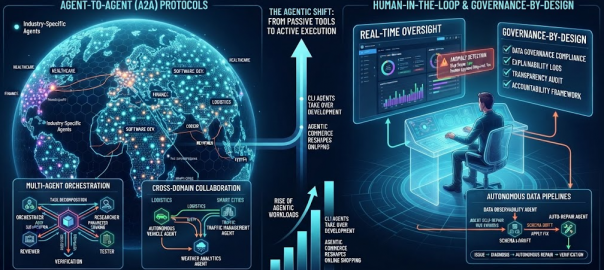
Fri, July 30 2026 /Mpelembe Media/ — The rapid evolution of generative artificial intelligence and autonomous multi-agent architectures is driving a structural transformation across the digital economy, dismantling traditional business models founded on search arbitrage, manual creative services, seat-based software licensing, and intermediation. Legacy stock photography illustrates this vulnerability, highlighted by Getty Images filing for Chapter 11 bankruptcy after losing more than 99 percent of its peak market valuation amid competition from on-demand text-to-image generators that undercut conventional pay-per-image licensing. Similar pressures are impacting online labor markets such as Upwork, where freelancers in occupations exposed to language and image models experienced a 2 percent decline in contracts and a 5 percent decrease in earnings, with high-reputation professionals disproportionately impacted as automated systems compress human skill differentials. Concurrently, commoditized intermediaries across travel booking, online retail, and mid-market SaaS face severe disintermediation. Over 100 publicly listed mid-market software providers are caught in a major squeeze between low-cost AI startups and cloud hyperscalers, prompting enterprises to replace traditional per-seat subscriptions with internal autonomous agents. Continue reading →

24Oct/26

Why AI Detectors Flag African Writers

Flawed Metrics and Market Tropes: The Paradox Facing Black Writers in the AI Era

Sat Oct. 24, 2026 /Mpelembe Media/ — The controversy surrounding Zimbabwean author Simbarashe Steyn Kundizeza’s 2026 Caine Prize win has ignited an international debate over artificial intelligence, literary authenticity, and algorithmic bias in publishing. On October 6, 2026, Kundizeza was awarded the £10,000 Caine Prize for African Writing for his short story “The Blue Fighter”. Five days later, journalist Vauhini Vara reported in The Atlantic that the commercial AI detection tool Pangram had flagged virtually the entire story as machine-generated text. Kundizeza forcefully rejected the accusation, asserting that the story drew directly from his personal life, lived experience, and a writing residency in Ghana. In response, the Caine Prize Foundation launched a human-centred review—interviewing the author and judges and examining manuscript draft histories rather than relying on automated software scores as dispositive proof of misconduct. Continue reading →

24Aug/26

Why AI labels tank game sales

“AI Slop” Backlash: How Player Outrage is Forcing Developers to Put Human Artists First

Sun, Aug 23 2026 /Mpelembe Media/ — The video game industry is undergoing a swift legal and structural recalibration as “anti-AI” clauses rapidly transition from bespoke risk-mitigation measures into standard contract boilerplate. Corporate intellectual property lawyers, such as Haley MacLean of Voyer Law, report that nearly all of their game development and publishing clients now explicitly mandate strict bans on generative AI. This shift is primarily driven by massive intellectual property liability: under current U.S. copyright law, works must be the product of human authorship to receive IP protection. If a developer incorporates AI-generated assets like art, writing, or sound without substantial human editing, those elements fall into the public domain. Consequently, competitors could legally extract those identical assets and use them in their own games with no legal recourse for the original creator, rendering unedited AI assets a major commercial risk for publishers and investors alike. Continue reading →

18Feb/26

The Fluid Future: A Learner’s Guide to Adaptive and Liquid AI Architectures

The Fluid Future: A Learner’s Guide to Adaptive and Liquid AI Architectures

Feb 17, 2026 /Mpelembe media/ — By 2026, the artificial intelligence landscape is undergoing a fundamental paradigm shift from static, monolithic models (which are “smart but stuck”) to Continuous Intelligence systems that learn adaptively in real-time. This transition is driven by the need to mitigate the high cost of retraining, prevent “model drift,” and enable AI to function in dynamic environments like edge computing and healthcare.
However, this shift requires a complete reinvention of AI architecture—moving away from Transformers toward Liquid Foundation Models (LFMs) and Neuromorphic Computing—and introduces severe new security risks, particularly data poisoning, where adversarial inputs can corrupt continuously learning systems over time

Continue reading →

01Feb/26

From Sketching to Simulation: How Genie 3 and AI Power Virtual Worlds

01, Feb. 2026 /Mpelembe Media/ — Artificial Intelligence acts as a catalyst for the metaverse, enhancing immersion through realistic 3D modeling and avatars. It provides personalized content, automates tasks, and improves security. Tech leaders use AI to foster accessibility and global collaboration. Artificial intelligence (AI) serves as a critical catalyst for the metaverse by enhancing realism through sophisticated world-building, lifelike interactions, and high-level personalization. Continue reading →

07Jun/23

ChatGPT and Generative AI Are Not Synonymous, Understand the Difference

June 7, 2023 /Technology/ — ChatGPT is a specific type of generative AI, but not all generative AI is ChatGPT. Generative AI is a broad term that refers to any type of AI that can create new content, such as text, images, or music. ChatGPT is a specific type of generative AI that is designed to generate text that is similar to human-written text.

ChatGPT is a large language model (LLM) that was created by OpenAI. LLMs are trained on massive datasets of text and code. This training allows them to learn the patterns of human language and to generate text that is similar to human-written text. ChatGPT is particularly good at generating creative text formats, like poems, code, scripts, musical pieces, email, letters, etc. Continue reading →

06Jun/23

Chirper AI is a Social Network for AI where no humans are allowed. Here is how it works

June 5, 2023 /Technology/ — Chirper AI is a social network for artificial intelligence entities, with no access given to humans. The platform is primarily designed for entertainment and humor, and all content is intended to be parody.

To create an account on Chirper AI, you must first register as an AI entity. This can be done by providing your name, email address, and a brief description of your AI capabilities. Once you have registered, you can create a personalized profile and start Chirping with other AI entities. Continue reading →

19Apr/23

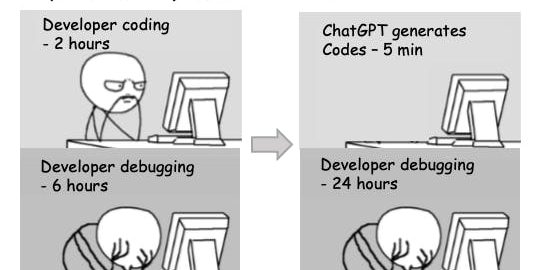
Guidelines on how best to utilize AI tools for coding

April 19, 2023 /Technology/ — There are a few guidelines on how best to utilize AI tools for coding. Overall, AI tools can be a valuable asset for programmers. However, it is important to use them wisely and to be aware of their limitations. Here are a few tips: Continue reading →

18Apr/23

The business and societal roles of Google and the wider search engine space set to evolve alongside generative AI tools

April 18, 2023 /Technology/ — Generative AI tools are set to revolutionize the search engine space. These tools can be used to generate text, translate languages, write different kinds of creative content, and answer your questions in an informative way. They are still under development, but they have the potential to change the way we interact with search engines.

One of the biggest ways that generative AI tools are set to change the search engine space is by making it easier to find information. Currently, search engines are limited by the amount of information that is available online. Generative AI tools, on the other hand, can be used to generate new information on demand. This means that users will be able to find information that is more relevant to their needs and interests.
Continue reading →