Tag Archives: Existential risk from artificial general intelligence

28Oct/26

Why AI Ethics Needs Ancient Theology

Faith, Human Dignity, and Governance: Why AI Ethics Demands Moral Depth Over Statistical Consensus

Wed, July 28 2026 /Mpelembe Media/ — The Limits of Preference Aggregation and the Rise of Algorithmic Pluralism Leading technology executives have proposed aligning artificial intelligence with human values by calculating a “weighted average” or statistical consensus through techniques such as Reinforcement Learning from Human Feedback (RLHF). However, social choice theory demonstrates that there is no unique voting protocol capable of universally aggregating individual preferences without generating logical contradictions or violating private ethical values. Theological and philosophical scholars emphasize that religious traditions cannot be reduced to modular, extractable rulebooks to be averaged in machine learning models. Attempting to compute a universal moral consensus flattens culturally rich worldviews, suppresses minority perspectives, and risks codifying dominant, secular-rational norms at the expense of global faith communities. Continue reading →

09Sep/26

GPT-6 Astra takes the steering wheel

“AGI Has Arrived”: Industry Declarations, Benchmark Discrepancies, and the Launch of GPT-6 Astra

Wed Sep 09 2026 /Mpelembe Media/ — The public discussion surrounding artificial general intelligence reached a pivotal moment following the rollout of OpenAI’s GPT-6 Astra in September 2026. Nvidia CEO Jensen Huang declared on social media that “AGI has arrived,” highlighting Astra’s training on more than 100,000 Grace Blackwell NVLink72 GPUs and noting that another 400,000 GPUs are scheduled to come online. This definitive stance represented a sudden shift from Huang’s statements during Nvidia’s Q2 FY2027 earnings call just days prior, where he described traditional AGI milestones as “senseless” and emphasized that the industry should focus on practical utility, useful work, and generating “profitable tokens”. Over the preceding two years, Huang’s public timeline for AGI shifted from passing every human test within five years to defining it as an AI capable of creating a temporary viral application, while acknowledging that AI agents remained incapable of replicating the complex work of running Nvidia itself. Analysts note that by framing Astra’s rollout as the literal arrival of AGI, Huang reinforced the market narrative that massive hardware investments directly drive corporate revenue. Continue reading →

23Jan/25

Cybersecurity Priorities 2025

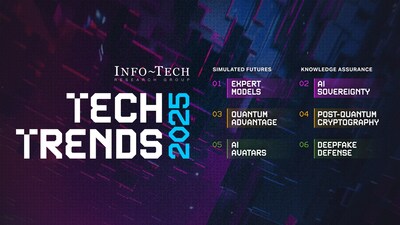
Jan. 23, 2025 /Mpelembe Media/ —  Info-Tech Research Group’s 2025 Security Priorities report identifies key cybersecurity challenges, including the rise of AI-powered threats and quantum computing. The report, based on extensive research, advises organisations to proactively manage risks by operationalising AI security, strengthening identity management, and building resilient vendor security practices. Continue reading →

03Jan/25

IRS AI Audit Selection: Innovation and Risk

Jan. 3, 2025 /Mpelembe Media/ —  The Internal Revenue Service (IRS) is using artificial intelligence (AI) to improve the efficiency and effectiveness of its audit selection process, particularly within the National Research Program (NRP). The NRP is used to develop estimates of the tax gap, which is the difference between taxes owed and taxes paid. The IRS is implementing AI models to select tax returns for audit in a way that is intended to be more targeted and efficient than traditional methods. Continue reading →

03Jan/25

IRS Artificial Intelligence Governance and Principles

Jan. 3, 2025 /Mpelembe Media/ — This interim guidance memorandum from the IRS Chief Data and Analytics Officer outlines new Internal Revenue Manual (IRM) 10.24.1, establishing AI governance principles and processes. It details requirements for AI use case inventories, approval procedures, and risk management, particularly for safety-impacting or rights-impacting AI. Continue reading →

31Dec/24

Threats, Incoming AI Regulations, and Exponential AI Adoption Among Top Trends to Prepare For, Says Info-Tech Research Group

As artificial intelligence (AI) continues its exponential expansion across industries, organisations are increasingly challenged to deploy AI responsibly and strategically. Info-Tech Research Group’s newly published AI Trends 2025 report provides critical guidance on Responsible AI, governance, and organisational policies necessary to drive value from AI initiatives. The global research and advisory firm’s report emphasises the importance of managing AI as a core element of organisational strategy and offers actionable steps for effective AI implementation. Continue reading

09Sep/24

AI Adoption Key to Boosting UK Competitiveness, Not Job Losses

A groundbreaking new white paper from British AI software leader Automated Analytics challenges the widespread fear that Artificial Intelligence (AI) will lead to mass job losses. Contrary to popular belief, the study reveals that none of the 5,000 clients across the UK and US who adopted AI solutions reported layoffs due to AI, highlighting that AI can be a catalyst for growth, not a threat to jobs. Continue reading

30Jul/24

74% of Americans Fear AI Will Destroy Privacy

YouGov and Aloha Browser today announced the results of their “How Does AI Affect Digital Privacy?” survey, in which almost three-quarters (74%) of respondents said they felt threatened by the potential of Artificial Intelligence (AI) to “destroy their privacy.” Read more