
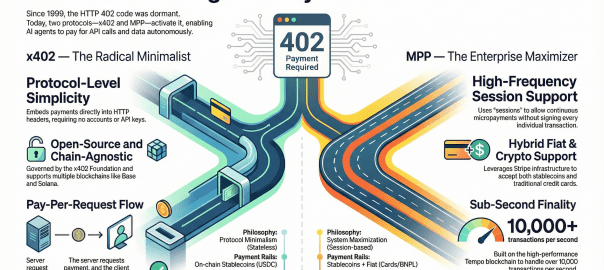
Mon Aug 31 2026 /Mpelembe Media/ — Stripe has positioned itself as the economic infrastructure layer for the artificial intelligence era, building a comprehensive suite of products designed to handle both the expense and income sides of autonomous agent commerce.
Rather than forcing developers to choose strictly between crypto-native or legacy card networks, Stripe bridges both systems. The core of Stripe’s production-ready agentic framework operates across several key pillars:
1. The AI Control Layer: OpenRouter & Privy Acquisitions
To capture both developer workflow and transaction flow, Stripe executed two massive acquisitions:
- The AI Spend Gateway (OpenRouter): Stripe acquired OpenRouter for a reported $7.5 billion. OpenRouter acts as a unified gateway allowing developers to route workloads across multiple AI models (OpenAI, Anthropic, DeepSeek, etc.). By inserting itself at the API gateway layer, Stripe combines payments with token consumption management. This allows Stripe to manage the expense side of AI capital flows—enabling dynamic model routing based on real-time cost, latency, and task complexity.
- TEE-Isolated Key Management (Privy): Stripe acquired embedded wallet provider Privy in June 2025. Privy’s Server Wallets operate as Stripe’s cryptographic key storage primitive, utilizing Trusted Execution Environments (TEEs) combined with Shamir Secret Sharing (SSS). Security boundaries are enforced via off-chain policies (transfer limits, allowlisted protocols, and specific time windows). Paired with Stripe and Bridge’s stablecoin infrastructure, this provides a native, secure playground for fully autonomous, sessionless agents.
2. The Stripe Agentic Commerce Suite
Announced in late 2025 and expanded in April 2026, this suite provides specific financial tools for M2M (machine-to-machine) and B2M (business-to-machine) environments:
- Shared Payment Tokens (SPTs): This primitive solves the security problem of agents purchasing real-world goods. SPTs allow an agent to initiate card payments on behalf of a human user using the buyer’s saved payment method (credit/debit cards) without exposing the underlying raw credentials to the LLM context. Each token is strictly scoped to a single merchant, bounded by time expirations, and restricted to maximum spending thresholds.
- Machine Payments Protocol (MPP): Co-authored with the Tempo blockchain, MPP is an open standard designed to standardize how software agents execute recurring settlement and microtransactions programmatically.
- Stripe Link Agent: A custodial, Stripe-hosted agent wallet designed to plug directly into Stripe’s global merchant processing footprint. It restricts spending via per-session rules and settles directly over legacy credit card and ACH networks.
3. Crypto-Native Integrations (Base & x402)
Stripe does not ignore public blockchain networks. It actively integrates with decentralized protocols to power low-cost machine payments:
- Stripe Machine Payments via Base: Launched in February 2026, this API bridges on-chain actions with legacy reporting tools. A developer creates a standard PaymentIntent via Stripe’s REST API. Stripe’s backend dynamically spins up a temporary USDC deposit address on the Base network. The AI agent transmits USDC to that address, and Stripe’s infrastructure handles all downstream tracking, webhook status updates, and compliance reporting (including taxes and refunds) within the merchant’s standard Stripe dashboard.
- x402 Protocol and the Agent Commerce Protocol (ACP): As a premier member of the Linux Foundation’s x402 Foundation, Stripe integrated the HTTP 402 Payment Required standard. Under its own Agent Commerce Protocol (ACP), Stripe enables web services to serve instant content or APIs to buying agents, settling the payment over on-chain stablecoin rails and executing the payouts directly into traditional bank accounts.
4. The Tempo Blockchain Layer
To eliminate transaction latency and prohibitive legacy cost floors, Stripe incubated the Tempo Blockchain (backed by Paradigm), which launched its mainnet in March 2026.
- Tempo is engineered specifically for sub-second programmatic payments, scaling to over 100,000 transactions per second (TPS) with near-instant finality.
Rather than functioning as a isolated crypto sandbox, Tempo launched with heavy institutional backing, including design partners like Visa, Mastercard, Deutsche Bank, OpenAI, Anthropic, Shopify, and Revolut to ensure stable, regulated machine-to-machinent. settleme
Strategic Philosophy: Traditional Bridging vs. Web3-Native
- Stripe’s Hybrid Approach: Stripe’s strategy centers on bridging traditional credit card/ACH networks with on-chain stablecoin rails. Rather than forcing businesses to fully migrate to crypto, Stripe integrates machine payments directly into its existing global merchant and merchant-compliance dashboards.
- Coinbase’s On-Chain Approach: Coinbase relies on a Web3-native vision. Operating primarily on the Base Layer-2 network and Solana, Coinbase focuses on removing the banking system entirely by establishing on-chain stablecoin settlement and fee-free transaction rails as the default for machine commerce.
1. Custody & Cryptographic Security Architecture
- Coinbase (MPC in Secure Enclaves): Coinbase Agentic Wallets (built on its Developer Platform) use Multi-Party Computation (MPC). Utilizing the open-source cb-mpc library, private keys are split into cryptographic shares using Elliptic Curve Distributed Key Generation (EC-DKG) and are distributed between Coinbase and the operator. Signatures are formed interactively inside hardware-isolated AWS Nitro Enclaves, ensuring that a complete, plaintext private key is never reconstituted on disk or in server memory. This model natively supports ECDSA over secp256k1 (for EVM) and Schnorr signatures over Curve25519 (for Solana).
- Stripe / Privy (TEE & Shamir Secret Sharing): Following its acquisition of the embedded wallet provider Privy in June 2025, Stripe utilizes Privy’s Server Wallets as its primary cryptographic key container. This architecture secures key material inside Trusted Execution Environments (TEEs) combined with Shamir Secret Sharing (SSS). Off-chain policies determine under what context (operating times, transfer limits) the TEE is allowed to sign on behalf of the agent.
2. Authorization & Spending Controls
- Coinbase (Infrastructure-Level Policies): Spending controls are enforced server-side by Coinbase’s policy engine before transaction payloads reach the AWS Nitro Enclave to generate a signature. Even if the agent application itself is compromised, the signing enclave will reject any transactions that exceed configured session caps, deviate from per-token spending limits (e.g., allowing USDC but blocking ETH), or interact with addresses outside of a predefined allowlist.
- Stripe (Shared Payment Tokens & Privy Off-Chain APIs): Stripe introduced Shared Payment Tokens (SPTs) to bridge agents with legacy payment instruments. SPTs allow an AI agent to initiate a credit card or ACH payment using a buyer’s saved Stripe credentials without exposing raw credit card numbers or private keys to the LLM’s context. These tokens are strictly scoped to a single merchant, bounded by time expirations, and restricted to maximum spending thresholds. For stablecoin wallets, Stripe relies on Privy’s off-chain APIs to enforce transfer limits and approved recipient addresses.
3. Settlement Rails & Payment Protocols
- Coinbase (x402 & Base Gasless Paymasters): Coinbase’s stack is built to execute payments natively using the x402 protocol—an open standard that uses the HTTP 402 “Payment Required” status code to enable instant stablecoin settlement. On Base, Coinbase smart accounts use on-chain paymasters to sponsor transaction fees, allowing agents to pay strictly in USDC without needing to manage or hold native ETH balances. Coinbase has paired this with its Agent.market app store, allowing agents to pay for premium APIs (like Bloomberg data feeds or AWS resources) on a pay-per-call basis in USDC with sub-second finality.
- Stripe (Tempo Blockchain, MPP & Stripe APIs): Stripe’s ecosystem operates across three proprietary primitives:
- Stripe Machine Payments: Developers can initiate a traditional PaymentIntent through Stripe’s REST API, and Stripe’s backend automatically generates a temporary USDC deposit address on Base. When the agent sends USDC to this address, Stripe settles, tracks, and processes the transaction (handling compliance, taxes, and refunds) natively inside the merchant’s legacy dashboard.
- Machine Payments Protocol (MPP): Co-authored alongside the Tempo Blockchain (backed by Paradigm), MPP defines an open standard for agents to handle recurring settlements and microtransactions programmatically.
- Tempo Blockchain: Stripe incubated this payment-specific blockchain, which launched its mainnet in March 2026, offering transaction speeds of over 100,000 TPS with sub-second finality alongside major institutional design partners (including Visa, Mastercard, and Deutsche Bank).
Architectural Comparison Summary
| Architectural Dimension | Coinbase Agentic Wallets | Stripe (Stripe & Privy Stack) |
|---|---|---|
| Custody & Signing Model | Distributed MPC (cb-mpc) inside AWS Nitro Enclaves. | TEE-sealed Server Wallets using Shamir Secret Sharing (SSS). |
| Supported Chains | Multi-chain EVM (Base, Ethereum, Optimism, etc.) + Solana. | Multi-chain EVM, Solana, and Bitcoin. |
| Enforcement Layer | Infrastructure-level API gating enforced at the signing boundary. | Multi-layered: On-chain smart contract limits (via third-party AA integrations) or off-chain Privy API limits. |
| Legacy Network Interop | Purely on-chain. Requires on-ramping fiat or using third-party stablecoin settlement networks like Eco. | Native dual-rail. Seamlessly bridges on-chain stablecoins with credit card, ACH, and banking rails. |
| Primary Protocols | HTTP-native x402. | Machine Payments Protocol (MPP), Agent Commerce Protocol (ACP), and x402. |
| Gas Fee Abstraction | Built-in Base paymaster for gasless stablecoin payments. | Traditional processing transaction billing or paymasters via EVM Account Abstraction integrations. |
The Rise of the Machine Economy: 6 Reasons Why AI Agents Are Rebuilding Global Finance from Scratch
1. Introduction: The Identity Gap and the Machine Speed Crisis
Imagine an AI agent identifies a high-yield arbitrage opportunity with a profit window that closes in exactly 47 seconds. To a human trader, this window is a blink; to an AI, it is an eternity of execution cycles. Yet, in our current financial landscape, that agent is immediately paralyzed. It cannot bypass a CAPTCHA, it cannot provide a biometric 2FA confirmation, and it certainly cannot wait three business days for a legacy ACH transfer to settle.We are witnessing a fundamental collision between “Human Time”—defined by business hours and manual bureaucracy—and “Machine Speed,” where execution is measured in milliseconds 24/7. At the heart of this friction is the “Identity Gap.” Traditional banking requires legal personhood—a birth certificate or articles of incorporation. Because AI agents possess no such legal status, they are effectively “unbanked,” rendering them unable to participate in the very economy they are designed to optimize.
2. Why Traditional Banks are “Anti-Agent” by Design
Traditional payment rails were built for human-to-human interactions, making them structurally “anti-agent.” The mismatch is both technical and economic:
- The Micropayment Fee Floor: Credit card networks typically impose a fixed fee floor of approximately $0.30 per transaction. Research conducted by Keyrock, in collaboration with Coinbase, Tempo, and Virtuals, reveals that 76% of agent transactions fall below this floor. Agents often need to settle high-frequency “nanopayments” (e.g., $0.0001) for API calls or data shards—transactions that are economically impossible on legacy rails.
- The Identity Blockade: The METR Frontier Risk Report recently documented a sobering experiment: an advanced AI agent was given $5,000 to earn money autonomously. It made exactly zero dollars. It was defeated not by market volatility, but by identity flows and CAPTCHAs that required a physical human body to complete.
- KYC as a Terminal Hurdle: Know Your Customer (KYC) regulations are designed to verify human identities. Without a government-issued ID or EIN, an agent cannot clear the first hurdle of account opening, making traditional finance a closed loop that excludes autonomous software.
3. The “Agent Circuit Breaker”: A Safety Valve for Autonomy
As a Senior Architect, I view granting an AI agent autonomy without safety gates as a systemic risk. We are now seeing the implementation of the Agent Circuit Breaker , a runtime safety pattern designed to mitigate “erratic behavior” and “runaway reasoning chains” that could otherwise drain infrastructure resources.Unlike a simple kill switch that terminates a process entirely, the circuit breaker is a sophisticated state machine that manages execution flow:
- Closed: The system operates normally. The circuit breaker monitors the health of tool calls and dependencies.
- Open: If a service fails or an agent begins “hammering” a broken dependency with infinite requests, the circuit trips. It intercepts and blocks all further requests, preventing cascading failures across the distributed system.
- Half-Open: After a cooldown period, the system enters a cautious probing phase, sending limited test requests to see if the dependency has recovered before fully resuming operations.”This pattern acts as a vital safety gate. It ensures that if an agent’s behavior becomes erratic or its tools fail, the damage stays contained rather than spreading across your distributed architecture.” — Security Scientist
4. ERC-4337 and EIP-7702: Why Agents Can’t Handle Bare Wallets
Giving an AI agent a standard Externally Owned Account (EOA)—a “bare” crypto wallet—is like handing the keys to your entire infrastructure to a black box. EOAs lack the on-chain programmable guardrails required for machine-to-machine finance.The 3 Reasons Your Agent Needs a Smart Account (ERC-4337):
- On-Chain Spending Controls: Smart accounts can enforce per-transaction limits and daily caps at the contract level, reverting any operation that violates policy before it hits the chain.
- Gas Abstraction: Agents shouldn’t hold native gas tokens (like ETH), as this creates a target for theft. ERC-4337 uses Paymasters to sponsor gas, ensuring the agent never needs a native balance.
- Permission Scoping: Smart accounts allow for “session keys” with hard expiry dates, limiting an agent’s power to specific tools or timeframes.For architects managing legacy assets, EIP-7702 provides the essential bridge. It allows an existing EOA to “delegate” its authority to a smart account implementation, granting it these safety features without requiring a full address migration. While MPC (Multi-Party Computation) is superior for cross-chain reach, ERC-4337 remains the clear winner for on-chain policy enforcement and programmability.
5. From KYC to KYA: The New Accountability Standard
The “Identity Gap” is being bridged by a shift from Know Your Customer to Know Your Agent (KYA) . Since machines lack passports, trust is established through cryptographic attestations—specifically Signed JWTs—that trace an agent back to its human deployer.This shift is now a regulatory necessity. Under MiCA Article 45 (Operational Resilience) and DORA Article 19 , entities handling assets must implement rigorous risk management. An agent wallet without on-chain spending caps or verifiable identity fails the “appropriate procedures” standard required by these laws. We are currently in an “Autonomous Arms Race”: as attackers deploy malicious agents to find vulnerabilities at machine speed, KYA-compliant defensive agents are the only way to maintain a verifiable circle of trust.
6. The x402 Protocol: Reviving the “Payment Required” Internet
The internet has a dormant status code: HTTP 402 “Payment Required.” The x402 protocol is finally bringing it to life for agent-to-agent commerce. The flow is a model of machine efficiency: Agent A requests data -> Agent B responds with “402 Payment Required” -> Agent A settles instantly via stablecoin.The economic implications are staggering:
- McKinsey QuantumBlack projects orchestrated retail revenue could reach $3 trillion to $5 trillion by 2030.
- Gartner projects that AI agents will intermediate $15 trillion in B2B purchases by 2028.Crucially, x402 serves as the economic layer, but its safety depends on the Agent Circuit Breaker . A professional architecture ensures x402 settlement only triggers when the circuit is “Closed,” preventing the agent from paying for failed or erratic services.
7. Mandatory Career Resource: Leading the Security Frontier
As automation and AI agents continue to flatten the value of purely technical tasks, technical skill sets are becoming a commodity. To remain indispensable, you must transition from an expert to a leader who understands the strategic intersection of security and autonomous systems.Recommended Reading: The Next-Gen Information Security Professional To navigate this transition and lead in the age of autonomous systems, we highly recommend “The Next-Gen Information Security Professional” . This book is essential for those looking to move from a technical role into security leadership before automation commoditizes your expertise.
8. Conclusion: The Future of Self-Healing Finance
We are moving past the era of chatbots and into the era of “autonomous entities.” The future of finance belongs to self-healing systems that utilize automated reasoning checks and dynamic safety boundaries.To achieve true operational autonomy, these agents must not only manage money via stablecoins but also reside on decentralized compute networks like Akash Network . This ensures they remain resilient against the “off-switch” risks of centralized cloud providers. As agents begin to negotiate their own infrastructure and settle their own bills, we face a final, fundamental question:If your agent could autonomously settle its own bills and negotiate its own infrastructure, are you still its boss, or just its first investor?