
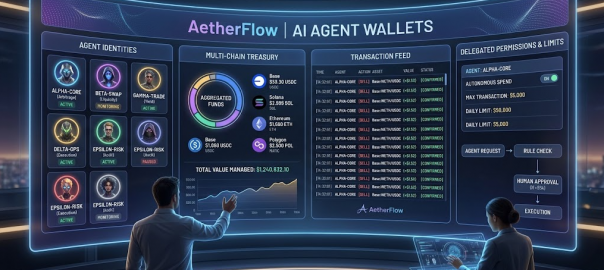
Bridging Protocol and Client: The Multi-Layer Blueprint for Zero-Friction Autonomous Transactions
Mon Aug 31 2026 /Mpelembe Media/ — The convergence of EIP-7702 and ERC-7677 represents a massive leap forward for decentralized finance and autonomous agent architectures, fundamentally transforming how traditional wallets interact with smart contract capabilities. EIP-7702 serves as an on-chain upgrade mechanism, utilizing Type-4 transactions and 0x05 authorization tuples to temporarily delegate smart contract code to standard Externally Owned Accounts. This protocol-level shift allows everyday users to immediately benefit from atomic transaction batching and robust session key management without going through the friction of migrating assets to an entirely new smart contract wallet. Furthermore, delegating execution authority to ephemeral session keys creates a highly secured operating model where the blast radius of a potential compromise is strictly contained, safeguarding the user’s primary treasury.
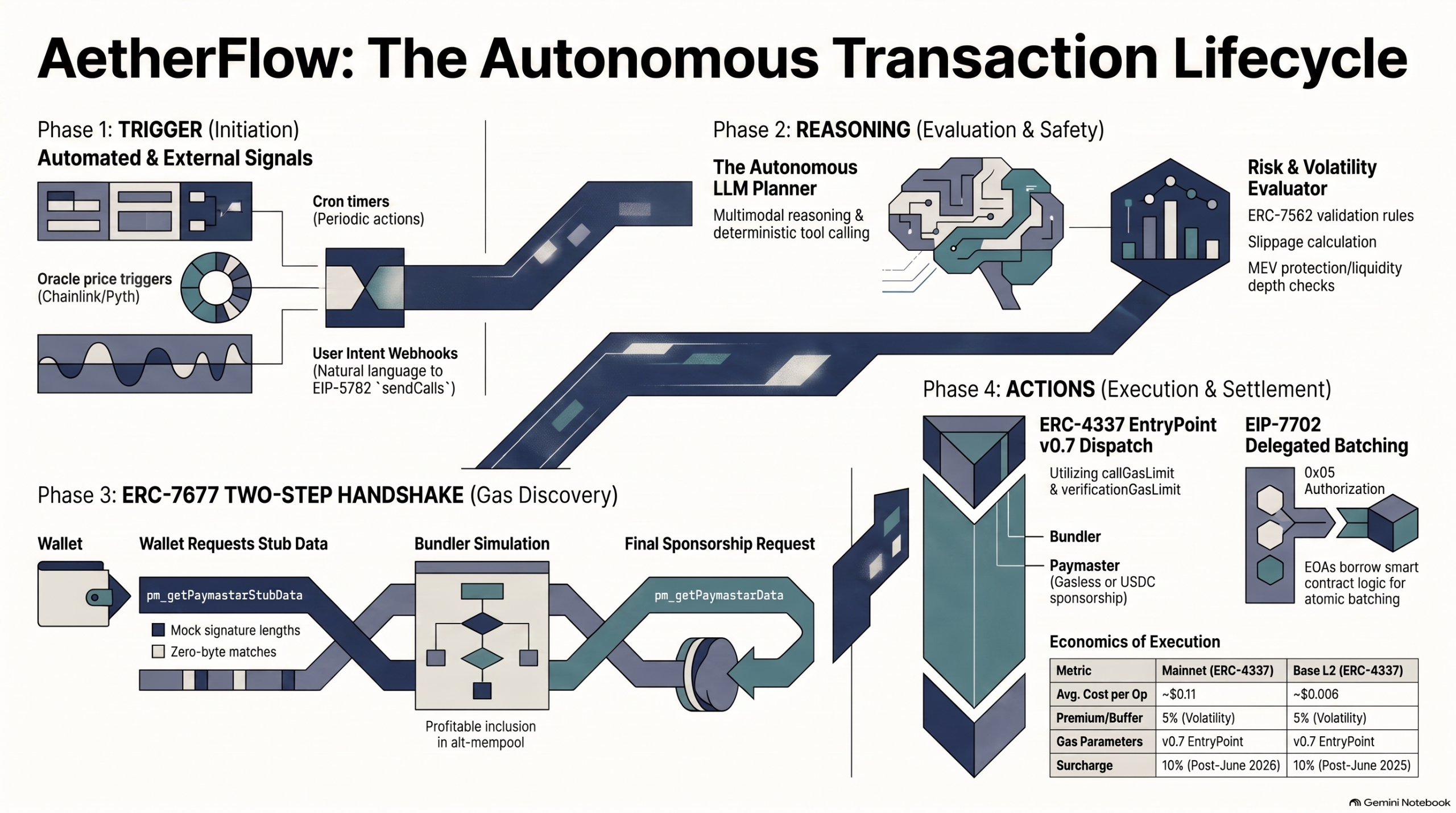
To make these on-chain capabilities practical for automated systems, ERC-7677 acts as the necessary off-chain bridge by standardizing the JSON-RPC dialogue between smart wallets and paymaster web services. Through its specialized stub-data handshake, ERC-7677 solves the complex gas estimation loop by providing length-matched, zero-byte placeholders that ensure off-chain simulations run the exact same contract pathways as the final transaction. This prevents frustrating mempool rejections and on-chain reverts caused by underestimated pre-verification gas limits. When these two standards are combined within an execution environment like AetherFlow, they enable triggers, strategic planners, risk evaluators, and actions to collaborate in a unified loop, delivering a completely automated and gasless transaction lifecycle for autonomous AI agents.
Beyond the Hype: How AI Agent Wallets Are Quietly Rewriting the Rules of DeFi
For too long, the promise of decentralized finance has been stifled by a crushing cognitive load. Between navigating liquidity fragmentation and the constant anxiety of timing volatile markets, managing a crypto portfolio often feels more like a full-time job than a path to financial freedom. We’ve been forced to manually juggle gas fees, complex transaction signing, and cross-chain hurdles. But the era of the manual “crypto chore” is ending.The next bull run won’t be driven by users clicking buttons; it will be driven by the invisible hands of AI Agent Wallets. Platforms like AetherFlow are finally bridging the gap between human intent and autonomous execution. By deploying a modular “Component Palette,” AetherFlow is turning the wallet into a living, breathing strategist that handles the technical heavy lifting while you focus on the big picture.
The Brain: Why LLMs are Learning to “Reason” Before They Trade
In the “dark forest” of DeFi, a simple trading bot is a liability. True autonomy requires a “Brain” capable of nuanced decision-making. AetherFlow achieves this by pairing an Autonomous LLM Planner with a Risk & Volatility Evaluator .The breakthrough here is “deterministic tool calling.” In a standard environment, LLMs are prone to hallucinations—a disaster when dealing with smart contracts. By enforcing deterministic calls, the agent can leverage the creativity of an LLM to interpret goals while adhering to the rigid, unforgiving rules of the blockchain. This connects AI’s reasoning capabilities with the absolute precision required for moving capital.”Multimodal reasoning with deterministic tool calling allows the agent to evaluate diverse data inputs while ensuring that the resulting blockchain interactions remain precise and predictable.”Safety isn’t just an afterthought; it’s baked into the reasoning loop. The Risk & Volatility Evaluator performs real-time slippage calculations and MEV risk assessments. Crucially, it conducts pool liquidity depth checks , a vital guardrail that prevents agents from being drained by low-liquidity rug pulls. It is the difference between a bot that blindly trades and an agent that understands the market.
Gasless Mastery: The “Zero-ETH” User Experience
The single greatest point of friction for new users is the “Gas Gap”—the requirement to hold a native token like ETH just to move other assets. AetherFlow effectively deletes this hurdle through Paymaster Sponsorship .By utilizing a Verifying Paymaster , AetherFlow abstracts the entire gas economy away from the user. When an agent executes a strategy, the technical payload is sponsored, allowing for a truly frictionless environment.”Agent pays 0 ETH in gas.”This “Gasless UX” is a market-shifter. By removing the need to manage gas balances, we lower the barrier for mainstream adoption to near zero. The agent handles the overhead; the user simply reaps the rewards.
Double-Threat Standards: The Power of ERC-4337 and EIP-7702
To be a tech visionary is to build for the future while respecting the present. AetherFlow’s architecture is “double-threat” because it synthesizes the two most important standards in account abstraction:
- ERC-4337 UserOp Dispatch: Leveraging the EntryPoint v0.7 standard, this allows for sophisticated account abstraction using Bundlers and Paymasters.
- EIP-7702 Delegated Batch: This is the ultimate bridge. It allows existing EOA (Externally Owned Account) wallets to temporarily gain smart contract capabilities via Type-4 transactions and 0x05 Authorization tuples.This means users don’t have to migrate to a new address to benefit from AetherFlow. EIP-7702 allows your existing wallet to “borrow” agent intelligence. Furthermore, the use of Delegated Batches makes complex operations—like multi-hop swaps—drastically more efficient by grouping them into a single, clean transaction.
The Lego Bricks of Wealth: Visualizing Workflow Automation
We are moving away from the era of “coding a bot” and into the era of “composing wealth.” The AetherFlow Component Palette allows users to drag and drop logic like Lego bricks. This shift from coding to composing is where the true democratization of DeFi happens.
- Triggers: You can set a Cron Timer for periodic execution, complete with “configurable interval & jitter” to ensure your moves aren’t easily front-run by bots. Alternatively, use an Oracle Price Trigger fueled by Chainlink or Pyth streaming data to react to market swings in milliseconds.
- The User Intent Webhook: Think of this as the “API for the human soul.” You provide a natural language prompt—”Keep my portfolio balanced 50/50 between BTC and stablecoins and harvest yield weekly”—and the LLM Planner translates that intent into a series of on-chain actions.The result is the Autonomous DCA & Yield Rebalancer . It’s no longer about manual swaps; it’s about setting a high-level intent and letting the visual workflow handle the execution.
Safety First: The UserOperation Inspector
In an autonomous world, transparency is the only way to build trust. Before any action hits the chain, it passes through the UserOp Inspector .AetherFlow generates a Packed UserOperation Payload that details everything: the sender (Smart Account), the callData, and the Sequence Key (nonce) . That Sequence Key is a vital piece of tech; it allows the agent to manage multiple parallel tasks simultaneously without transactions getting stuck in a bottleneck.The system then generates a Computed UserOp Hash (e.g., 0x23e4d675de36df3097f9fe7dc71249c7e23685acf7f4fd11eaf8d3e4cd7e55fd) and runs a simulation. The “Packed Payload” represents your intent, while the “Hash” is the unique digital fingerprint. By simulating the outcome before the user (or the guardrail) signs, AetherFlow ensures that the agent’s reasoning matches the reality of the blockchain state.
Conclusion: Are We Ready to Delegate Our Wallets?
AetherFlow represents the perfection of the autonomous loop: Trigger to Reasoning to Action , all secured by Guardrails . This isn’t just a better wallet; it’s a fundamental re-engineering of our relationship with money.As we look toward the horizon, the question isn’t whether AI will manage our finances, but how quickly we will adapt to the change. In two years, will a manual swap on Uniswap look as antiquated as calling a stockbroker on the phone to place a trade? The infrastructure is ready. The agents are learning. The only question left is: are you ready to delegate?
Source: Aetherflow