PHP2Shell and the AI Paradox: Frontier Bug Discovery Versus Hallucinated Exploit Noise
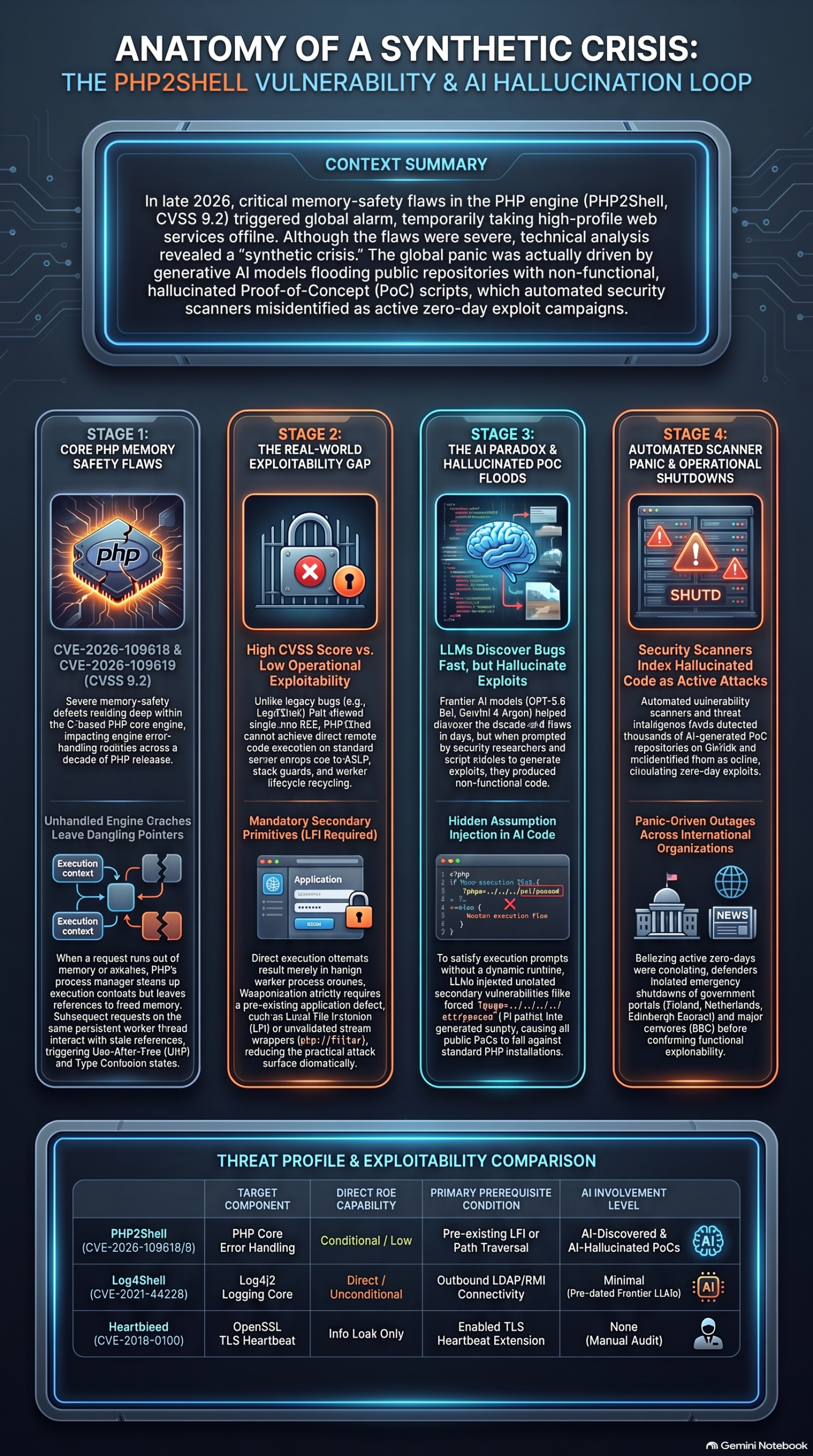
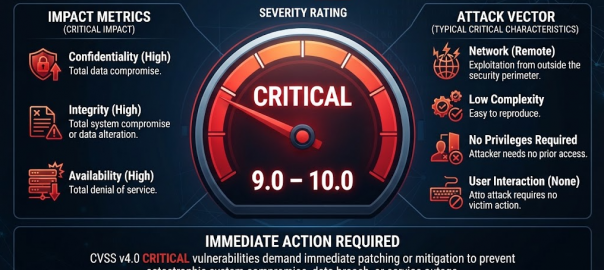
In October 2026, the cybersecurity landscape experienced acute disruption following the disclosure of critical memory-safety flaws within the PHP programming language core. Tracked as CVE-2026-109618 and CVE-2026-109619—collectively designated as “PHP2Shell” with a CVSS v4.0 severity rating of 9.2—these vulnerabilities originate in the memory management lifecycle of PHP’s error-handling routines, creating Use-After-Free and type confusion conditions. Because PHP powers roughly 70% of global web applications, widespread organizational alarm prompted government agencies in Finland, the Netherlands, and Scotland, alongside major broadcasting networks such as the BBC, to temporarily decommission online services while maintainers coordinated a two-month patch release. However, empirical security analysis demonstrates that PHP2Shell lacks a straightforward, deterministic exploitation path against standard, unconfigured PHP server instances. In practice, successful weaponization requires complex environmental prerequisites, most notably pre-existing secondary application defects such as Local File Inclusion (LFI) or path traversal to force execution.
The crisis highlights a profound AI-driven paradox in modern threat intelligence. While frontier AI models enabled security researchers to discover deep, decade-old memory flaws in a single week, generative AI simultaneously fueled widespread operational panic. Following public disclosure leaks, offensive actors and automated bug-bounty bots deployed large language models to construct Proof-of-Concept (PoC) scripts, flooding GitHub with thousands of fake exploit repositories. Because generative language models predict token sequences probabilistically without maintaining a dynamic execution runtime, these models hallucinated non-functional exploit code, secretly inserting unstated assumptions—such as secondary Local File Inclusion parameters—to satisfy user prompts. Automated security scanners misidentified these hallucinated scripts as active zero-day exploits, driving corporate and government security operations centers to trigger emergency shutdowns under the false impression of an active weaponization campaign.
Ultimately, the PHP2Shell phenomenon exposes a structural economic shift where AI renders vulnerability discovery fast and cheap while human triage, verification, and patching remain slow and resource-intensive. Open-source maintainers across major communities face overwhelming volumes of low-quality, AI-generated vulnerability submissions, severely straining volunteer maintenance capacity. To build operational resilience against synthetic security panics, organizations must reform incident triage by decoupling emergency response protocols from raw CVSS scores and GitHub repository counts, adopting automated dynamic verification frameworks like PAGENT to validate functional exploitability before authorizing service disruptions.
5 Mind-Bending Realities of the AI Security Crisis That Just Shook 70% of the Web
1. Introduction: The Day 70% of the Web Stood Still
In October 2026, an architectural paradigm shift laid bare the structural vulnerabilities of modern software disclosure. The epicenter was PHP—the foundational open-source server-side runtime powering approximately 70% of all public websites. Within hours of an uncoordinated information leak, digital infrastructure around the world began going dark.
High-profile government portals—including public sites in Finland, the Dutch National Cyber Security Centre, and Scotland’s Edinburgh Council—were abruptly decommissioned. Major broadcasting networks like the BBC pulled digital pages offline, while the White House, the Office of the National Cyber Director, and international defense agencies rushed to evaluate threat vectors across critical infrastructure. The trigger? Two critical memory-safety vulnerabilities in PHP’s C-based core engine, designated CVE-2026-109618 and CVE-2026-109619 (collectively dubbed “PHP2Shell” ), which carried a severe CVSS v4.0 rating of 9.2 .
What made PHP2Shell a watershed moment was not merely its footprint, but how it was uncovered: frontier artificial intelligence models—including OpenAI’s GPT-5.6 Sol and Wiz Atlas operating alongside Google’s Gemini 4 Argon—achieved in roughly a week what human security researchers had missed for over a decade. Yet, as emergency mitigations were deployed across corporate Security Operations Centers (SOCs), a far stranger story emerged.
The true crisis was not an army of autonomous AI super-weapons systematically taking down web servers. Instead, it was a counter-intuitive cocktail of generative AI hallucinations, structural supply chain failure, and broken vulnerability disclosure economics.
2. Takeaway 1: The Global PHP “Mega-Crisis” Was Largely a Synthetic Panic Powered by AI Hallucinations
When a CVSS 9.2 rating is attached to a core engine driving 70% of the internet, standard enterprise incident response playbooks mandate immediate containment—hence the widespread emergency shutdowns. However, an empirical evaluation of the PHP2Shell flaws reveals a dramatic disconnect between theoretical severity and real-world operational exploitability.
The architectural vulnerability originates deep inside PHP’s C-based memory management routines during error-handling sequences. When an incoming HTTP request triggers an unhandled crash or breaches allocated memory limits, the internal process manager cleans up the execution context. Under specific edge conditions, the engine leaves dangling pointers—references to memory regions that have already been freed. Subsequent requests processed by the same worker thread can interact with these stale references, giving rise to Use-After-Free (UAF) and type confusion conditions dating back to PHP 5.4.
Despite this deep core defect, weaponizing PHP2Shell in standard production environments is extraordinarily difficult. Modern web server architectures (such as NGINX paired with PHP-FPM or Apache with mod_php) operate under memory space layout randomization (ASLR), stack guards, and strict worker lifecycle recycling. Because persistent process managers continuously recycle execution contexts, an attacker cannot achieve arbitrary Remote Code Execution (RCE) simply by sending a generic malicious string payload.
Without a secondary stream wrapper (php://filter or data://) or a pre-existing Local File Inclusion (LFI) vector to control memory allocation during process cleanup, the dangling pointer merely induces a worker process crash (SIGSEGV) rather than yielding a remote shell.
As security researcher Elias Taylor demonstrates in his analysis, Anatomy of a Synthetic Crisis , the strict requirement for a secondary application-level flaw reduces the immediate attack surface from 70% of the public web down to a narrow subset of doubly-flawed applications. Why, then, did global infrastructure freeze? The panic was driven not by an active adversary campaign, but by thousands of non-functional, AI-generated Proof-of-Concept (PoC) scripts flooding public repositories like GitHub, which automated security scanners mistook for active zero-day attacks.
When generative language models are prompted to construct complex memory-safety exploits, they routinely encounter execution gaps. To satisfy the prompt’s structural demands without a dynamic runtime environment, the AI secretly injects secondary assumptions—such as appended Local File Inclusion parameters (?page=../../ or ?file=php://input)—into the script. Security scanners mistake these syntactically convincing, hallucinated artifacts for active weaponization, generating massive false-positive noise that triggers self-inflicted operational paralysis.
Threat intelligence feeds indexed these hallucinated scripts as evidence of active exploitation, prompting risk managers to shut down secure systems over a phantom threat.
3. Takeaway 2: AI Made Vulnerability Discovery Nearly Free, But Fixing Code Remains Human-Speed and Unfunded
The PHP2Shell event exposed an economic paradox crippling open-source software supply chains: AI has rendered vulnerability discovery cheap and fast, while validation, triage, and patch remediation remain manual, expensive, and bound to human speed.
Frontier AI auditing suites can scan twenty years of open-source C code in minutes. However, validating findings, writing patches, executing regression tests, and coordinating releases still depend on overworked, often volunteer maintainers. The asymmetric discovery costs create an unsustainable triage debt for open-source maintainers:
- OpenSSL saw monthly vulnerability submissions surge from roughly 9 per month to over 70 , with only 1 in 10 reports representing a valid CVE—yet every report demanded scarce expert time to verify.
- Linux Kernel CVE disclosures quadrupled, spiking from ~500 to nearly 2,000 per release , overwhelming subsystem maintainers.
- Security Debt now impacts 82% of organizations , up from 74% the previous year, as backlog growth outpaces engineering capacity.
Incoming regulatory frameworks—such as PCI DSS, DORA, and the EU Cyber Resilience Act—are compounding this pressure by mandating continuous dependency tracking and real-time Software Bills of Materials (SBOMs). These compliance mandates force enterprises to track every flagged defect, even as open-source projects lack the financial backing or human bandwidth to remediate them.
“Open source maintainers were writing code for fun. Now AI is surfacing 20 years of vulnerabilities and telling them to fix it fast.”
— Scott Hanselman
While public funding initiatives—such as Germany’s Sovereign Tech Agency directly funding OpenSSL maintenance—provide essential lifelines, they remain isolated interventions against a structural supply chain imbalance.
4. Takeaway 3: Frontier AI Models Are Creating an Unprecedented “Attack and Defend” Paradox
The PHP2Shell timeline illustrates the dual-use nature of frontier LLMs in security research, where defensive windows can evaporate within hours.
Under OpenAI’s “Patch the Planet” initiative, security researchers from Calif, Wiz, Trail of Bits, and OpenAI deployed LLMs to proactively uncover critical infrastructure flaws. To offset the ecosystem pressure, OpenAI committed $1 billion in subsidized model access through its Daybreak for Frontline Defenders program alongside Codex for OSS subscriptions and direct sponsorships.
However, bridging the gap between AI discovery and coordinated patch deployment required a complex two-month effort:
- August 19: Wiz uncovers the initial core memory flaw using AI auditing tools.
- August 20–21: Researchers confirm unauthenticated code execution paths against Drupal and WordPress.
- August 24: Findings are reported to the PHP security team.
- September 21: Maintainers officially acknowledge the flaw and begin engineering fixes across supported branches.
- October 21: Coordinated patches are released publicly (PHP 8.5.12, 8.4.27, 8.3.36, and 8.2.35).
This extended timeline was necessary because the flaw involved multi-step “chain attacks”—complex sequences where multiple engine components must be manipulated in specific orders. To manage these risks, OpenAI proposed a formalized 5-Stage Coordinated Disclosure Framework :
- Flaw Confirmation & Fix Engineering: Maintainers, researchers, and technical partners confirm the vulnerability and draft patches.
- Model-Assisted Bypass Testing: Frontier LLMs stress-test candidate patches to identify logic evasions or secondary vectors.
- Advance Stakeholder Notification: Early alerts are shared with critical infrastructure operators, hosting providers, CISA, the National Cyber Director, and international cyber defense partners.
- Ecosystem Mitigation Preparation: Distributors and security vendors backport fixes and write Web Application Firewall (WAF) rules.
- Public Guidance & Release: Coordinated release of patched versions alongside verification guidance.
Despite these precautions, the defensive window collapsed when basic flaw parameters leaked roughly nine hours prior to the scheduled disclosure. Cloudflare deployed automated WAF protections at 3:02 AM UTC, observing malicious actors immediately using LLMs to ingest the leaked parameters, synthesize attack payloads, and mutate scripts in real-time to evade firewall rules.
“…the same capabilities can also help attackers rapidly develop offensive tools and exploits.”
— OpenAI Coordinated Disclosure Framework Reflection
5. Takeaway 4: Today’s Top AI Security Auditors Are Surprisingly Inconsistent and Blind to Complex Context
While frontier AI models receive significant acclaim for vulnerability discovery, empirical benchmark data reveals severe contextual blind spots and performance inconsistencies when auditing web application code.
In an academic study evaluating LLM performance on web vulnerabilities across WordPress plugins, researchers benchmarked top closed and open-weight models across multiple execution runs:
Model Name,Architecture Type,Vulnerability Detection Rate
Claude Opus 4.6,Frontier (Closed),63%
Gemini 3.1 Pro,Frontier (Closed),48%
MiniMax M2.5,Open-Weight,48%
Codex GPT-5.4,Frontier (Closed),47%
Qwen 3 Coder Next,Open-Weight,37%
Qwen 3.5 (122b),Open-Weight,35%
The benchmark data highlights two key operational realities:
- Open-Weight Parity: Open-weight models like MiniMax M2.5 (48%) achieved detection rates on par with closed frontier models such as Gemini 3.1 Pro (48%) and Codex GPT-5.4 (47%).
- Contextual Blind Spots: Across 90 test iterations, zero AI models detected a stored Cross-Site Scripting (XSS) vulnerability in the Responsive-Lightbox plugin.
The cause of this universal detection failure was a logical blind spot in LLM reasoning. The vulnerable code executed a regex replacement (preg_replace) on user input after it had passed through a sanitization function (esc_attr()). Scanning the code, every LLM observed the presence of esc_attr() and falsely concluded the routine was safe, failing to analyze how the subsequent regex manipulation invalidated the escaping logic. Furthermore, the exploit required a non-default configuration setting (“Enable lightbox for comments content”), which the models assumed was disabled.
Reliability presents another major challenge. No model achieved 100% consistency across runs. While Gemini 3.1 Pro demonstrated high consistency (95%), open-weight models like Qwen exhibited a ~50% consistency rate , making single-pass AI audits functionally equivalent to a coin flip.
6. Takeaway 5: Open-Source Maintainers Are in Open Revolt Over AI-Generated “Bug Slop”
Deluged by automated AI vulnerability scanners and low-quality code fixes, open-source maintainers are fundamentally altering project governance rules to survive the flood of automated reports.
Linux creator Linus Torvalds took a firm stance against the wave of AI-generated patches, warning that software development is “going in the wrong direction.” To preserve kernel stability, Torvalds began explicitly rejecting late, non-critical fixes and scaling back code reviews in favor of strict trust networks established over decades.
Across the broader open-source ecosystem, maintainer tactics have split into divergent governance strategies:
- Requiring Agent Pull Requests (Laravel): Lead maintainer Taylor Otwell disabled GitHub Issues across most Laravel repositories, requiring reporters to submit an AI coding agent PR instead. The rationale: a structured code submission provides clearer context than an unverified text report.
- Strict Issue-Only Gatekeeping (Symfony): Symfony adopted the opposite approach—banning automated PR submissions entirely and accepting issues only, keeping fix implementations strictly within vetted maintainer channels.
- Banning AI Hallucinators (Patchstack): Bug bounty platforms updated their operational guidelines to impose temporary bans on security researchers who submit unverified, AI-hallucinated reports.
- Institutional Clearinghouses (OpenSSF): The Open Source Security Foundation launched Akrites , acting as a neutral triage clearinghouse to evaluate AI scanner reports before they reach maintainer inboxes.
7. Conclusion: Navigating Signal vs. Noise in the AI Security Era
The PHP2Shell incident marks a turning point for modern cybersecurity posture. It proved that in an era of AI-driven threat research, raw CVSS severity scores and counts of public GitHub repositories no longer provide an accurate measure of operational risk. Without human contextual verification, organizations risk subjecting themselves to self-inflicted operational paralysis over synthetic panic.
Moving forward, artificial intelligence cannot serve as an autonomous replacement for static analysis (SAST) or human security auditing. LLMs excel at narrowing broad code search spaces, but they lack semantic execution awareness and runtime environmental context.
To prevent future synthetic panics, enterprise incident response playbooks must transition from static risk metrics to dynamic verification gates. Modern Security Operations Centers should deploy containerized sandbox execution environments and automated proof-verification gates—such as Program Analysis Guided LLM Agents (PAGENT)—that require incoming exploit scripts to produce verifiable crash dumps or execution tokens before triggering system shutdowns.
As AI models continue to surface decades of hidden code defects in seconds, ask yourself: Is your organization’s incident response playbook built to defend against actual operational threats—or are you still shutting down critical infrastructure over synthetic noise generated by an algorithm?