
Investing in the Lusaka Securities Exchange: Comparative Pathways, Settlement Mechanics, and Treaty Tax Relief for UK Residents
Sat Oct. 24, 2026 /Mpelembe Media/ — The Lusaka Securities Exchange (LuSE) operates under the regulatory supervision of the Securities and Exchange Commission (SEC) of Zambia pursuant to the Securities Act No. 41 of 2016, providing a centralized capital market with an equity market capitalization of approximately USD 2.30 billion. To prevent off-market fragmentation, Zambian law mandates that all public companies with 50 or more shareholders must register with the SEC and trade exclusively on a recognized stock exchange, effectively prohibiting Over-The-Counter (OTC) equity markets. The exchange functions across a two-tier market structure comprising the Main Board (Official List) for established public enterprises and the Quoted Tier for growth-phase entities. Zambia maintains a fully liberalized foreign exchange regime with no exchange controls, permitting up to 100% foreign ownership in private and listed assets—with narrow statutory exceptions, such as domestic cellular network operators required to float 10% of their shares on the exchange—and guaranteeing the repatriation of investment capital, dividends, and profits through the Bank of Zambia.
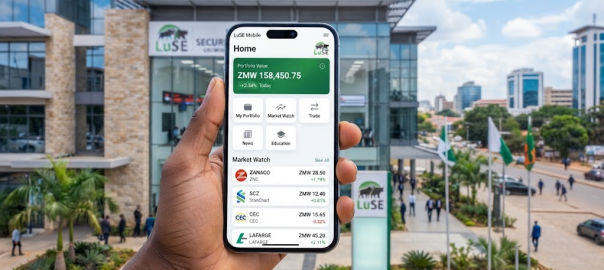
United Kingdom resident investors seeking exposure to Zambian equities select an access vector based on their capital scale, administrative tolerance, and desired custodial relationship. Cross-border multi-market FinTech platforms such as mystocks.africa offer a USD/GBP digital dashboard allowing UK allocators to invest across African exchanges without establishing a local Zambian bank account or direct local brokerage relationship. Alternatively, direct brokerage onboarding with licensed Zambian stockbrokers—such as Stockbrokers Zambia Limited (SBZ) or Pangaea Securities Limited—grants direct legal title recorded in the client’s name at the Central Share Depository (CSD), supported by SWIFT wire funding. While the official LuSE Mobile App provides direct order routing to local brokers, its reliance on domestic mobile money payment channels and local Zambian identification formats creates operational hurdles for non-resident foreign investors.
Establishing a direct account with a Zambian stockbroker involves a structured Know Your Customer (KYC) onboarding process requiring a certified copy of a valid international passport, proof of UK residence dated within three months, bank details, and in select cases professional reference letters. Secondary market equity orders settle on a rolling T+3 settlement cycle under a strict Delivery versus Payment (DvP) protocol, ensuring that funds transfer and share allocation occur simultaneously. Because ownership records are held at the beneficial-owner level directly within the dematerialized CSD registry, investor holdings remain legally protected in the event of an intermediary broker’s insolvency.
Executing secondary market equity transactions on the LuSE incurs both statutory regulatory levies and commercial broker commissions. Combined statutory regulatory fees represent an aggregate fixed charge of 0.500% per trade side, consisting of the 0.125% SEC fee, the 0.250% LuSE operating fee, and the 0.125% CSD clearing fee. Commercial stockbroker commissions are negotiable, indicatively ranging between 1.00% and 1.50% per trade side. While Stockbrokers Zambia assesses zero account opening fees, Pangaea Securities charges an initial account registration fee of ZMW 400.00 alongside a minimum order requirement of ZMW 1,000.00. Overseas allocators remitting funds directly from the UK must also factor in international SWIFT transfer charges and commercial bank foreign exchange conversion spreads.
Zambia maintains a tax policy designed to attract international portfolio flows, imposing 0.00% Capital Gains Tax and 0.00% Property Transfer Tax on exchange-listed equity transactions. Under Section 81 of the Zambian Income Tax Act, dividend distributions paid by LuSE-listed companies to individual shareholders (natural living persons) are subject to a 0.00% Withholding Tax rate, applying universally regardless of tax residency. Dividend payments to UK corporate entities incur standard non-resident withholding tax of 20%, which is capped under Article 10 of the UK-Zambia Double Taxation Agreement at 15.00% for corporate portfolio holdings under 10% voting control and 5.00% for direct corporate investments controlling 10% or more of voting power. While UK individual investors report global dividend income to HMRC without a Zambian foreign tax credit offset because local source tax is zero, UK corporate entities can claim Foreign Tax Credit Relief up to treaty limits against UK Corporation Tax liabilities.
6 Counter-Intuitive Truths About Zambia’s Tax and Financial Architecture You Need to Know
For foreign investors and global business leaders searching for yield in emerging markets, frontier expansion often feels like navigating a legal minefield. Too many capital allocators get tripped up by hidden regulatory traps, administrative friction, and deeply misunderstood tax regimes.
Zambia stands out as one of Africa’s most dynamic frontier destinations, boasting a fully liberalized foreign exchange regime and strong statutory capital protections. However, beneath its market-friendly surface lies a tax and legal architecture with surprising rules that flip standard market assumptions on their head.
Whether you are deploying portfolio capital into listed equities or structuring cross-border corporate operations, here are six counter-intuitive truths about Zambia’s financial structure you cannot afford to ignore.
1. Individual Investors Pay 0% Tax on Listed Stock Dividends and Capital Gains
Standard market logic dictates that non-resident foreign investors face heavier tax burdens than domestic participants. In Zambia, while non-resident corporate entities face a standard 20% Withholding Tax (WHT) on corporate dividends, individual investors enjoy a statutory tax haven hidden in plain sight.
Under Section 81 of the Zambian Income Tax Act, dividend distributions paid by companies listed on the Lusaka Securities Exchange (LuSE) to individual shareholders—defined as natural living persons—are subject to a 0% Withholding Tax rate . Crucially, this exemption applies universally regardless of the individual shareholder’s tax residency.
“Section 81 of the Zambian Income Tax Act grants a 0% Withholding Tax rate on dividend distributions paid by companies listed on the Lusaka Securities Exchange to individual shareholders (natural living persons), irrespective of whether the individual is a resident or non-resident.”
Furthermore, Zambia imposes 0% Capital Gains Tax (CGT) , and Property Transfer Tax (PTT) on listed share sales is 0% , compared to 8% for unlisted private shares. By contrast, indirect transfers of shares in non-resident holding companies owning 10% or more of a Zambian entity trigger an 8% PTT on the effective shareholding value, though recent statutory amendments grant full relief for group reorganisations where the entity relationship has been maintained for at least three consecutive years.
This individual exemption creates a stark structural contrast against corporate investment vehicles. Under the UK-Zambia Double Taxation Agreement, a UK corporate entity pays a treaty-capped WHT of 15% on portfolio dividends, or 5% if it directly or indirectly controls at least 10% of the voting power.
As a result, global High-Net-Worth Individuals (HNWIs) and retail investors hold a massive tax advantage over institutional corporate wrappers when deploying capital into dividend-yielding LuSE equities like Copperbelt Energy Corporation (CEC) or Zambian Breweries.
2. In Brokerage Agreements, “Delivered” Doesn’t Mean “Received”
In the era of modern digital trading, international investors expect real-time support, clear notifications, and proactive customer care from their brokers. However, standard legal frameworks governing Zambian brokerage accounts place 100% of operational and monitoring risks squarely on the investor.
Consider the standard Cash Trading Account Agreement from Pangaea Securities, a leading Lusaka stockbroker. Under Section 20 (Notification) , any communication sent by the broker via email or fax to the address on file is legally considered “delivered to you personally whether or not you actually receive it.”
Even more striking is Section 9 (Terms of Securities) , governing corporate actions on expiring instruments like warrants, subscription rights, or convertible bonds. The contract grants brokers the discretionary right to sell expiring securities without client instructions to preserve value—and charge full brokerage commissions—yet explicitly imposes zero legal obligation on the broker to act or notify the client if the instrument expires completely worthless.
Note: Although we may take the actions described above, we are not obligated to do so or to notify you of impending expiration or redemption dates.
This legal fine print completely flips modern digital service expectations. It forces cross-border investors to maintain disciplined personal oversight, as a missed email notification or expired corporate action cannot be legally blamed on the brokerage.
3. You Cannot Trade OTC: The 50-Shareholder Mandate
In many global capital markets, over-the-counter (OTC) trading offers a flexible, private mechanism for exchanging equity outside formal stock exchanges. In Zambia, attempting to trade public equity OTC is statutorily illegal.
Under the Securities Act and market regulations enforced by the Securities and Exchange Commission (SEC) of Zambia, any public company with 50 or more shareholders is legally mandated to trade its securities on a recognized, licensed exchange, such as the LuSE Main Board or Quoted Tier. Off-market OTC equity trading for these entities is strictly prohibited.
Far from restricting trade, this mandate safeguards market integrity. By forcing all public equity transactions onto a unified venue, the law eliminates off-market fragmentation and consolidates order-driven liquidity.
The result is guaranteed, uniform price discovery. Minority retail investors trade on the exact same transparent market terms as multi-billion-dollar institutions.
4. Making Zero Profit? You Still Owe the Government 1% of Your Turnover
A foundational tenet of corporate taxation is that income tax is levied on net profits, not gross revenue. Under Zambia’s standard corporate tax regime, incorporated businesses pay a 30% Corporate Income Tax (CIT) rate on net accounting profits.
However, Section 14A of the Income Tax Act (introduced via the Income Tax Amendment Act No. 10 of 2025) disrupts this assumption by establishing a Minimum Alternative Tax (MAT) . This provision imposes a flat 1% tax on total annual turnover for companies and partnerships reporting minimal profits or tax losses.
To preserve equity, the law incorporates a credit mechanism allowing MAT payments to be offset against future normal corporate income tax liabilities when the business returns to profitability, preventing double taxation.
Tax Framework,Taxable Base,Applicable Rate & Trigger
Standard Corporate Income Tax (CIT),Net Accounting Profits,30% standard rate on net taxable income
Minimum Alternative Tax (MAT),Total Gross Turnover,1% flat rate when reporting losses or minimal profits
Voluntary Disclosure (Section 91A),Unreported Tax Errors,100% penalty waiver for self-reporting prior to audit
While MAT aggressively seals tax leaks at top-line revenue, the tax code balances this enforcement with Section 91A . This provision incentivizes cooperative compliance by waiving 100% of penalties for taxpayers who voluntarily disclose omissions, errors, or mistakes before they are uncovered through a Zambia Revenue Authority (ZRA) audit or investigation.
5. Sending Capital Abroad? Lack of Tax Clearance Costs You 15% Upfront
Zambia maintains a fully liberalized foreign exchange regime with no exchange controls and guarantees unencumbered capital repatriation. However, remitting capital abroad without administrative preparation triggers swift financial penalties.
The government enforces a 15% Advance Income Tax on foreign currency remittances and exports exceeding USD 2,000 (or its equivalent) executed without a valid Tax Clearance Certificate (TCC). This levy functions as an immediate withholding tax deducted at the transactional point of payment.
This remittance penalty reflects a broader ZRA strategy to eliminate informal economic leakages through regulatory choke-points. A Taxpayer Identification Number (TPIN) is now mandatory for opening accounts with water utilities, mobile network operators, ISPs, NHIMA, and NAPSA, as well as registering title deeds with local authorities and renewing professional memberships.
Furthermore, obtaining any government license or commercial bank financing requires a valid Tax Clearance Certificate. Combined with the mandatory Smart Invoice system required for all sales and input VAT claims, Zambia effectively enforces tax compliance at every financial clearing gate before capital can leave the country.
6. Why the Official Exchange App Might Block Foreign Capital
To digitize retail stock trading, the Lusaka Securities Exchange introduced the LuSE Mobile App (developed in partnership with Escrow Systems). The application offers direct order routing, live market depth, and instant execution from smartphones.
However, non-resident foreign investors trying to use the native app encounter severe operational friction. The onboarding interface enforces domestic Zambian National Registration Card (NRC) logic, local phone number formatting, and cash clearing tied strictly to Zambian Mobile Money (Airtel/MTN) or local ZMW bank accounts.
To deploy capital efficiently, non-resident foreign investors must bypass the native mobile app and choose an access channel tailored to cross-border mechanics:
Channel Parameter,LuSE Mobile App Channel,Direct Stockbroker SWIFT Channel
Target Audience,Domestic Zambian retail investors,Foreign HNWIs and institutional allocators
Funding Currency,Zambian Kwacha (ZMW via Mobile Money/Local Bank),Foreign Currency (USD or ZMW via SWIFT Wire)
CSD Legal Ownership,Direct CSD sub-account via sponsor broker,Direct beneficial title registered at CSD
Settlement Protocol,Local mobile money / bank clearing,T+3 rolling settlement via DvP protocol
Non-Resident Friction,High (Blocked by NRC and local phone logic),Low to Moderate (Standard non-resident KYC)
Establishing a direct relationship with licensed stockbrokers (such as Stockbrokers Zambia or Pangaea Securities) enables wire transfers into segregated client accounts and direct beneficial registration at the Central Share Depository (CSD). Under this Delivery versus Payment (DvP) protocol on a T+3 settlement cycle, legal share title is registered directly in the investor’s name, insulating capital against broker insolvency. Alternatively, investors can leverage multi-market FinTech platforms (like mystocks.africa) for automated foreign exchange routing.
Final Thoughts: Navigating Frontier Precision
Zambia offers one of Africa’s most compelling frontier investment environments, combining a fully liberalized foreign exchange framework, 0% capital gains tax, and a statutory 0% dividend withholding tax for individual equity investors. However, unlocking these advantages requires moving beyond superficial assumptions and mastering the precise legal mechanics governing the market.
From turnover-based alternative taxes and automated remittance penalties to stringent brokerage notification clauses, operational precision is essential. As Zambia continues to refine its financial architecture, how will you adapt your cross-border investment and tax structuring strategies to capitalize on these unique structural edge cases?