
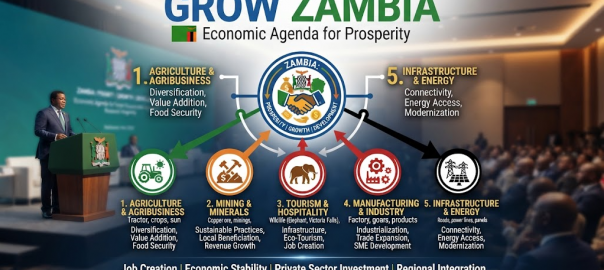
Unlocking Zambia’s Potential: Driving Job Creation and Private Sector Investment Across 5 Key Sectors
The “Grow Zambia: Economic Agenda for Prosperity” outlines an integrated national framework focused on fostering long-term prosperity, economic growth, and sustainable development across Zambia. Rather than depending solely on raw resource extraction, the agenda prioritizes structural economic transformation through sectoral diversification, local value addition, industrialization, and modern infrastructure expansion. Underpinned by foundational commitments to job creation, economic stability, private sector investment, and regional integration, the blueprint coordinates five strategic economic drivers designed to build a resilient and self-sustaining economy
Blueprint for Prosperity: 5 Key Pillars Driving Zambia’s Economic Future
1. Introduction: The Agenda for Growth
Have you ever wondered what it takes for an emerging economy to unlock its next phase of exponential growth? Across developing markets, the transition from raw resource extraction to modern, resilient industrial ecosystems isn’t just a policy goal—it’s an urgent economic imperative.
Enter the “Grow Zambia: Economic Agenda for Prosperity” initiative. Built around the core foundational values of Prosperity, Growth, and Development , this strategic roadmap offers a compelling blueprint for macroeconomic modernization. Rather than relying on isolated market interventions, the agenda lays out an integrated model designed to catalyze sustainable development across five interconnected growth engines.
At its core, the entire framework rests upon four foundational goals:
- Job Creation
- Economic Stability
- Private Sector Investment
- Regional Integration
Let’s take a deep dive into the five strategic pillars driving this ambitious framework and examine how they work together to build a resilient, future-ready national economy.
2. Takeaway 1: Agriculture Is Moving Beyond Basic Farming to Value Addition
When you look at the fundamental drivers of sub-Saharan growth, agriculture remains the ultimate baseline. Pillar 1, Agriculture & Agribusiness , signals a major structural transition by shifting focus from basic crop harvesting to a modernized, high-yield agribusiness framework. Visually anchored by icons of a tractor, crops, and the sun , this pillar bridges mechanical innovation with climate-resilient inputs.
“Driving long-term food security requires transforming raw agricultural outputs into high-value processed goods through structural diversification.”
Moving from primary harvesting to localized processing is essential for long-term economic stability. By prioritizing Diversification , Value Addition , and Food Security , the country mitigates vulnerability to global commodity price swings. Instead of exporting raw produce at a discount and re-importing finished goods, processing harvests domestically captures maximum supply-chain value, strengthens domestic food networks, and builds a sustainable agrifood ecosystem.
3. Takeaway 2: Mining Strategy Focuses on Local Beneficiation and Sustainability
For decades, mineral wealth in developing nations has suffered from the classic resource curse—extracting raw wealth only to export it unprocessed. Pillar 2, Mining & Minerals , visually represented by crossed pickaxes, coins, and mineral rocks , introduces a modern framework for managing critical assets like Copper ore and broader minings operations.
“Maximizing national revenue growth hinges on local mineral beneficiation paired with strict, sustainable extraction practices.”
The strategic game-changer here is Local Beneficiation —the practice of smelting, refining, and processing copper ore domestically prior to export. Shifting away from exporting raw copper ensures that high-value processing margins remain inside the national economy. When combined with Sustainable Practices , this model drives sustained Revenue Growth , retains high-value industrial skills locally, and establishes a responsible extraction blueprint for the global green energy transition.
4. Takeaway 3: Eco-Tourism and Natural Assets Drive Job Creation
Natural capital is one of Africa’s most compelling economic assets, yet converting biodiversity into sustainable growth requires careful structural alignment. Pillar 3, Tourism & Hospitality , leverages world-renowned natural assets—symbolized in the framework by Wildlife (Elephant) icons and landmark destinations like Victoria Falls .
“Transforming natural wonders into permanent economic growth requires aligning eco-tourism with robust infrastructure investment.”
By establishing targeted policies around Eco-Tourism , the agenda turns ecological conservation into a primary engine for Job Creation . Upgrading critical supportive Infrastructure —such as regional transport links, hospitality facilities, and digital connectivity—allows natural landmarks to attract high-value global travel without degrading fragile ecosystems. This balanced approach creates steady, regional employment across hospitality, conservation, and local transport networks.
5. Takeaway 4: Industrialization and SME Development Form the Engine of Trade
A nation cannot trade effectively on the global stage without a robust domestic production engine. Pillar 4, Manufacturing & Industry , visually depicted by factory buildings, intermeshed gears, and packaged products , sets the stage for rapid industrial transformation.
“Building a resilient trade network relies on scaling domestic industrialization while empowering small and medium enterprises.”
Accelerating Industrialization requires a dual-track strategy. Expanding factory capacity drives mass manufacturing and export capability, while dedicated SME Development ensures local suppliers and light manufacturers can integrate seamlessly into broader commercial supply chains. Empowering these Small and Medium Enterprises creates economic agility, broadens domestic wealth distribution, and serves as the core catalyst for regional Trade Expansion .
6. Takeaway 5: Infrastructure and Energy Modernization Act as the Critical Backbone
None of the preceding sector strategies can function in a vacuum. Pillar 5, Infrastructure & Energy , acts as the vital circulatory system for the entire national economic architecture. It is visually defined by concrete physical enablers, including paved roads, high-voltage power lines, and solar panels .
“Modern energy access and physical connectivity form the indispensable foundation for all sector-level economic growth.”
Achieving universal Connectivity and reliable Energy Access is a mandatory prerequisite for broader systemic Modernization . High-grade transit corridors ensure agricultural harvests reach value-addition plants swiftly, while clean, consistent power keeps mining beneficiation smelters active and industrial factories operating at full capacity. Without modern power grids and transport links, modern industrial ecosystems simply cannot scale.
7. Conclusion: The Integrated Pathway to Economic Prosperity
The “Grow Zambia: Economic Agenda for Prosperity” represents far more than a collection of sector goals; it is an integrated, self-reinforcing engine for national economic transformation. By tying raw resource potential to localized value addition, sustainable mineral processing, eco-tourism, industrial manufacturing, and modern energy infrastructure, the blueprint demonstrates how developing economies can systematically construct long-term prosperity.
Underpinned by the overarching foundation of Job Creation , Economic Stability , Private Sector Investment , and Regional Integration , each pillar reinforces the next to build a modern, resilient economy capable of competing on the global stage.
As emerging markets navigate an increasingly complex global economic landscape, how will integrated strategies like this redefine the future of regional trade and sustainable resource management across the continent?