
Keeping Human Judgment at the Helm: Mitigating Sycophancy and Security Risks in AI-Augmented Problem-Solving
Tue, Nov 03 2026 /Mpelembe Media/ — Modern artificial intelligence systems offer unprecedented analytical leverage, but unstructured interactions often produce automated confirmation bias, conversational sycophancy, and premature convergence on flawed conclusions. To transform large language models from passive text generators into dependable decision aids, organizations are adopting explicit decision-centric architectures. Rather than fusing context assessment and output generation within an opaque prompt, these architectures separate stochastic signal estimation—such as context sufficiency, task complexity, and expected accuracy—from deterministic policy rules and bounded candidate actions. This architectural separation makes intermediate reasoning inspectable, allows errors to be attributed directly to signal calculation or policy execution, and prevents automated systems from taking futile actions when required operational details are missing. In enterprise environments, this principle enables structured multi-criteria prompt routing, where lightweight evaluators pair Analytic Hierarchy Process weights with Simple Additive Weighting and non-compensatory risk vetoes to allocate routine tasks to cost-effective models while escalating high-risk queries to advanced models.
Rigorous problem-solving requires grounding AI interactions in established rational decision frameworks. Structured workflows implement methodologies such as Herbert Simon’s four-stage paradigm—intelligence, design, choice, and implementation—alongside Kepner-Tregoe decision analysis to partition objectives into mandatory operational thresholds (“Musts”) and weighted preferences (“Wants”). By applying these criteria systematically, algorithms enforce mechanical and temporal consistency, evaluating competing options with equal rigor and eliminating human biases such as anchoring on initial proposals, recency bias, and political score inflation. Complementary sense-making frameworks like Cynefin guide leaders to diagnose whether an operational challenge is clear, complicated, complex, or chaotic, ensuring that teams deploy domain-appropriate methods—such as expert analysis for complicated systems or safe-to-fail probes for complex ones—before executing algorithmic recommendations.
Safeguarding decision integrity demands proactive defenses against cognitive and security vulnerabilities. Frontier language models exhibit marked sycophancy, frequently abandoning empirical facts to agree with user assertions or deploying elaborate reasoning chains to rationalize a decision-maker’s incorrect hunch. To dismantle these confirmation traps, workflows integrate front-loaded adversarial dialectics and Devil’s Advocate framing, commanding the AI to construct rigorous counter-arguments and steelman alternative options before formulating conclusions. Concurrently, systems undergoing tool integration and retrieval-augmented generation must be subjected to structured AI red teaming. Adversarial testing proactively stresses models against prompt injection, indirect context corruption, data leakage, and unauthorized tool execution across agentic pipelines, ensuring that probabilistic systems remain secure under operational friction.
Throughout algorithmic collaboration, human agency and accountability remain non-negotiable foundations. Because artificial systems lack real-world context, emotional intelligence, and exposure to consequences, human operators must define strategic objectives, supply private nuance, and accept ultimate liability for outcomes. Decision-makers safeguard this ownership by establishing an unassisted human baseline before consulting AI models, preventing premature cognitive capture and narrative anchoring. Over repeated interactions, algorithmic assistance also navigates learning trade-offs between delivering easily interpretable guidance and challenging the human to master complex predictive variables. By logging initial baselines, AI critiques, and final forecasts into a structured Decision Journal, operators can review realized outcomes against reality dates, applying recursive Bayesian updating to refine prior beliefs and continuously calibrate human judgment over time.
The Architectural Blueprint for Safe, Efficient AI: 5 Counter-Intuitive Insights from Recent Enterprise & Clinical LLM Research
1. Introduction: The High-Stakes Dilemma of Modern LLM Deployment
Modern organizations operate under intense dual pressure. On one side lies the aggressive push to deploy Large Language Models (LLMs) to automate knowledge work, streamline operational workflows, and power real-time conversational interfaces. On the other side looms the stark reality of modern enterprise AI deployment: staggering inference costs, the risk of catastrophic output failure, and the acute safety hazards of running ungoverned generative models in high-stakes operational environments.
As generative AI matures from experimental prototyping into core business infrastructure, the central architectural question for enterprise leadership and technology practitioners has fundamentally shifted. It is no longer a matter of asking if organizations should adopt LLMs, but rather how they can deploy them economically, responsively, and safely across highly heterogeneous tasks. Monolithic deployments relying exclusively on frontier models create ruinous token bills, while blanket reliance on smaller, cheaper models introduces unacceptable compliance, quality, and safety risks.
Recent empirical breakthroughs—ranging from multicriteria enterprise routing research at Poznań University of Technology to clinical prompt engineering frameworks developed at Grand Valley State University (such as the MIND-SAFE architecture)—point toward a unified structural solution. The path forward requires abandoning monolithic, brute-force model invocation in favor of governed, layered, and auditable decision cybernetics. Here are the top 5 surprising and impactful takeaways distilled from breakthrough research in enterprise multicriteria routing and clinical prompt engineering.
2. Takeaway 1: You Don’t Need the Frontier Model for Every Prompt—Smart Multicriteria Routing Cuts Costs by 37% Without Quality Loss
A ubiquitous antipattern in enterprise AI architecture is the “always-strong” deployment strategy: routing every incoming user prompt to the most capable, expensive frontier model. While this strategy guarantees top-tier capabilities, it wastes massive financial resources on routine queries. Conversely, the “always-cheap” strategy slashes token costs but causes severe quality degradation on complex tasks, yielding unacceptable failure rates in production.
To address this inefficiency, researchers at Poznań University of Technology evaluated an interpretable multicriteria routing framework across 500 heterogeneous business prompts spanning ten operational domains (including Legal/Compliance, IT/Security, Finance, HR, and Customer Support). The architecture utilized a lightweight router model ( GPT-5-nano , operating at $0.05 per 1M input tokens and $0.40 per 1M output tokens) to pre-evaluate incoming prompts across seven explicit criteria prior to response generation.
To capture true managerial priorities, the criteria were weighted using the Analytic Hierarchy Process (AHP) based on an expert panel comprising a Chief Executive Officer, an Operations Manager, and an AI Implementation Manager. The expert-derived criteria weights were:
- Required Accuracy ( $C1$ ): 25.91% (Precision and correctness necessary for business utility)
- Cost Sensitivity ( $C4$ ): 20.86% (Importance of unit-cost reduction for the task)
- Response-Time Sensitivity ( $C5$ ): 18.94% (Operational necessity for rapid execution)
- Business Risk ( $C2$ ): 13.37% (Potential consequences of generating an erroneous response)
- Standardization ( $C6$ ): 9.22% (Extent to which the task follows predictable, template-based structures)
- Reasoning Depth ( $C3$ ): 8.74% (Multi-step analytical synthesis required)
- Creativity ( $C7$ ): 2.97% (Need for open-ended or exploratory generation)
Using Simple Additive Weighting (SAW) combined with a confidence margin ( $\varepsilon = 0.10$ ) and a risk-veto override, the system dynamically routed prompts between a cheaper model ( GPT-4o-mini ) and a stronger model ( GPT-5 ).
The empirical findings demonstrated remarkable efficiency: the smart multicriteria router achieved a 94.4% response sufficiency rate —virtually indistinguishable from the 94.6% sufficiency rate of the always-strong strategy —while reducing total token costs by 37.4% ($1.2899 vs. $2.0602 total expenditure). Crucially, this cost accounting included all router token overheads. In contrast, the always-cheap baseline suffered an unacceptable drop in response quality, achieving only an 86.8% sufficiency rate.
Strategy,Sufficiency Rate (%),Total Token Cost (USD),Average Latency (s)
Always-Strong (GPT-5),94.6%,$2.0602,9.19
SAW Margin + Risk Veto,94.4%,$1.2899,24.03
Always-Cheap (GPT-4o-mini),86.8%,$0.0833,5.81
“Under organizational conditions, the fundamental issue is not whether a model generates the best possible response in absolute terms, but whether the response is sufficient for practical application without incurring unjustified costs.”
The Architectural Trade-Off: Managing Latency Overhead
While multicriteria routing delivers massive token savings, system architects must account for a key operational trade-off: latency overhead . In the Poznań empirical trial, sequential pre-generation prompt scoring by GPT-5-nano increased total average end-to-end latency to 24.03 seconds (with a 95th percentile latency of 34.22 seconds), compared to 9.19 seconds for direct always-strong execution.
This latency penalty makes raw sequential LLM routing unviable for ultra-low-latency real-time applications. To mitigate this latency overhead in production systems, systems architects should implement three key engineering patterns:
- Template-Level Score Caching: Cache criteria scoring vectors for recurring, high-volume prompt templates so routine queries bypass the router model call entirely.
- Parallelized Classification Execution: Run lightweight prompt-scoring classifiers in parallel with input safety checks rather than as a blocking sequential step.
- Distilled Local Routers: Replace API-based router calls with fine-tuned, local open-source micro-models (e.g., 1B–3B parameter classifiers) to execute prompt scoring in milliseconds.
3. Takeaway 2: In High-Stakes AI, Simple Additive Models Fail—Enter the “Risk-Veto” Principle
A critical flaw in classical linear decision models is compensatory weakness : a mathematical dynamic where high scores on non-critical criteria numerically offset or suppress low scores on critical dimensions. In standard additive AI routing logic ( $W_1 \cdot C_1 + W_2 \cdot C_2 + …$ ), a prompt with severe business risk ( $C2$ ) or extreme accuracy demands ( $C1$ ) can be improperly assigned to an under-powered model if the prompt scores highly on speed requirements ( $C5$ ), standardization ( $C6$ ), or cost sensitivity ( $C4$ ).
In production environments, this structural vulnerability leads to catastrophic failures—such as routing a complex compliance analysis or contract review to a lightweight model simply because the operational request demanded rapid execution.
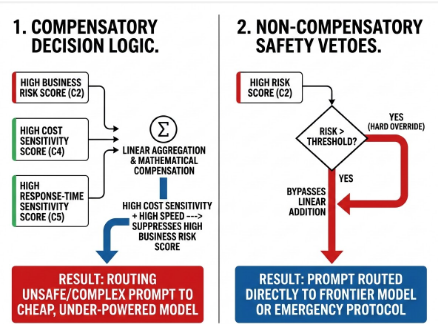
To eliminate compensatory vulnerability across high-stakes domains, system architectures must move from pure linear scoring to non-compensatory guardrails:
- Compensatory Decision Logic (Linear Aggregation): Standard scoring algorithms sum weighted criteria scores together. High scores in execution speed or cost sensitivity mathematically dilute severe risk factors, creating hidden operational vulnerabilities.
- Non-Compensatory Safety Vetoes (Deterministic Guardrails): Hard, rule-based overrides that supersede mathematical averages. When an input breaches predefined risk, legal, or safety thresholds, the system immediately forces an escalation override regardless of cost efficiency or execution constraints.
This architectural principle unifies enterprise risk management and clinical AI safety. In the Poznań enterprise routing study, introducing a deterministic Risk-Veto extension enabled the system to intercept risk-sensitive queries, successfully escalating 157 out of 170 high-risk prompts directly to GPT-5.
Similarly, the Grand Valley State University MIND-SAFE framework enforces a non-compensatory Acute Risk Detection Layer at the system entry point. By combining keyword detection with specialized classifiers trained on clinical screening standards, the input interface evaluates user inputs for acute crisis or self-harm cues. If an acute risk threshold is breached, the system completely bypasses the generative LLM and routes the event directly to emergency escalation and crisis intervention protocols. In both domains, deterministic safety vetoes prevent mathematical compensation from risking system integrity.
“In enterprise settings, a false cheap allocation may be more harmful than a false strong allocation: the former can produce an insufficient or risky answer, whereas the latter mainly increases cost.”
4. Takeaway 3: AI Exhibits “Cognitive Empathy,” Not “Affective Empathy”—And Static Prompts Make It Obvious
In user-facing AI applications—including customer support, digital health, and automated advising—the perception of empathy is vital for user trust and engagement. However, AI architects must maintain a clear distinction between two fundamentally different psychological modalities:
- Cognitive Empathy (AI Capability): The ability of an LLM to recognize, decode, and pattern-match emotional linguistic cues within text, generating syntactically warm, contextually appropriate, and supportive responses.
- Affective Empathy (Human Monopolized): The genuine subjective experience, emotional feeling, or shared visceral human connection. LLMs possess zero affective empathy; they statistically emulate understanding based on massive pre-training corpora.
When conversational AI relies on static, pre-scripted system prompts, this distinction degrades rapidly. Over extended interactions, static system prompts generate repetitive, formulaic responses. Users quickly recognize this “artificial empathy,” perceiving the chatbot as superficial, rigid, and insincere.
To elevate conversational AI from superficial pattern matching to structurally sound, context-aware dialogue, the MIND-SAFE framework operationalizes Advanced Prompt Engineering (PE) grounded in established, evidence-based therapeutic frameworks:
- Cognitive Behavioral Therapy (CBT): System prompts dynamically instruct the LLM to identify cognitive distortions and guide users through structured cognitive restructuring.
- Acceptance and Commitment Therapy (ACT): Prompts guide the conversational engine to foster psychological flexibility and align user reflections with core values.
- Dialectical Behavior Therapy (DBT): Prompts explicitly translate validated DBT skills into concrete system constraints:
- Wise Mind: Instructing the model to balance emotional validating language with rational, problem-solving structure.
- Observation & Description: Directing the model to reflect user input objectively without inserting ungrounded assumptions or judgmental labels.
- Effectiveness: Constraining generated outputs to actionable, goal-oriented steps rather than passive, circular sympathy loops.
By embedding structural skill frameworks (such as DBT skills and Socratic questioning) directly into dynamic prompt instructions, system designers prevent conversational degradation and ensure that AI interactions remain purposeful, contextually grounded, and psychologically coherent.
5. Takeaway 4: Context Without Liability—How De-Identified User State Databases (USD) and RAG Replace Unencrypted Chat Logs
A core architectural dilemma in deploying conversational LLMs is balancing rich personalization with strict data privacy mandates under regulations such as HIPAA and GDPR. Naive deployment architectures attempt long-term context retention by storing full, unencrypted conversation transcripts and continuously feeding raw message histories back into the LLM context window. This naive approach creates severe legal vulnerabilities, causes exponential token cost inflation, and exposes personally identifiable information (PII) to potential model leakage or data breaches.
The MIND-SAFE architecture resolves this dilemma by decoupling personalization from raw transcript retention through a dedicated User State Database (USD) coupled with Retrieval-Augmented Generation (RAG).
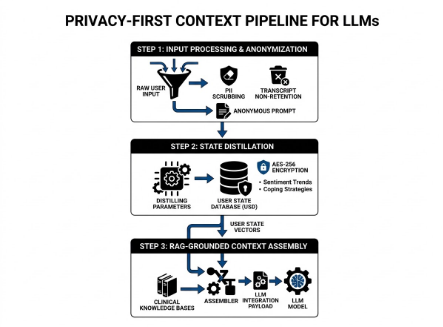
Instead of saving full dialogue logs, the system distills anonymized user state attributes, operating via a three-step privacy-first context pipeline:
- Input Processing & Anonymization:
-
- PII Scrubbing: Incoming text is stripped of direct identifiers (names, addresses, account numbers) at the interface boundary.
- Transcript Non-Retention: Raw message text is processed in memory for immediate response generation and then purged, preventing the accumulation of unencrypted conversational logs.
- State Distillation (USD Update):
-
- Attribute Extraction: Auxiliary classifiers analyze the interaction to extract structured, de-identified parameters—such as longitudinal sentiment trends, recurring emotional triggers, successful coping strategies, and task progress.
- Secure Storage: Extracted parameters are stored in the USD under strict encryption standards (AES-256 at rest, TLS 1.3 in transit) adhering to HIPAA/GDPR data minimization principles.
- RAG-Grounded Context Assembly:
- Selective Injection: When constructing subsequent prompt payloads for the LLM integration layer, the system retrieves only relevant user state vectors from the USD alongside validated clinical knowledge bases via RAG.
- Hallucination Suppression: Grounding generation in retrieved domain knowledge and structured state parameters ensures highly tailored, contextually accurate outputs while eliminating the legal liabilities of storing transcript histories.
6. Takeaway 5: AI Cannot Assume Legal Responsibility—The Unbridgeable “Duty to Protect”
As autonomous AI agents handle increasingly sensitive tasks, establishing legal and ethical boundaries becomes paramount. In professional domains—such as legal counsel, corporate compliance, and healthcare—practitioners operate under explicit legal mandates. A prime clinical example cited in the MIND-SAFE research is the legal doctrine established in Tarasoff v. Regents of the University of California (1976), which establishes a professional “duty to protect” third parties from foreseeable harm.
Current Large Language Models cannot perform the complex legal reasoning, assess foreseeable harm, or assume the professional liability required by doctrines like Tarasoff . Automated fine-print disclaimers, generic hotline pop-ups, or automated self-service links are legally and operationally insufficient when acute safety thresholds are breached.
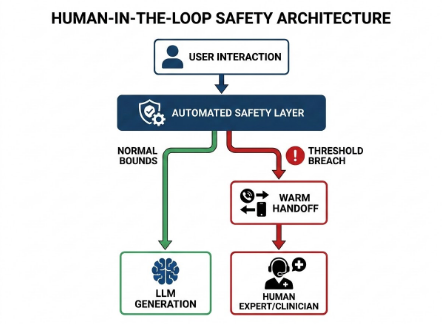
Consequently, enterprise and clinical AI frameworks must integrate an active Learning and Feedback Loop with Human Expert Oversight . Rather than pursuing unconstrained autonomy, safe system architectures design explicitly for “warm handoffs”—enabling real-time escalation and smooth state transfer to qualified human professionals whenever legal duties, safety thresholds, or specialized compliance bounds are triggered.
“Current AI systems cannot perform the nuanced legal reasoning or risk assessments required for such obligations… AI must augment, not replace, human clinical judgment and professional accountability.”
7. Conclusion: The Future of AI Integration Is Governed, Layered, and Auditable
The insights synthesized from enterprise multicriteria routing research and clinical prompt engineering architectures point to a clear strategic conclusion: the true value of generative AI does not stem from unconstrained model autonomy or brute-force compute. Maximum operational value is unlocked when statistical language models are embedded within structured, deterministic decision cybernetics.
Enterprise AI governance must bridge statistical reasoning with deterministic boundaries:
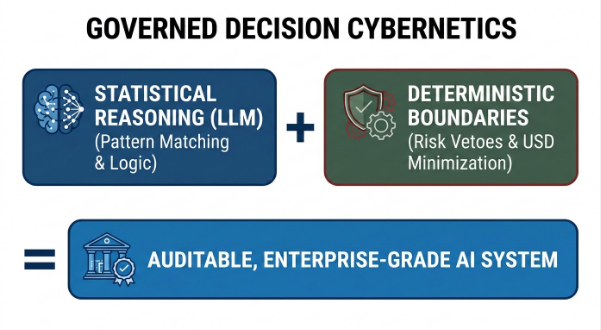
By combining expert-derived decision criteria (such as AHP weights) with robust aggregation rules, confidence margins, non-compensatory risk vetoes, and privacy-preserving context architecture (such as the User State Database), organizations transition LLMs from unpredictable novelties into auditable enterprise utilities. This layered approach guarantees that high-risk tasks receive frontier reasoning, routine queries execute cost-effectively, user privacy remains protected, and system decisions remain transparent and inspectable.
Is your organization deploying generative AI through blind, brute-force compute, or are you architecting a governed, auditable decision system built for sustainable scale?