
Moody’s Upgrade Marks Turning Point for Zambia, Yet Household Relief Remains Ahead
Tue 03 Sept 2026 /Mpelembe Media/ — On October 30, 2026, Moody’s upgraded Zambia’s sovereign credit rating from Caa2 to Caa1 with a positive outlook, citing substantial, sustained progress in government debt management following the nation’s 2020 default. This rating action follows earlier upgrades by S&P Global Ratings and Fitch Ratings, alongside a staff-level agreement reached on October 9, 2026, for a US$1.472 billion, 36-month IMF Extended Credit Facility. Over time, these improved assessments are expected to lower sovereign borrowing costs and help attract financing for major infrastructure initiatives such as the Lobito Corridor.
Despite this momentum, significant financial vulnerabilities persist, and the rating remains seven steps below investment grade (Baa3) firmly within sub-investment or “junk” territory. Zambia’s fiscal position continues to face heavy strain, with 35% of state revenue consumed by debt interest payments, representing one of the highest debt-service burdens in the region. In addition, the US$1.472 billion IMF package awaits final executive board approval, and the new Caa1 standing merely returns Zambia to where it stood in July 2018 before its slide into default. Crucially, these financial and macroeconomic milestones have not yet translated into tangible gains in jobs, household incomes, or living standards, leaving attention focused on the upcoming 2027 Budget presentation on November 6, 2026, and the formal IMF Board decision.
7 Counter-Intuitive Lessons from Zambia’s Blueprint for Climate and Economic Survival
In 2024, Zambia was hit by the most severe drought in living memory. The devastating climate shock crippled the agricultural sector as crop production collapsed, with maize yields plummeting by 53.6%, rice by 60.8%, and soya beans by 77.7%. Millions of citizens faced acute food insecurity while water tables dried up, severing access to safe drinking water across the country.
The hydrological crisis struck the national energy grid with equal severity. Reliant on hydropower for 84% of its electricity generation, Zambia watched its functional power generation capacity collapse from an installed capacity of 3,811 megawatts (MW) down to roughly 1,225 MW. The resulting grid failure forced severe daily load shedding, threatening to paralyze domestic commerce and industrial output.
Rather than treating the catastrophe as a reason to retreat into passive crisis management, the Zambian government launched an aggressive structural pivot. On February 29, 2024, President Hakainde Hichilema declared a National Disaster and Emergency, prompting Parliament to realign the national budget toward immediate relief like Cash for Work and expanded Social Cash Transfers.
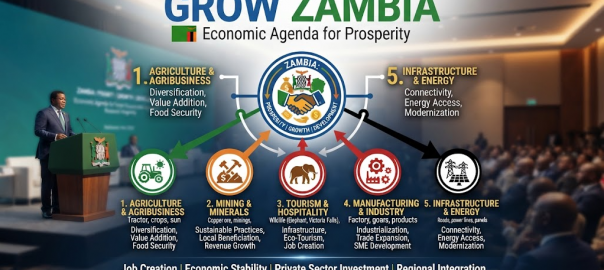
Crucially, policy leaders used the emergency to accelerate systemic economic reforms. Anchored by the 2025 Budget theme, “Building resilience for inclusive growth and improved livelihoods,” Zambia transformed a climate shock into an economic blueprint designed to build long-term structural stability.
1. Cleaning Up Agriculture: Purging “Ghost Farmers” to Drive Regional Exports
To fortify the nation against future climate shocks, the government executed an overhaul of the Farmer Input Support Programme (FISP), migrating 730,000 smallholders onto a digital e-voucher system.
This digital shift eliminated bureaucratic intermediaries and enabled real-time settlement of agro-dealer payments. Most importantly, it subjected the distribution rolls to cryptographic verification, identifying and purging over 210,000 fraudulent “ghost” beneficiaries from the system.
By reclaiming these lost resources, 99% of valid, registered farmers received their crop inputs ahead of the rainy season. The resulting harvest recovery was swift: maize production rebounded from 1.5 million metric tonnes in the 2023/2024 season to 3.7 million metric tonnes in 2024/2025.
(No code block – represented in fluid text as requested)
The broader structural turnaround produced an unexpected trade flip. Zambia transitioned from a net importer of Compound-D fertilizer to a net regional exporter, expanding its fertilizer exports from over 19,000 metric tonnes in 2023 to more than 91,000 metric tonnes in 2024. Aggressively purging systemic corruption from input distribution directly fortified regional food supply chains.
2. Defusing the Sovereign Debt Bomb: How Restructuring Saved $7.4 Billion in Fiscal Space
Entering 2025, Zambia faced a severe sovereign debt bottleneck. Having accumulated $5.34 billion in external debt arrears by end-December 2023, the nation faced assessed external debt service obligations (combined with accumulated arrears) of $8 billion (K246.4 billion) in 2025 alone—an unpayable obligation that threatened complete default.
To avert financial collapse, the state initiated comprehensive restructuring negotiations across every creditor tier. The government successfully restructured its Eurobonds, executed bilateral agreements under an Official Creditor Committee Memorandum of Understanding co-led by France and China, and reached agreements in principle with key commercial lenders, including Industrial and Commercial Bank of China, China Development Bank, Huawei, Paramount, Nedbank, and ZTE.
The immediate dividend of this diplomatic and financial push was a dramatic expansion of fiscal runway. Debt restructuring reduced the actual 2025 external debt service payable from $8 billion down to $599 million (K16.7 billion), freeing up over $7.4 billion in fiscal space to maintain domestic social protection and health spending.
Reflecting on the long-term imperative of fiscal discipline during his budget address, Minister of Finance and National Planning Dr. Situmbeko Musokotwane underscored that sovereign debt relief ensures future generations will not be forced to bear:
“the shameful yoke of unsustainable debt.”
3. Rethinking “Cheap” Power: The High Price of Resisting Tariff Reform
For decades, domestic policy favored sub-cost-reflective electricity tariffs, anchored by an 84% national reliance on cheap hydropower. When the 2024 drought eliminated over two-thirds of the country’s hydro generation capacity, the structural weakness of this low-cost model was exposed.
The crisis revealed a stark economic lesson: resisting cost-reflective tariffs to preserve “cheap” power proved vastly more expensive over time than paying realistic energy prices. The macroeconomic losses generated by widespread industrial load shedding—combined with the immense cost of running private diesel generators—far exceeded the incremental cost of cost-reflective electricity tariffs that could have attracted private energy producers years earlier.
To repair this structural vulnerability, the government targeted a dramatic shift in the energy mix, aiming to expand non-hydro renewables from 3% to 33% of national generation by 2026.
Key capital deployments to achieve this diversification include:
- Thermal Expansion: Doubling the Maamba thermal power plant capacity from 300 MW to 600 MW.
- Utility-Scale Solar: Accelerating 100 MW solar developments in Chisamba, Kasama, and Kariba, alongside a 50 MW plant in Choma.
- Regulatory Streamlining: Operationalizing an Energy Single Licensing System and Net-Metering Policy Framework to invite independent power producers into the national grid.
4. Bypassing Empty Coffers: Unleashing Private Capital for Infrastructure
Faced with constrained state revenues and urgent repair needs across main transport corridors, the government avoided taking on new sovereign loans for major civil works. Instead, it positioned Public-Private Partnerships (PPPs) as the primary engine for commercial highway construction.
Zambia quickly emerged as an African benchmark for PPP execution, signing seven major concession agreements covering 838 kilometers of primary road networks. Notable milestones include the completion of the commercial Chingola-Kasumbalesa Road corridor and steady progress on the 327-kilometer Lusaka-Ndola Dual Carriageway.
By leveraging off-balance-sheet private capital for high-density arterial transit, state revenues were preserved for regional priorities. The government redirected public funds directly to local governance structures through the Constituency Development Fund (CDF).
To address operational bottlenecks in rural logistics, the 2025 budget expanded the CDF by K5.5 million per constituency, explicitly earmarking K3.3 million per constituency specifically for purchasing fuel for feeder road maintenance machinery . This targeted allocation ensured local councils could operate heavy equipment to grade and maintain 2,980 kilometers of rural feeder roads, directly connecting rural farmers to urban markets.
5. Leapfrogging the Digital Divide: Satellite Tech in Brick-and-Mortar Outposts
Extending digital connectivity across low-density rural regions traditional fiber-optic infrastructure is often cost-prohibitive. Zambia bypassed expensive physical cabling by granting a low-earth-orbit (LEO) satellite license to Starlink and procuring 525 satellite receiver kits for rapid rural deployment.
Rather than building expensive new digital centers, the administration integrated satellite hardware directly into existing public assets. Satellite kits were installed across:
- 109 rural post offices
- 23 youth resource centers
- 156 constituency offices
- Rural health facilities, agricultural extension camps, and border posts
This low-cost hardware deployment converted physical post offices into operational “Digital Transformation Centres” (with 48 established in 2024 and dozens more scheduled for rollout). These connected outposts provide underserved communities with access to e-governance platforms, market data, and digital finance systems—supporting a broader financial ecosystem where mobile money now underpins 55% of financial inclusion nationwide.
6. Managing the School Surge: Balancing Free Access with Local Capacity
The implementation of the Free Education Policy in 2022 generated an immediate surge in primary and secondary school attendance, bringing over 2.3 million previously out-of-school and vulnerable children back into the formal education system. However, this sudden influx strained physical infrastructure: classrooms became overcrowded, desk shortages escalated, and the primary teacher-pupil ratio widened from 1:43 in 2021 to 1:60 in 2022.
To restore educational quality without retreating from universal access, the state orchestrated a multi-pronged intervention:
- Teacher Workforce Expansion: The government hired over 39,000 new teachers (reaching over 42,000 cumulatively since 2021), successfully pulling the national teacher-pupil ratio back down to 1:51 by 2024.
- Decentralized Desk Production: Public funds were routed through local communities to manufacture classroom furniture. Out of 812,598 desks procured under a national initiative, 712,562 (87%) were purchased through localized CDF allocations, contributing to a total supply of over 1.6 million desks nationwide.
- Nutritional Support Scaling: To improve retention and learning outcomes, the Home-Grown School Feeding Programme expanded from 70 districts (covering 1.9 million learners in 2021) to 106 districts in 2025, reaching over 4.6 million students.
7. Revitalizing Distressed Assets: The Drive Toward 3 Million Tonnes of Copper
Recognizing that mining remains the primary driver of foreign exchange and industrial activity in Zambia, the government prioritized resolving long-standing legal deadlocks surrounding core extraction assets. State intervention restored operational stability to distressed giants Konkola Copper Mines and Mopani Copper Mines, while a $300 million private investment saved Lubambe Mine from premature closure.
This regulatory resolution restored private sector confidence, unlocking multi-billion-dollar greenfield and brownfield capital commitments:
- Mingomba Mine Project: A $2 billion greenfield investment in Chililabombwe targeted to generate over 1,000 direct jobs.
- Shaft 28 Revival: Reopening an abandoned mine complex in Luanshya after nearly two decades of dormancy, creating 3,000 jobs.
- New Greenfield Developments: Mining operations at Kitumba (creating 2,500 jobs) and Kalengwa.
These investments underpin an aggressive national plan to scale annual copper production from a baseline of approximately 800,000 metric tonnes up to 3 million metric tonnes per annum—an ambitious ~3.7x expansion over the coming years. To support this growth trajectory, the country initiated a nationwide, high-resolution aerial geophysical survey to map mineral reserves, alongside establishing pilot gold trading hubs in Mumbwa and Rufunsa to integrate artisanal mining into the formal economy.
Darkest Before the Dawn
Zambia’s experience through the severe climate and economic shocks of 2024 demonstrates that acute crisis does not have to lead to long-term economic decay. By pairing immediate relief with disciplined fiscal governance, aggressive debt restructuring, market-led tariff reforms, and structural decentralization—highlighted by the expansion of the Constituency Development Fund from K36.1 million in 2025 to K40.0 million per constituency in 2026—the country laid the groundwork for structural recovery.
As Minister Dr. Situmbeko Musokotwane framed the national effort during his budget address:
“it is always darkest before the dawn of a bright new day.”
As climate shocks and fiscal tightening continue to strain developing economies worldwide, Zambia’s strategy offers a case study in crisis governance: Can other developing nations facing severe environmental shocks successfully execute this model of structural reform—or will they remain bound to reactive, short-term relief?