
Hundreds of Thousands Stranded: Middle East Airspace Shutdown and Strait of Hormuz Closure Paralyze Global Transit
March 2, 2026 /Mpelembe Media/ — The United States and Israel launched a massive, coordinated military campaign—codenamed Operation Epic Fury and Operation Lion’s Roar—against the Islamic Republic of Iran. The coalition conducted nearly 900 strikes in the first 12 hours, targeting Iranian air defenses, missile production facilities, and IRGC command centers. The strikes successfully assassinated Supreme Leader Ali Khamenei and dozens of top Iranian military and government officials. In retaliation, Iran launched “Operation True Promise 4,” firing waves of ballistic missiles and drones at Israel and US military installations across the Persian Gulf, including bases in Qatar, Bahrain, Kuwait, and the UAE.
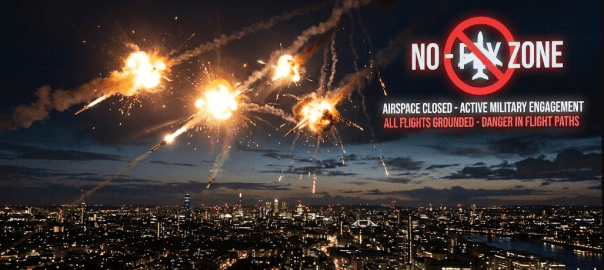
The military escalation has triggered an unprecedented global travel and logistics crisis. Airspace across at least eight Middle Eastern countries—including Iran, Iraq, Israel, Syria, Qatar, the UAE, Kuwait, and Bahrain—has been closed, paralyzing major international aviation hubs like Dubai, Abu Dhabi, and Doha. Major global airlines have suspended routes to the region, resulting in thousands of flight cancellations and leaving hundreds of thousands of passengers stranded worldwide. The crisis has also severely impacted global shipping, with commercial traffic dropping by 70% in the Strait of Hormuz after the IRGC warned vessels not to pass through the vital oil chokepoint.
Fearing a broader regional war, governments are scrambling to protect their citizens. The US State Department issued a “Worldwide Caution” and authorized the departure of non-emergency embassy staff from Israel and Lebanon, while the US Embassy in Qatar temporarily ordered a shelter-in-place. The United Kingdom is preparing one of the largest evacuation operations in its history for over 76,000 Britons registered in the Gulf, and nations including Spain, China, India, and the Netherlands have urged their citizens to evacuate the region immediately via land borders or limited commercial flights.
Diplomatically, the strikes occurred just 48 hours after a reported breakthrough in US-Iran nuclear negotiations in Geneva, destroying what Omani mediators described as a potential agreement for Iran to permanently halt uranium enrichment. The United Nations Secretary-General condemned the military escalation, warning that the strikes and subsequent retaliations severely undermine international peace and risk igniting a conflict that no one can control.
The Day the Sky Fell: 5 Realities of the 48 Hours That Shattered the Middle East
For the modern global citizen, the Middle East is more than a geographic region; it is the physical central nervous system of global connectivity. Between February 28 and March 1, 2026, that system suffered a catastrophic failure. In a span of just 48 hours, the world’s most critical transit hubs—once the glittering monuments to a seamless, globalized world—transformed into silent, kinetic war zones.The transition from the hushed, hopeful diplomacy of Geneva to the thunder of B-2 stealth bombers over Tehran was a whiplash event for global stability. On February 27, Omani mediators were briefing the press on a historic nuclear breakthrough; by the morning of February 28, the United States and Israel had unleashed “Operation Epic Fury” and “Operation Genesis.” This coordinated decapitation strike, involving over 200 fighter jets and a sophisticated array of cruise missiles, did more than target military assets—it severed the primary arteries of global transit.What we are witnessing is not a temporary flare-up, but a systemic regional recalibration. As the smoke clears over 24 Iranian provinces, the reality of a “shattered order” is setting in. How did the world’s most vital connectors become silent in two days?Here are the five takeaways that define this new, fractured reality.
1. The Great Stranding: The Death of the Hub-and-Spoke Model
The immediate byproduct of “Operation Epic Fury” was the near-simultaneous closure of airspace across eight nations, including the UAE, Qatar, Bahrain, and Iraq. This triggered the total paralysis of the “hub-and-spoke” aviation model that has defined 21st-century travel.The primary arteries of global movement—Dubai (DXB), Abu Dhabi (AUH), and Doha (DOH)—effectively went dark. According to aviation analytics firm Cirium, the disruption resulted in more than 3,400 flight cancellations and 19,000 delays in a single day. The three major Gulf carriers, which typically move 90,000 passengers daily, were forced to ground their entire fleets.The vulnerability of modern connectivity to regional kinetic events is now undeniable. As aviation analyst John Strickland observed, the logistical nightmare is not merely the stranded passengers, but the “complexity of having crews and aircraft scattered all over the place” with no clear timeline for recovery. Long-haul travel between Europe and Asia has been pushed into fuel-intensive, narrow corridors over Turkey and Egypt, causing immediate technical failures at secondary hubs.
2. The Decapitation Vacuum: Tactical Innovation and the Headless State
The strikes were surgically designed to dismantle the Iranian command-and-control apparatus. Reports indicate that the Pasteur district in Tehran was hit by at least seven missiles, resulting in the reported deaths of Supreme Leader Ali Khamenei, IRGC Commander-in-Chief Mohammad Pakpour, and Defense Minister Aziz Nasirzadeh.From a tactical perspective, the operation saw the debut of Task Force Scorpion Strike , utilizing the first combat deployment of Low-cost Unmanned Combat Attack System (LUCAS) drones . These $35,000-per-platform autonomous systems provided a scalable, low-cost precision that older cruise missile doctrines lacked. This technological edge allowed for a “strategic surprise” that successfully eliminated the top tier of Iranian leadership, leaving a temporary three-person council—including President Masoud Pezeshkian—to manage the wreckage.However, a regime without a head is often more dangerous than one with a clear command structure. As regional proxies consider uncoordinated retaliation, the words of the coalition leaders echo:”This operation allows the Iranian people to cast off the yoke of this murderous regime.” — Benjamin Netanyahu“We are defending the American people by eliminating imminent threats from the Iranian regime.” — Donald Trump
3. The Double-Choke: Why $73 Oil is Only the Beginning
The conflict has rapidly evolved from a bilateral punishment into a systemic threat to the global economy. We are currently facing a “double-choke” on world trade: Iran’s “Shield of Judah” retaliation has successfully closed the Strait of Hormuz , while Houthi militants have simultaneously threatened a total restart of attacks in the Red Sea .This pincer move on the Suez-Hormuz trade artery has forced shipping giants Maersk, MSC, and CMA CGM to suspend all regional transits. The economic shock was immediate, with Brent crude spiking to $73 per barrel .Immediate Systemic Impacts:
- Energy Paralysis: A fifth of global oil consumption normally passes through Hormuz; that flow is now zero.
- Maritime Rerouting: Carriers are diverting vessels south of Africa, adding weeks to supply chains and triggering emergency “war-risk” surcharges.
- Port Congestion: Jebel Ali reported fires and operational suspensions following drone interceptions, leading to yard congestion that will take months to clear.
- Financial Volatility: The Israeli shekel recorded its worst two-day streak in years as markets priced in a prolonged regional war.
4. The Diplomacy Paradox: The “Betrayal” in Geneva
The most jarring aspect of the crisis is its timing. The strikes occurred less than 48 hours after Omani Foreign Minister Badr Albusaidi announced an unprecedented breakthrough in Geneva. Iran had reportedly agreed to zero stockpiling of enriched uranium and full IAEA verification—a framework Albusaidi described as “completely new” and significantly stronger than the 2015 JCPOA.The decision by the U.S. and Israel to move forward with “Operation Epic Fury” despite a deal that achieved every stated non-proliferation goal suggests a pivot toward “regional recalibration” over diplomacy. This “betrayal of diplomacy,” as Russian officials termed it, has left the international community in a state of shock.”This military action carries the risk of igniting a chain of events that no one can control in the most volatile region of the world.” — UN Secretary-General António Guterres
5. The “New Normal” of Evacuations and Humanitarian Cost
The human cost of this escalation reached a tragic peak in the southern city of Minab, where an Israeli strike on an elementary girls’ school reportedly killed 148 people , many of them students. This disaster highlights the brutal reality of “decapitation” strikes in densely populated areas and has fueled a massive wave of Non-combatant Evacuation Operations (NEOs).The scale of the exodus is staggering:
- United Kingdom: Currently planning the largest evacuation in its history for 76,000 British nationals, mostly in the UAE.
- Thailand: The National Security Council is addressing the safety of 110,000 nationals in the region, including 7,700 specifically trapped inside Iran .
- Third-Country Strategy: Countries like Thailand are pivoting to “lily-pad” evacuations, moving citizens to safe regional neighbors before attempting long-range flights home.For those stuck in internet-blackout zones like Iran, the only hope is a dangerous overland trek toward the borders of Turkey or Armenia—a stark contrast to the high-tech precision of the initial strikes.
Conclusion: A World Recalibrated
As we assess the fallout of these 48 hours, one truth is clear: the Middle East as a reliable connector for the global economy has been shattered. The “Khamenei vacuum” threatens to dissolve Iran into civil disorder, while the closure of the world’s most vital air and sea lanes has effectively severed East from West.The ultimate question for the coming weeks is whether “Operation Epic Fury” actually secured the world from a nuclear threat, or if it simply traded a manageable risk for a chaotic, uncoordinated regional collapse. For the hundreds of thousands stranded in airport terminals and the families mourning in Minab, the world hasn’t just been changed—it has been broken.