
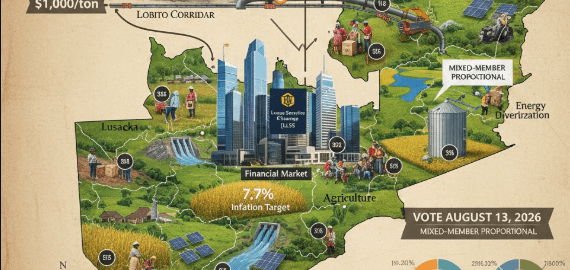
Jan. 8, 2026 /Mpelembe Media/ — In 2026, Zambia is positioned at a critical crossroads, transitioning from a period of climate-induced shocks (2024–2025) into a high-growth phase. The economy is projected to expand by 6.4%, a “rebound” driven primarily by a resurgence in the mining sector as copper production targets 1 million metric tons. This growth is supported by a more stable agricultural season and a strategic pivot toward renewable energy to mitigate future power deficits.
Fiscal & Financial Stability
Under the theme “Consolidating Economic and Social Gains,” the government has committed to strict fiscal discipline to satisfy IMF requirements and post-debt-restructuring agreements. Key targets include:
Fiscal Deficit: Reducing to 2.1% of GDP.
Inflation: Returning to the 6%–8% target band (averaging roughly 7.7% for the year).
Budgeting: A total expenditure of K253.1 billion, with a significant portion (over 30%) still dedicated to debt servicing, which continues to limit the “fiscal space” for social investment.
The 2026 Election & Social Outlook
The August 2026 General Election serves as the year’s primary political “gravity well.” The ruling UPND government is leveraging high-visibility local spending—specifically a K40 million per constituency CDF allocation—to bolster support. However, despite macroeconomic improvements, the high cost of living remains a significant grievance for the electorate, with nearly 60% of the population still living in poverty.
Political Landscape
The political arena is a three-way contest between the incumbent UPND Alliance, the consolidated Tonse Alliance (PF-led), and the populist People’s Pact (Socialist-led). While current polling suggests a lead for President Hichilema, the new Mixed-Member Proportional Representation system may lead to a more fractured Parliament, potentially complicating policy implementation in late 2026 and beyond.
The following breakdown details the key factors shaping Zambia’s economy this year:
Economic Growth & Domestic Factors
Zambia is entering 2026 with strong momentum, with real GDP growth projected to reach 6.4% to 6.5%.
Mining Boom: The primary driver is a massive ramp-up in copper production. Following major investments from firms like Barrick Gold and First Quantum Minerals, Zambia is targeting an output of over 1 million metric tons this year, moving toward its long-term goal of 3 million tons by the 2030s.
Agricultural Recovery: After the 2024 drought, the 2025/26 farming season is benefiting from more stable rainfall patterns, supporting food security and rural incomes.
Energy Sector: Reliance on hydroelectric power remains a vulnerability, but 2026 sees increased diversification into solar and coal projects (notably a $900M investment from Amsons Group) to mitigate future climate shocks.
Fiscal Policy & Debt Restructuring
Zambia has largely emerged from the “default era,” having restructured approximately 94% of its external debt by late 2025.
Budgetary Discipline: The government is targeting a narrow budget deficit of roughly 2.1% of GDP for 2026. This fiscal consolidation is aimed at maintaining IMF support and rebuilding international reserves.
Revenue Reform: There is a strong focus on improving tax collection and leveraging mineral royalties. A “dual currency” mine tax system has been adopted to capture more value from the copper sector in foreign exchange.
Debt Servicing: While debt-to-GDP is falling (projected at ~68% for 2026 down from over 100%), interest payments remain a significant portion of the budget, limiting the “fiscal space” for social spending.
Financial Markets & The Kwacha
Exchange Rate: The Kwacha has shown relative stability entering 2026, supported by high copper export earnings and restored investor confidence.
Monetary Policy: The Bank of Zambia (BoZ) is focused on bringing inflation back into the 6–8% target band.8 While inflation was in double digits for much of 2025, it is expected to average roughly 7.7% to 9.2% in 2026 as the effects of the drought fade.
Capital Markets: The Lusaka Securities Exchange (LuSE) has seen increased activity, including oversubscribed IPOs, signaling a return of domestic and regional private equity interest.
Geopolitics & International Trade
Critical Minerals Race: Zambia is a focal point of the global energy transition. It has become a strategic partner for both the West (via the Lobito Corridor rail project) and the East (with significant Chinese and Russian mining investments).
Copper Prices: International copper prices remain “bullish” (near or above $10,000/ton), driven by global demand for electric vehicles and renewable energy. This provides a vital cushion for Zambia’s trade balance.
Regional Integration: The rehabilitation of the TAZARA railway and the TAZAMA pipeline has improved trade logistics with Tanzania and the wider SADC region.
Cost of Living & Social Impact
Despite the positive macroeconomic numbers, the “man on the street” continues to face challenges:
Persistent Poverty: High food and fuel prices from previous years have left a lasting impact. Poverty rates remain high, especially in rural areas where roughly 78% of the population lives below the poverty line.
Public Services: The 2026 budget is under pressure to balance debt payments with the need for better health and education funding.
Employment: While the mining sector is growing, it is capital-intensive. Job creation in the services and manufacturing sectors is not yet keeping pace with the growing youth population.
Summary Table: 2026 Projections
| Indicator | Projected Value |
| Real GDP Growth | 6.4% – 6.5% |
| Inflation (Average) | 7.7% – 9.2% |
| Budget Deficit | ~2.1% of GDP |
| Copper Production | > 1,000,000 Tons |
| Debt-to-GDP | ~68% |
In the 2026 National Budget, presented by Finance Minister Dr. Situmbeko Musokotwane, the Zambian government has significantly increased the nominal funding for both health and education. However, analysts note that as a percentage of the total budget, these shares have slightly decreased due to competing demands like debt servicing and the 2026 General Election.
Below are the specific allocations and strategic priorities for these sectors:
Education Sector (K33.0 Billion)
Education remains the largest social sector allocation, representing 13.1% of the total national budget (a slight decline from 14.5% in 2025).
Free Education Programme: K2.4 billion is allocated to sustain the “Education for All” policy, which has removed tuition fees for primary and secondary schools.
Infrastructure: K2.3 billion is earmarked for completing 120 secondary schools, rehabilitating existing infrastructure, and finishing hostel blocks at the University of Zambia (UNZA) and Copperbelt University (CBU).
Human Resources: The budget funds the recruitment of 3,500 additional teachers in 2026, bringing the total recruited since 2022 to over 45,000.
School Feeding: The Home-Grown School Feeding Programme is being expanded to all 116 districts (reaching 4.6 million learners) to improve retention and nutrition.
Tertiary Support: K1.4 billion is allocated to the Higher Education Loans and Scholarship Board, with a focus on students from vulnerable households.
Health Sector (K26.2 Billion)
The health budget increased by roughly 13% from the previous year, now making up 10.3% of the total budget.
Drugs and Medical Supplies: A major focus is the 30% increase in funding for essential medicines, rising to K6.4 billion. This aims to address the persistent “stock-outs” seen in previous years.
Recruitment: The government plans to hire 2,500 additional health personnel in 2026 to reduce the patient-to-staff ratio.
Maternity and Primary Care: Significant funds are channeled through the Constituency Development Fund (CDF) to build maternity annexes and mini-hospitals in rural areas.
Specialized Care: Funding is also targeted at expanding specialized hospitals to reduce the need for expensive “treatment abroad” referrals.
Key Challenges & Gaps
While nominal funding is up, international partners like UNICEF and the World Bank have highlighted several critical gaps:
| Factor | Description |
| The “Abuja Gap” | At 10.3%, the health budget still falls short of the 15% target set by the Abuja Declaration. |
| Nutrition Crisis | Despite high stunting rates, nutrition programs receive less than 0.02% of the budget (K33.7 million). |
| Debt vs. Social Spend | Debt servicing and general public services consume over 36% of the budget, essentially “crowding out” deeper investments in social services. |
Summary of Social Sector Budget Trend
| Sector | 2025 Allocation | 2026 Allocation | % Change |
| Education | K31.49 Billion | K33.04 Billion | +4.9% |
| Health | K23.17 Billion | K26.17 Billion | +13.0% |
| Social Protection | K16.16 Billion | K15.67 Billion | -3.0%* |
| *The dip in Social Protection is primarily due to the phase-out of emergency 2024 drought relief funds. |
The 2026 General Election, scheduled for August 13, 2026, serves as the primary “gravity well” for Zambia’s economic policy this year. It creates a delicate balancing act between the populist demands of a campaign season and the rigid fiscal discipline required by the IMF and debt restructuring agreements.
Here is an analysis of how the election is expected to impact spending and policy:
The “Election Premium” on Local Spending
The government is pivoting toward high-visibility, “grassroots” spending to consolidate voter support.
Constituency Development Fund (CDF) Hike: The 2026 budget increased CDF from K36 million to K40 million per constituency. This is a strategic move, as it places resources directly in the hands of local communities for projects like clinics, schools, and bridges—tangible “wins” that can be showcased during the campaign.
Infrastructure “Ribbon-Cutting”: Expect an acceleration of Public-Private Partnership (PPP) road projects and the completion of rural mini-hospitals. The focus will be on projects that can be commissioned before the May 15 dissolution of Parliament.
Civil Service Stability: Having already recruited over 45,000 teachers and health workers since 2022, the 2026 budget adds 6,000 more (3,500 teachers, 2,500 health staff). This reinforces the government’s narrative of job creation.
Fiscal Discipline vs. Populist Pressures
While many election years lead to “budget blowouts,” Zambia is under a microscope:
IMF “Handcuffs”: Zambia is currently under an IMF Extended Credit Facility. Any significant overspending could jeopardize the final disbursements and the hard-won stability of the Kwacha. Consequently, the government has set a remarkably tight 2.1% fiscal deficit target for 2026.
The Debt Shadow: Over 36% of the budget is still tied up in debt servicing and general public services. This leaves very little room for the “election gifts” (like massive fuel subsidies or civil service double-pay) typical of previous Zambian administrations.
Investor Sentiment & The Mining Sector
The election introduces a “wait-and-see” period for major international players.
Resource Nationalism: During campaigns, rhetoric often shifts toward “Zambia for Zambians.” Investors will be watching closely for any talk of increasing mineral royalties or state ownership in mines to woo voters.
Capital Allocation Delays: Some mining firms may delay the final stages of the $10 billion+ pledged for expansion until after the August results are certified, seeking to ensure that the policy environment remains “investor-friendly” under whoever wins.
Impact on the Cost of Living (The “Voter’s Pocket”)
The cost of living is the opposition’s strongest weapon.
Social Cash Transfer (SCT): To counter the impact of high food prices, the government has expanded the SCT to 1.5 million households, with 88% of the funding now coming from domestic revenue rather than donors. This is a crucial safety net intended to mitigate voter frustration over inflation.
The Kwacha Factor: The Bank of Zambia will likely move aggressively to prevent any major currency depreciation in the months leading up to August, as a falling Kwacha immediately drives up the price of fuel and mealie meal (maize flour), which are historically “regime-changing” issues in Zambian politics.
Key Election Milestones to Watch
February 2026: Physical inspection of the Provisional Register of Voters.
May 15, 2026: Dissolution of Parliament. The official campaign period begins.
August 13, 2026: General Election Day.
In 2026, the Zambian political landscape has shifted significantly. While the ruling UPND (United Party for National Development) campaigns on a platform of “Economic Restoration,” the opposition has consolidated into two major blocs to challenge President Hakainde Hichilema.
The opposition’s economic argument centers on the “Cost of Living Crisis” and a critique that the government’s macroeconomic successes (debt restructuring and GDP growth) have not “trickled down” to the average household.
The “Tonse Alliance”
The Tonse Alliance is the most prominent opposition coalition. Originally chaired by former President Edgar Lungu, it has become the primary vehicle for the Patriotic Front (PF) and its partners following Lungu’s passing in mid-2025. It is currently led by Acting Chairperson Given Lubinda.
Key Economic Message: “The Era of Infrastructure and Affordability.”
Proposed Alternatives:
Subsidies: They advocate for the return of broader subsidies on fuel and electricity, arguing that the IMF-backed removal of these “safety nets” has impoverished the middle class.
Mining “Nationalism”: They critique the current government’s tax concessions to foreign mining firms, proposing a more aggressive mineral royalty regime to fund social programs immediately.
Domestic Debt: A promise to “dismantle domestic arrears” more aggressively to inject liquidity into local Zambian businesses that have struggled during the debt restructuring period.
The “People’s Pact” (Led by Fred M’membe)
In early 2026, a second major bloc emerged called the People’s Pact, a coalition of civil society and smaller parties that adopted Fred M’membe (Socialist Party) as its presidential candidate.
Key Economic Message: “Class Struggle: The Ku vs. The Kwa.”
Proposed Alternatives:
Radical Socialist Reform: M’membe argues that Zambia is divided into two nations: the wealthy (Ku) and the poor (Kwa). His platform focuses on state-led industrialization rather than reliance on foreign direct investment (FDI).
Agricultural Revolution: Proposes a state-run input distribution system that bypasses private middle-men to provide free or low-cost fertilizer to all small-scale farmers.
Social Services: Calls for a total reversal of any “user fees” in health and education, funded by higher taxes on “super-profits” in the mining and banking sectors.
Independent / Third-Way Players
-
Kelvin Fube Bwalya (KBF) & Citizens First: KBF positions himself as a technocratic alternative, focusing on Citizen Empowerment. His platform suggests that neither the UPND’s neoliberalism nor the PF’s populism works, proposing a “Zambian-First” policy that mandates 40% of all government contracts be awarded to local, youth-led firms.
Comparative Economic Platforms: 2026
| Feature | Ruling UPND | Tonse Alliance (PF-led) | People’s Pact (Socialist) |
| Mining Policy | High FDI / Stability | Higher Royalties | State Ownership / High Tax |
| Cost of Living | Target Inflation (6-8%) | Reintroduce Subsidies | Price Controls on Food |
| Debt Strategy | IMF/International Creditors | Domestic Arrears First | Debt Repudiation/Reparations |
| Main Target Voter | Urban Youth / Professionals | Rural Poor / Civil Servants | Shanty Town (“Kwa”) Residents |
The “Wildcard”: Constitutional Changes
The recent 2025 Constitutional Amendments have introduced a Mixed-Member Proportional Representation system for the 2026 election. This means that while Hichilema may lead in the presidential polls (currently hovering around 60%), the opposition could gain significant power in Parliament through the new proportional seats, potentially creating a “hung parliament” that could stall economic legislation in late 2026.
As of January 2026, the first wave of comprehensive opinion polling has begun to emerge, painting a picture of a polarized but largely stable electorate. The data suggests that while the “honeymoon phase” of the Hichilema presidency has ended, the opposition has yet to overcome the incumbent’s lead in key metropolitan areas.
Here is a summary of the latest polling data and voter sentiment trends heading into the 2026 campaign season:
Headline Polling Numbers (Early 2026)
A landmark poll released in late December 2025 by a team of independent consultants (including University of Zambia demographers) indicates that if the election were held today, the incumbent would likely secure a first-round victory.
| Candidate | Polling Percentage | Sentiment Trend |
| Hakainde Hichilema (UPND) | 58% – 60% | Stable: Driven by the UPND Alliance consolidation (MMD/PNUP endorsements). |
| Combined Opposition | 35% – 38% | Gaining: Picking up steam in rural and Copperbelt regions. |
| Undecided | 5% – 7% | Decreasing: Voters are starting to pick sides early. |
Approval Ratings by Key Issue (Afrobarometer & Local Surveys)
Recent data from Afrobarometer (Round 10/11) and local trackers show a “split-screen” reality for the government:
Education (High Approval): 72% of respondents view the Free Education Policy as the government’s greatest achievement. This remains Hichilema’s strongest “voter-retention” tool.
Infrastructure & Energy (Mixed): Following the power crises of 2024–2025, only 38% of urban voters approve of the government’s handling of the electricity supply, though this is recovering as new solar and coal projects come online.
Cost of Living (Low Approval): Only 29% of respondents feel the government is doing enough to reduce the price of basic commodities like mealie meal and fuel. This is the “achilles heel” for the ruling party.
Regional Sentiment Shifts
The 2026 election is expected to be won or lost in the “Swing Provinces”:
The Copperbelt: Traditionally a “kingmaker,” the Copperbelt is currently a battleground. While the revival of Mopani and KCM mines has brought back some support for the UPND, the opposition’s populist rhetoric on higher mining taxes is resonating with local contractors and labor unions.
Lusaka: Remains a UPND stronghold but shows signs of “voter fatigue.” The youth vote, which was decisive in 2021, is more cynical in 2026 due to the high cost of urban living.
Northern & Muchinga: These remain the heartlands for the Tonse Alliance (PF-led). Sentiment here is strongly anti-incumbent, focused on the perceived neglect of rural agricultural subsidies.
Southern & Western: These remain rock-solid for the UPND, with little to no significant opposition penetration.
The “Alliance Effect”
A major factor in these poll numbers is the consolidation of political blocs:
The MMD Endorsement: In late 2025, the MMD (led by Nevers Mumba) officially announced it would not field a candidate and would instead back Hichilema. This has solidified the “moderate” vote.
The People’s Pact: The emergence of Fred M’membe as the face of the Socialist-led People’s Pact has fractured the opposition vote. While he is pulling away “left-leaning” youth and intellectuals, this split between him and the Tonse Alliance (PF) effectively benefits the incumbent.
Summary of the “Voter Mood”
The 2026 voter is transactional. The 2021 election was about “Change and Democracy”; the 2026 election is about “Pockets and Plates.” If the Kwacha remains stable and the mining boom begins to translate into local business contracts by May 2026, Hichilema’s 60% lead is likely to hold. If food prices spike again, a second-round “run-off” (requiring 50% + 1) becomes a real possibility.
I will certainly keep a close eye on these developments for you. As we enter the second week of January 2026, the “pre-campaign” machinery is already in high gear.
Based on the latest data from the Electoral Commission of Zambia (ECZ) and independent pollsters, here is the current state of play:
Latest Opinion Poll Summary (Jan 2026)
Fresh data from late December 2025/early January 2026 confirms that President Hakainde Hichilema maintains a strong but narrowing lead.
Hakainde Hichilema (UPND Alliance): 60%
Combined Opposition (Tonse & People’s Pact): 35%
Undecided/Other: 5%
Analysis: Hichilema’s numbers are bolstered by the UPND Alliance’s success in absorbing former “moderate” opposition parties like the MMD (led by Nevers Mumba), which officially endorsed him for 2026.4 However, his support in the Copperbelt is more volatile than in 2021 due to the slow pace of the mining recovery’s impact on small local businesses.
The Official Electoral Roadmap
The ECZ has finalized the 2026 calendar. If you are tracking the economic or social impact of the election, these are the dates to watch:
February 9 – 23, 2026: Voter Register Inspection. This is a critical period where political parties verify the roll. Expect increased political rhetoric and “voter education” campaigns during this time.
April 30, 2026: Certification of the Final Register. The ECZ aims to increase the voter roll from 7 million to 10.5 million, heavily targeting first-time youth voters.
May 15, 2026: Dissolution of Parliament. The official campaign period begins. Government spending usually shifts significantly toward completing community projects at this stage.
August 13, 2026: General Election Day.
Key Sentiment Shifts to Watch
While the headline numbers look good for the incumbent, two “undercurrents” are emerging in the January 2026 reports:
The Proportional Representation Factor: Under the 2025 Constitutional Amendments, Zambia now has a Mixed-Member Proportional system.7 While Hichilema may win the presidency, the UPND faces a much tougher battle to maintain its majority in the National Assembly, as 40 seats will now be distributed based on the total national vote share.
Youth Cynicism: Afrobarometer reports from late 2025 show that while 85% of Zambians prefer democracy, satisfaction with how it is working has dropped to 54% (from 71% in 2022). This “satisfaction gap” is where the Socialist Party (People’s Pact) is finding its momentum.
While the 2026 outlook is generally positive, it is underpinned by significant vulnerabilities. This “Risk Report” outlines the primary threats that could derail Zambia’s recovery during this critical election year.
Climate & Energy Security Risk (High)
Zambia’s “rebound” is fragile because of its extreme sensitivity to weather patterns.
Hydro-Dependency: Despite efforts to diversify, over 80% of Zambia’s electricity still comes from hydropower. A recurrence of the 2024–2025 drought would lead to immediate power rationing, crippling both mining production and small-scale manufacturing.
The “Energy Deficit” Gap: While 1,500 MW of solar is being added to the grid, much of this capacity is still under construction in early 2026. A dry spell in the first half of the year would force the government to import expensive emergency power, blowing the budget deficit target of 2.1%.
Global Commodity Price Volatility (Medium-High)
Zambia’s fiscal health is effectively a “bet” on copper.
Price Sensitivity: The 2026 budget assumes copper prices will stay above $9,500/ton. While Goldman Sachs and UBS forecast prices as high as $11,000–$12,500 due to the AI and EV boom, a global recession or a slowdown in Chinese industrial demand could send prices below $8,500.
Revenue Impact: Since copper accounts for nearly 60% of export receipts, a price drop would trigger Kwacha depreciation, immediately spiking the cost of imported fuel and fertilizer.
Election-Year Fiscal Slippage (High)
2026 is an “August Election” year, which historically leads to populist overspending.
The IMF “Tightrope”: The government must maintain a strict fiscal deficit to keep its IMF Extended Credit Facility active. However, the pressure to “deliver” before August 13th could lead to unbudgeted spending on civil service bonuses or food subsidies to appease a frustrated electorate.
Crowding Out the Private Sector: To fund the election-year budget, the government is projected to increase domestic borrowing by 41% (up to K21 billion). This risks “crowding out” local businesses by making credit more expensive and harder to find.
Social Unrest & The “Cost of Living” Gap (Medium)
There is a dangerous lag between macroeconomic “success” and household reality.
Poverty Stagnation: While GDP is growing at 6.4%, poverty remains stubbornly high at 60%. If the “Copper Renaissance” doesn’t create visible jobs by mid-2026, the opposition’s populist rhetoric could trigger localized protests or strikes in the Copperbelt and Lusaka.
The “Double Burden”: Zambia is currently spending as much on debt servicing (36%) as it is on essential social services. This “zero-sum” game means any economic shock (like a fuel price hike) has no remaining fiscal buffer to protect the poor.
Geopolitical & Regulatory Risk (Low-Medium)
Resource Nationalism: As the election nears, political rhetoric regarding “super-profits” in the mining sector may increase. While unlikely to lead to nationalization, it could cause foreign investors to pause capital-intensive projects like the Mingomba or Lumwana expansions until the 2027 policy environment is clear.
The “Lobito Corridor” Execution: Zambia’s status as a “land-linked” hub depends on the successful rollout of regional rail projects. Any diplomatic friction with neighboring DRC or Angola could delay the logistics efficiency needed to hit the 1-million-ton copper export target.
Summary Risk Matrix
| Risk Factor | Probability | Impact | Primary Consequence |
| Drought/Power Cuts | High | Extreme | Mining & GDP contraction |
| Copper Price Drop | Medium | High | Currency crash & Budget deficit |
| Election Overspend | High | Medium | IMF program suspension |
| Social Unrest | Medium | Medium | Operational disruptions in cities |