Zambia’s Strategic Evolution: From Landlocked to Land-Linked Economic Powerhouse
25 Feb. 2026 /Mpelembe Media/ — This is an analysis of John McDermott, The Economist chief Africa correspondent
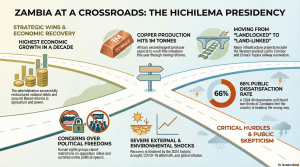
interview with Zambian President Hakainde Hichilema (often referred to as “HH”) ahead of the country’s upcoming August elections,. Hichilema is urging voters to “stay the course,” arguing that his administration has made significant strides in repairing the damage left by his predecessor, Edgar Lungu. He highlights several achievements, including securing a debt restructuring deal, delivering free education, enacting liberal reforms in power and agriculture, and initiating major infrastructure projects like the Lobito Corridor and Tazara railway renovations to transform Zambia into a “land-linked” nation. He also aims for the country to reach 1 million tonnes of copper production this year.
Despite these long-term economic strategies, Hichilema’s administration is grappling with severe immediate challenges. He inherited a national debt default and has had to navigate the COVID-19 pandemic, global inflation driven partly by the war in Ukraine, and one of the worst droughts in Zambia’s history in 2024. Because the dividends of his infrastructure and mining deals are not expected to fully materialize for another five to ten years, many citizens are frustrated; polling shows that two-thirds of Zambians feel the country is heading in the wrong direction.
Furthermore, Hichilema faces scrutiny over his record on civil liberties. The NGO Freedom House accuses his administration of restricting political space, hindering opposition rallies, and intimidating journalists. While Hichilema defends his record by stating that current opposition figures have it much easier than he did when he faced treason charges under Lungu, critics argue that simply being better than his predecessor is not a high enough standard for true political freedom.
The Macro-Economic Pivot
Under the administration of Hakainde Hichilema (HH), Zambia is executing a fundamental recalibration of its sovereign risk profile. The central pillar of this strategy is the aggressive transition from a “landlocked” geographic constraint to a “land-linked” logistical arbitrage play. By positioning the state as the indispensable multimodal transit hub for Southern Africa’s mineral wealth, the administration aims to institutionalize structural stability and leverage its borders with eight neighboring nations to drive regional integration. For high-level stakeholders, this pivot represents more than a rebranding; it is a move to de-risk the Zambian economy by diversifying its role in the global supply chain.The current economic trajectory must be viewed against the inherited volatility of the previous regime. The following table contrasts the previous administration’s legacy with the macro-critical milestones achieved under the Hichilema government as of early 2026:| Inherited Challenges (Lungu Era) | Current Reform Milestones (Hichilema Administration) || —— | —— || Sovereign debt default and creditor impasse | Successful multi-billion dollar debt restructuring deals || Entrenched systemic corruption and fiscal opacity | Highest GDP growth rate recorded in over a decade || Documented civil rights and press freedom abuses | Implementation of universal free school-age education || Stagnant industrial growth and interventionist policy | Liberalization of the power and agricultural sectors |
This evolution is underpinned by a stark shift in executive governance. Moving away from the populist volatility of the “Lungu era,” President Hichilema operates with a “formal and brief-commanding” technocratic style. While he is fundamentally in command of his brief, he is often perceived as aristocratic and, at times, pompous—a persona that, while restoring investor confidence in the professional management of the state, risks creating a perception gap with a domestic electorate sensitive to elitism. This shift toward a predictable, albeit formal, leadership style is the primary driver of renewed interest in the engine of the Zambian economy: the mining sector.
The Copper Catalyst: Target 1 Million Tonnes
Copper production remains the macro-critical engine for Zambia’s debt servicing and long-term growth. As Africa’s second-largest producer, the nation’s ability to meet its restructured debt obligations is inextricably tied to its extraction volumes. The Hichilema administration has re-asserted an ambitious target of 1 million tonnes of copper production for the current year. It is crucial for investors to note that this is an aspirational figure cited—admittedly—not for the first time. Validating this “stay the course” narrative ahead of the August 2026 elections is essential for maintaining the momentum of the administration’s reformist mandate.To facilitate this production surge, the government has moved to enhance fiscal regime predictability through several key liberalizations:
Royalty Framework Transparency: Moving toward a more competitive and stable mining tax environment to incentivize deep-level capital expenditure.
Power Sector Liberalization: Unbundling and modernizing the energy grid to accommodate the intensive load requirements of Tier-1 mining assets.
Agricultural Market De-regulation: Streamlining resource allocation to ensure industrial mining expansion does not compromise national food security.The “So What?” for the investor community is a matter of solvency: achieving or significantly nearing this 1 million-tonne target is the litmus test for the administration’s economic “dividends.” Should production continue to lag due to historical bottlenecks, the cash flow underpinning the newly restructured debt becomes precarious, potentially exposing the state to a secondary “creditor squeeze.” However, the extraction volume is only one side of the coin; the ability to move that volume to global markets via strategic infrastructure is the second.
Infrastructure Pillars: The Dual-Corridor Strategy
Zambia’s “land-linked” vision is a masterclass in geopolitical hedging. By aggressively diversifying its transport routes, the administration is mitigating offtake risk and ensuring that the nation’s mineral wealth is not held hostage by a single exit point or a lone geopolitical partner.This strategy is anchored by two flagship projects that balance Eastern and Western interests:
The Tazara Railway Renovation: Backed by Chinese capital and expertise, this project focuses on the total revitalization of the rail link to the port of Dar es Salaam, Tanzanian. This secures a high-volume eastern corridor for copper exports to Asian markets.
The Lobito Corridor Extension: Supported by Western interests (notably the US and EU), this extension connects the Copperbelt to the Atlantic coast via Angola. It serves as a strategic counter-weight, providing a direct, modernized route to Western industrial hubs.The “So What?” analysis of this dual-corridor approach reveals a sophisticated attempt at regional trade integration that allows Zambia to play both sides of the global infrastructure race to its advantage.”This will mean Zambia is ‘land-linked’ not landlocked.” — President Hakainde HichilemaWhile this infrastructure provides the roadmap for the next decade, the administration must still navigate a complex architecture of internal and external risks that threaten the stability of these long-term plays.
Risk Architecture: Navigating Environmental and Geopolitical Volatility
The Zambian economy remains highly sensitive to external shocks that remain outside the direct control of Lusaka’s technocrats. These factors create a “production ceiling” that could undermine even the most robust mining targets.
Climate and Energy Risk: The 2024 drought—one of the most severe on record—exposed a critical vulnerability in Zambia’s hydropower-concentration. For a nation whose industrial productivity and energy grid are dependent on water levels, climate volatility creates an inherent cap on mining production and agricultural output.
Global Inflationary Pressure: The protracted fallout from the Russian invasion of Ukraine has maintained upward pressure on domestic prices, eroding the purchasing power of the average citizen and offsetting the macro-economic gains of debt restructuring.
Political & Civil Risk: While the President often cites his own past imprisonment as proof of the country’s progress, Freedom House has highlighted ongoing concerns regarding “hate speech” legislation and the restriction of opposition rallies.There is a palpable tension between Hichilema’s technocratic excellence and the grassroots reality. Despite the administration’s defense of its record, 2024 Afrobarometer data indicated that two-thirds of Zambians felt the country was heading in the “wrong direction.” This disconnect between high-level fiscal reform and domestic sentiment—compounded by the President’s perceived aristocratic detachment—poses a significant risk to policy continuity as the August 2026 election approaches.
Strategic Outlook: The Dividend Timeline
Investors must maintain a realistic horizon for structural returns. Large-scale mining concessions and trans-continental rail projects operate on decadal cycles that do not align with the four-year volatility of democratic politics. The Hichilema administration correctly argues that the most significant economic dividends of the current “land-linked” transformation are likely five to ten years away.Stakeholder Summary: Key Indicators to Watch
August 2026 Election Mandate: A definitive signal for the continuity of current fiscal and infrastructure policies versus a return to populist interventionism.
Copper Output vs. Debt Covenants: Monitoring whether production volumes can support the interest and principal payments of the restructured sovereign debt.
Mitigation of Hydropower Concentration Risk: The speed and success of energy diversification efforts to remove the production ceiling currently imposed by climate volatility.
Logistical Milestone Realization: Official groundbreaking and progress reports on the Tazara and Lobito projects as a gauge of sustained international capital commitment.Zambia stands at a definitive crossroads: it will either cement its status as the indispensable “land-linked” hub of the Copperbelt or serve as a cautionary tale of the lag between macro-economic reform and grassroots prosperity.