
Faith, Love, and the “Falling” Narrative: A Study in Narrative Subversion
Sun, Jun 07 2026 / -Falling is a six-part British romantic drama created by BAFTA-winning writer Jack Thorne that premiered on Channel 4 in May 2026. The series stars Keeley Hawes as Anna, a cloistered nun of 20 years, and Paapa Essiedu as David, a progressive, community-focused Catholic priest.
The narrative ignites when David visits Anna’s convent and a chance physical touch in the kitchen sparks an intense, sudden attraction between them. Overwhelmed by her feelings, Anna abruptly leaves her order, abandoning her vows of obedience, poverty, and chastity to enter the secular world. The series follows their turbulent transition: Anna struggles severely with modern, secular life—experiencing panic attacks and exhibiting a childlike naivety—while David battles his own past traumas, a history of alcoholism, and an ongoing conflict with the church’s conservative leadership regarding his social advocacy in Bristol.
A major element of the show is its authentic representation of the deaf community. David lives with his deaf sister, Susan (played by Sophie Stone), and their bilingual household communicates entirely through British Sign Language (BSL), which serves as a vehicle for emotional honesty and grounds David’s character.
The central premise of the show was inspired by the real-life romance of Sister Mary Elizabeth, a Carmelite nun, and Friar Robert, a visiting monk. The pair met in Lancashire, fell in love, and ultimately left the church in 2015 to marry and begin new secular lives.
Critically, Falling has been highly polarizing. Supporters, including The Times, praised the series as a “spellbinding” and beautifully restrained exploration of sudden love. Conversely, detractors, such as The Guardian and The Telegraph, labeled the show a “god-awful mess”. These critics argued the central relationship felt unconvincing and heavily criticized Thorne’s writing of Anna, stating her extreme naivety bordered on infantilism
The Collision of Faith and Flesh: A Narrative Case Study of Falling
- Executive Overview: The Strategic Intersection of Duty and DesireThe Channel 4 drama Falling , helmed by Jack Thorne, serves as a sophisticated psychological post-mortem of “forbidden longing” within the rigid ecclesiastical bureaucracy of the Catholic Church. This narrative functions not merely as a romance, but as a “nuclear bomb” detonated within the ontological security of two individuals—a nun and a priest—whose identities are structurally predicated on celibacy. By stripping away the hagiographic shielding of the clergy, the series examines the volatile debris that remains when human instinct collides with doctrinal absolute. The strategic significance of this case study lies in its deconstruction of how a singular, visceral moment of connection can dissolve decades of disciplined devotion.The primary conflict drivers that maintain this narrative’s high-stakes tension are synthesized into three core thematic pillars:
- Ontological Identity: The friction between the consecrated persona—defined by total surrender to the divine—and the emergence of a secular self-demanding individual agency.
- The Tripartite Vow: The structural scaffolding of Poverty, Chastity, and Obedience, which serves as both a protective cocoon and a psychological cage for the protagonists.
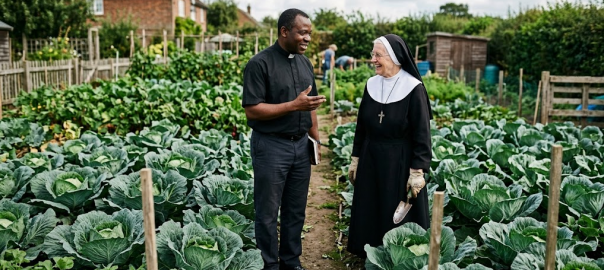
- Human Fallibility as Subversion: The tactical portrayal of vices—David’s alcoholism and Anna’s “impure” internal monologues—which humanizes the clergy while simultaneously making their “fall” an inevitability rather than a shock.These abstract themes are personified through the divergent backstories of Sister Anna and Father David, whose collision initiates a radical dismantling of their respective vocations.2. Character Profile: Anna and the Burden of Consecrated InnocencePsychologically, Anna represents the profound developmental arrest inherent to the “convent lifer.” Entering the consecrated life at age 16, her psyche was formed within a vacuum of ecclesiastical seclusion. The narrative’s strategic choice to portray Anna as “infantile” or “otherworldly” upon her transition to the secular world heightens the stakes; her displacement is not merely social, but a fundamental failure to navigate a reality for which she has no cognitive map. Her twenty-year devotion to the convent’s vegetable patch serves as a displacement of maternal nurturing onto the earth, a safe outlet for the “fleshly” instincts she has otherwise suppressed.Anna’s spiritual life is characterized by a sophisticated internal dialogue regarding the mechanics of belief, noting:”Faith is dependent on doubt. Without doubt, there is no faith.”This intellectualized faith is tested by the “maternal catalyst”—Anna’s mother, an empathy-vacuum who views Anna’s religious life as a personal slight. During their Episode Two confrontation, her mother describes Anna as a “wizened, dry old Christmas cake no one wants to eat in January.” This metaphor is a calculated psychological strike against Anna’s fertility and societal utility, effectively shaming her for her “wasted” years. This maternal rejection leaves Anna uniquely vulnerable to the first representative of the outside world who treats her with genuine, non-doctrinal warmth: Father David.3. Character Profile: David and the Paradox of the Radical PriestFather David is the narrative’s “earthly” counterpoint, possessing an urban energy that contrasts sharply with Anna’s pastoral seclusion. Having moved from Reading to Bristol after his career path to becoming a Bishop “blew up,” David is a man defined by restlessness. His addiction and Marxist leanings represent a rebellion against the very institution he serves. He is a shepherd who has lost the “ability to pray” in the traditional sense, instead engaging in a theological subversion where he “finds God in the bottle”—a desperate attempt to self-medicate the trauma of a young parishioner’s suicide.The anatomy of David’s character is further defined by two critical factors:
- The Lost Ability to Pray: His trauma is not just professional but spiritual. By losing the capacity for vocal prayer, he occupies a state of religious liminality where he is a priest in title but a secular man in spirit.
- Unvoiced Intimacy (BSL): David’s primary intimate bond is with his sister, Susan. Their use of British Sign Language (BSL) serves as a strategic bypass of religious authority. Unlike David’s public role—which requires “the Word” and preaching—BSL allows for a form of “unvoiced” communication that is private, tactile, and inherently subversive to an institution that demands vocalized confession and public prayer.As a “community champion” advocating for needle exchanges and basketball courts, David’s radicalism creates friction with Bishop Peter, who prioritizes ecclesiastical infrastructure like underfloor heating. This friction leaves David spiritually and socially isolated, making the “seismic shift” triggered by Anna’s arrival an inescapable catalyst for his own collapse.4. The Rupture: Evaluating the “Hand of God” CatalystThe narrative’s inciting incident—the kitchen encounter where David runs Anna’s burned hand under a tap—is a masterful subversion of sacred imagery. What would typically be an act of pastoral care becomes a “nuclear” event precisely because it acknowledges the flesh. By framing this touch through “soft morning light,” Thorne suggests that the “Hand of God” is found not in a miracle, but in the forbidden electricity of human contact.The impact of this rupture is best analyzed by measuring their subsequent behaviors against the “Three Sacred Vows”:| Three Sacred Vows | Actual Outcomes Observed || —— | —— || Obedience | Irreversible Rupture: Anna leaves the convent immediately. Once she has “thrown away her life” for David, she cannot return to the order. || Poverty | Material Desperation: Anna realizes she literally “needs money to survive.” She becomes dependent on Muriel for financial and logistical support in the secular world. || Chastity | Physical Realignment: Despite sex being described as “closer to fear than desire,” the admission of specific, undeniable attraction effectively terminates their spiritual “purity.” |
The attraction is perceived through different psychological lenses: Anna, in her “infantile” certainty, believes the intensity of the feeling must signify “God’s will.” David, better acquainted with the complexity of human failure, attempts to categorize the bond as “friendship”—a strategic compromise intended to preserve his collar while satisfying his heart. This internal shift necessitates their physical relocation to the testing grounds of the secular world.5. Environmental Transition: The Secular World as a Testing GroundAs the protagonists migrate toward the secular, Falling transforms into a radical coming-of-age study. The environment acts as a crucible; the coach trip to Weston-Super-Mare serves as the primary liminal space where the boundaries of their past and future blur. In this setting, the “Bambi effect” is manifested in Anna’s ontological displacement—most notably her panic attack in a changing cubicle and her bizarre exchange with Graham the greengrocer. When she responds to Graham’s compliment (“You are lovely”) with “YOU are lovely, Graham! THESE are vegetables!”, her infantilism highlights the developmental chasm left by two decades in the cloister.Supporting entities facilitate this transition through specific “life lessons”:
- Muriel: Provides the grounded support necessary for survival. Her instruction on “shaving and haircuts” represents a vital reclamation of the self; for Anna, removing the “hairy” remnants of her convent life is a rejection of her mother’s “dry Christmas cake” prophecy.
- Susan: Uses the “unvoiced” clarity of BSL to force David to confront the “demons” of his addiction, refusing to let him hide behind the facade of the collar.These external experiences—shaving, the mall, and the seaside—strip away the “habit,” forcing a final confrontation between their history of duty and their new, terrifying reality.6. Conclusion: The Synthesis of Love and BeliefFalling succeeds as a “silly-serious” narrative by using the mundane and the humorous—such as the awkward dialogue regarding cabbages and cauliflowers—to humanize the clergy. This humor is a strategic tool, lowering the audience’s guard before delivering the “nuclear” emotional payload of their fall.The case study yields three critical takeaways regarding the intersection of identity and duty:
- Humanity as the Primary Doctrine: Thorne argues that “vows” are often manmade barriers that cannot withstand the fundamental force of human connection. The protagonists find that their humanity is more “extraordinary” than their divinity.
- The Ethical Necessity of Doubt: True faith is only possible when the risk of “falling” is present. By choosing to leave the Church, Anna and David move from a state of enforced obedience to one of authentic moral choice.
- The Displacement of the Divine Safety Net: As the formal structures of the Church (personified by Bishop Peter) fail to provide solace, secular communities and sibling bonds emerge as the true agents of “healing.”The final cost of falling in love in this narrative is the total dismantling of one’s previous life. For Anna and David, “falling” is not a descent into sin, but a necessary crash into the reality of being human. They lose the divine safety net of the Church, but in doing so, they find a relatable, ordinary connection that is, in its own way, truly divine.