
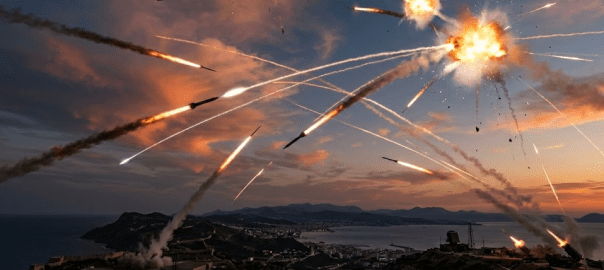
March 7, 2026 /Mpelembe Media/ — Geopolitical Risk Report: The 2026 West Asian Realignment and the Collapse of Regional Diplomacy
The U.S.-Israel-Iran conflict is triggering severe shocks across the global economy, primarily through disruptions to energy supplies, international trade routes, financial markets, and critical technology infrastructure.
Energy Market Upheaval The most immediate economic threat stems from rising energy prices due to the disruption of the Strait of Hormuz—a crucial maritime chokepoint that normally handles about one-fifth of the world’s oil and liquefied natural gas (LNG). Following Iranian threats, commercial shipping through the strait has slowed to a near-standstill, with tanker traffic dropping by about 90% and multiple insurance firms canceling coverage for Gulf vessels.
Furthermore, direct military strikes have paralyzed key energy production facilities. Drone attacks hit Saudi Aramco’s Ras Tanura oil refinery and Qatar’s Ras Laffan gas facilities. In response to the strikes, QatarEnergy halted all gas production and declared force majeure on its contracts, causing European LNG prices to surge by as much as 50%. Global crude oil prices have also spiked between 15% and 20.5%, pushing Brent crude over $84 per barrel and WTI crude to $79.06. Analysts warn that if the disruption persists, oil could hit $100 to $150 a barrel, placing a particularly heavy burden on highly import-dependent Asian economies like India, Japan, and South Korea.
Disruption of Global Shipping and Aviation The conflict has severely impacted global logistics. Beyond the Strait of Hormuz, Houthi forces in Yemen have renewed threats in the Red Sea and the Strait of Bab-el-Mandeb, prompting major maritime carriers like Maersk to reroute ships around the Cape of Good Hope. Aviation has also been thrown into chaos. Regional states including Bahrain, Iraq, Israel, Kuwait, Qatar, Syria, and the UAE have closed their airspace, forcing international airlines to suspend services to the Middle East and reroute global flights.
Technological Infrastructure Vulnerabilities The war has demonstrated that commercial cloud infrastructure is no longer insulated from kinetic military action. Drone strikes physically damaged three Amazon Web Services (AWS) data centers in the UAE and indirectly damaged another in Bahrain. Because these data centers experienced structural damage, flooding, and cooling system failures, the region suffered complete outages of fundamental web infrastructure, including AWS S3 storage and DynamoDB databases.
Financial Market Volatility and Inflation Risks The compounding crises have heightened fears of global inflation and recession. The uncertainty sank stock markets, with the Dow Jones Industrial Average dropping as much as 1,200 points and the S&P 500 experiencing an initial 2.5% drop. Economists note that a sustained surge in energy prices will drive up the cost of everyday goods—U.S. gasoline prices already jumped 27 cents per gallon in the opening days of the conflict. This will likely force central banks to raise borrowing costs to curb inflation, which would subsequently drag down global economic growth. The IMF estimates that global economic growth is reduced by 0.15% for every 10% rise in oil prices.
Compounding U.S. Tariff Shocks Adding to the global economic instability is the Trump administration’s parallel implementation of a new worldwide tariff regime. Just before the war began, the U.S. Supreme Court struck down the administration’s broad IEEPA tariffs. In response, the administration invoked Section 122 of the Trade Act of 1974 to enact a 10% to 15% global tariff on imports as a stopgap measure. The chaotic rollout of these tariffs—justified by controversial interpretations of “balance-of-payments deficits”—has converged with the Middle East conflict to create a perfect storm of uncertainty in global supply chains and financial markets.
1. Strategic Context: From Rapprochement to Active Hostilities
The military hostilities that erupted in late February 2026 represent the definitive collapse of the “era of de-escalation” that had characterized West Asian diplomacy since 2023. This conflict signifies the total disintegration of a fragile regional security architecture that relied on Chinese-brokered normalization and cautious engagement. The current state of high-intensity warfare is not an isolated incident but the culmination of a strategic environment where diplomatic hedges were overtaken by kinetic imperatives. The definitive shift occurred as regional actors—specifically Saudi Arabia and Israel—lobbied the Trump administration to move from containment to “decapitation,” arguing that a nuclear-capable Iran under domestic duress presented an intolerable existential risk.The transition from the 2023 rapprochement to the February 2026 offensive, codenamed Operation Epic Fury, was catalyzed by the return of “Maximum Pressure” and the fallout of the January 2026 Iranian internal massacres, where security forces killed an estimated 7,000 to 32,000 protesters. While Western leadership viewed the Iranian state as critically vulnerable, the tipping point was the failed diplomatic track in Muscat and Geneva. U.S. envoy Steve Witkoff reported that during the February 6 negotiations, Iranian officials boasted of a nuclear hedge consisting of 460 kilograms of 60% enriched uranium—sufficient for 11 nuclear bombs. This revelation, combined with repeated lobbying from Crown Prince Mohammed bin Salman—who warned that Iran would become “stronger and more dangerous” without an immediate strike—solidified the decision for a pre-emptive joint U.S.-Israeli campaign.
Strategic Timeline of Diplomatic Failure (2023–2026)
Date,Event,Strategic Significance
March 2023,Chinese-Brokered Normalization,”Restored Riyadh-Tehran ties; initiated the “”de-escalation era”” now considered defunct.”
June 2025,”The “”Twelve-Day War”””,Brief kinetic exchange; U.S. strikes on nuclear sites established the limits of containment.
January 2026,Iranian Massacres,Internal state violence against protesters; served as the strategic catalyst for Western intervention.
“Feb 6, 2026”,Muscat Negotiations,”Iran rejects “”zero enrichment”” proposal; Witkoff reports Iranian boasts of 11-bomb uranium stockpile.”
“Feb 27, 2026”,Geneva Breakdown,”Despite Omani claims of a “”breakthrough,”” U.S. leadership identifies Iranian intransigence as a terminal risk.”
“Feb 28, 2026”,Operation Epic Fury,Joint U.S.-Israeli strikes launch; assassination of Ali Khamenei and destruction of command nodes.
This rapid descent into regional warfare has left the Gulf Cooperation Council (GCC) states in a state of profound strategic shock, realizing their diplomatic investments have yielded zero protection against asymmetric retaliation.
2. Analysis of the Diplomatic Fallout: The GCC Betrayal Narrative
The GCC states—principally Saudi Arabia, Qatar, and Oman—now find themselves as “reluctant bystanders” in a conflict they spent years attempting to mitigate. Despite investing significant diplomatic capital in neutrality, these nations have become the primary targets of Iranian asymmetric retaliation. Tehran’s adoption of “Non-Belligerent Target Selection” is a calculated effort to use the GCC as a pressure point against Washington, effectively punishing neighbors for the presence of U.S. military assets despite ironclad assurances from Gulf capitals that their territories would not be used for offensive sorties.The sense of betrayal is acute. Riyadh, Doha, and Muscat provided explicit guarantees to Tehran that their airspace was closed to U.S.-Israeli attackers. Iran’s response, Operation True Promise IV, ignored these safeguards, targeting critical energy nodes and civilian hubs to initiate “energy blackmail” against the global economy.
GCC Diplomatic Pledges vs. Iranian Asymmetric Retaliation
GCC State,Diplomatic Assurance Offered,Iranian Kinetic Response / Strategic Impact
Saudi Arabia,Confirmed territory/airspace would not be used for strikes; MBS lobbied for U.S. action privately while calling for diplomacy publicly.,Ballistic missile strikes on Riyadh; Ras Tanura oil refinery set ablaze on March 4; hits on Aramco infrastructure in the Eastern Province.
Qatar,Primary mediator; hosted Muscat/Geneva tracks; pleaded for de-escalation up to the hour of the strike.,”Drone strikes on Ras Laffan Industrial City ; “”unprecedented shutdown”” of global LNG supply; destruction of a $1.1 billion THAAD radar system .”
UAE,Maintained multi-vector neutrality; called for urgent ceasefire via joint EU statements.,Strikes on Dubai Marina and Burj Al Arab; Fairmont The Palm hotel fire; 3 civilians killed and 78 injured by projectile debris.
Kuwait,Provided repeated assurances of non-belligerence and restricted U.S. base usage.,Missile strikes on Kuwait International Airport ; single drone strike on a U.S. base killed 6 American service members.
Moral and Legal Failure of “Asymmetric Retaliation”
The targeting of non-combatant neighbors represents a profound violation of international humanitarian law. Iranian strikes have focused on civilian infrastructure with a ferocity that exceeds the strikes directed at Israel; for every missile fired at Tel Aviv, roughly twenty drones were directed at Gulf hubs. The “unprecedented shutdown” of Qatar’s Ras Laffan—which Bloomberg and Tokyo researchers analyze as potentially a proactive move by Doha to pressure the West—nevertheless stems from the kinetic threat environment created by Tehran. This strategic choice by the Interim Leadership Council has permanently “burned the bridges” of the 2023 normalization.
3. Security Realignment: The Emergence of a New West Asian Architecture
The 2026 conflict has forcibly integrated the GCC into a Western-Israeli security alignment they previously sought to balance. By treating “neutral” hubs like Dubai, Doha, and Manama as legitimate battlefields, Iran has effectively validated Israeli security doctrines and pushed its Arab neighbors into a deep, permanent security dependency on Washington.
The Impact of Operation True Promise IV
Iranian doctrine intended for these strikes to shatter the regional coalition. Instead, it has produced a consolidated defensive front. The sinking of the Iranian frigate IRIS Dena by a U.S. submarine in the Indian Ocean (resulting in 87 Iranian fatalities) and the internment of the IRIS Bushehr in Sri Lanka illustrate the total maritime isolation of the Iranian Navy. For the GCC, the focus has shifted from “neutrality” to “survival,” leading to a quiet but definitive integration into the U.S.-led regional defense umbrella.
European Deterrence and NATO Mobilization
The conflict has expanded into the Eastern Mediterranean, necessitating the mobilization of a “European Defense Coalition.”
- Cyprus as a Strategic Red Line: Following Iranian drone strikes on the UK’s Akrotiri base, the Mediterranean has become a secondary theater. Spain deployed the frigate Cristóbal Colón to protect Euro-Atlantic trade routes, while Greece and Italy moved F-16s and naval assets to defend Cyprus.
- NATO Article 4 Risk: The conflict nearly reached a tipping point for the Alliance when a ballistic missile entered Turkish airspace over the Hatay Province , with debris landing in Dörtyol . This incident remains the primary driver for a potential NATO Article 4 invocation by Turkey, as Ankara balances its “friendly” relations with Tehran against the technical reality of Iranian missile anomalies.
4. Macroeconomic and Energy Security Risk Assessment
The closure of the Strait of Hormuz has triggered a global economic “Force Majeure.” The artery for 20% of global petroleum and 25% of seaborne oil is now a “soft-blocked” combat zone, with the IRGC issuing radio warnings that “no ship is allowed to pass.”
Primary Economic Shocks and Fiscal Burdens
- Energy Volatility: WTI Crude has surged to $79.06 , a 20.5% increase. Domestic U.S. gasoline prices jumped 27 cents per gallon by March 5, creating immediate political pressure on the Trump administration.
- Supply Chain Collapse: QatarEnergy’s halt of production has removed a fifth of the global LNG supply. Experts warn that a prolonged closure of the Strait (exceeding 90 days) will lead to a global recession.
- The Fiscal Toll of “Epic Fury”: The U.S. is currently expending $1 billion per day. The first 100 hours alone cost ****$ 3.7 billion , excluding the loss of high-value assets like the $1.1 billion THAAD radar in Qatar. The cost of attrition is high; each Mark 48 torpedo used in sub-surface engagements costs ****$ 5 million , an expenditure that contrasts sharply with the domestic austerity measures of the “Big Beautiful Bill.”
5. Internal Power Dynamics and the Future of Iranian Governance
The assassination of Ali Khamenei on February 28, 2026, alongside the deaths of Defense Minister Aziz Nasirzadeh and IRGC Commander Mohammad Pakpour, has resulted in the decapitation of the Islamic Republic’s traditional command-and-control hierarchy.
The Interim Leadership Council and the Civilian-IRGC Rift
An Interim Leadership Council was established on March 1, led by:
- Masoud Pezeshkian (President)
- Gholam-Hossein Mohseni-Eje’i (Chief Justice)
- Alireza Arafi (Ayatollah)A significant rift has emerged within this council. President Pezeshkian has publicly apologized for the strikes on neighboring GCC states, blaming “miscommunication in the ranks.” This suggests that the IRGC core has lost centralized control, with localized units operating under outdated “True Promise” protocols. This internal instability is the primary risk factor for a total state collapse.
Rebellion and the Opposition Factor
- Kurdish Offensive: The Coalition of Political Forces of Iranian Kurdistan (CPFIK) and the PJAK have launched military offensives into Western Iran, reportedly seeking U.S. air cover.
- The Pahlavi Factor: Reza Pahlavi has signaled readiness to lead a transitional government. While the U.S. officially seeks “unconditional surrender,” the administration is privately weighing Pahlavi’s “boots on the ground” strategy vs. a prolonged occupation.| Scenario | Strategic Implications || —— | —— || Regime Continuity | Hardline IRGC factions consolidate under a new Supreme Leader; proxies (Hezbollah/PMF) remain active. || Power Vacuum | Fragmentation leads to provincial warlordism and ethnic secession in Kurdistan and Balochistan. || Democratic Transition | A U.S.-backed transitional government led by the Pahlavi-Kurdish coalition; requires massive ground presence. |
6. Geopolitical Outlook and Policy Implications
The region is currently in a “ladder lock.” The Trump administration has shifted its objective from nuclear denial to demanding the “unconditional surrender” of the Iranian state. However, the risk of a prolonged, three-month-plus engagement is high, given Iranian resilience and proxy activity.
Critical Risk Factors for Policy Monitoring
- Intelligence Interference: Strategists must monitor Russian and Chinese involvement. Reports indicate Russia is providing intel on U.S. ship locations, while the Chinese firm Mizarvision is tracking U.S. deployments with satellite precision.
- Strait of Hormuz Permanency: A blockade lasting into Q2 2026 will trigger a global depression.
- NATO / Turkey Article 4: Continued “technical anomalies” involving Turkish airspace will force a NATO intervention, expanding the war beyond the Gulf.
Final Assessment
The 2026 war has not only destroyed military hardware; it has poisoned regional relations for a generation. The 2023 Chinese-brokered normalization is dead, replaced by a landscape of rigid security blocs and maritime insecurity. The GCC states, feeling used by Washington and betrayed by Tehran, face a future of permanent mobilization. Peace in West Asia has been replaced by a “poisoned peace,” defined by the ruins of trust and the reality of a fractured, high-risk regional order.