The “Epic Fury” Fallout: 6 Takeaways That Are Redefining the Middle East
10 Feb. 2026 /Mpelembe Media/ — These reports detail a 2026 military escalation involving coordinated U.S. and Israeli air strikes against Iran under the Trump administration. Operation “Epic Fury” resulted in the death of Supreme Leader Ali Khamenei and the destruction of significant nuclear and missile infrastructure, prompting Iranian retaliation against Israel and Gulf states. Experts describe the American strategy as maximalist but improvised, noting a lack of clear plans for regime change or post-war governance. The conflict has triggered global economic anxiety due to potential disruptions in the Strait of Hormuz and surging energy prices. Regional security is further complicated by Hezbollah’s involvement in Lebanon and the selection of Mojtaba Khamenei as Iran’s new hardline leader. Ultimately, the sources highlight a strategic dilemma for Washington: balancing the desire for a decisive victory against the risk of an endless regional war.
1. Introduction: The Week the Map Caught Fire
On February 28, 2026, the scent of ozone and burning crude replaced the quiet diplomacy of the winter season as the Middle East underwent a seismic rupture. What was initially marketed by the Trump administration and Israeli leadership as a “surgical” operation—codenamed “Epic Fury” by the U.S. and “Roaring Lion” by Israel—to neutralize Iran’s nuclear and missile capabilities has transmuted into a sprawling regional conflagration.The initial tactical triumph, which achieved the high-profile assassination of the Supreme Leader, briefly suggested a decisive blow. However, the reality of “calibrated statecraft” has been subsumed by the atavistic impulses of a regime in survival mode. As global markets reel from Brent crude spikes and the Strait of Hormuz effectively closes, the international system is grappling with the return of “forever wars” in a more virulent, high-tech form. The conflict has moved beyond a tool of policy into a monstrous power that now dictates the actions of its participants.
2. The Decapitation Paradox: Why Killing a Supreme Leader Didn’t End the War
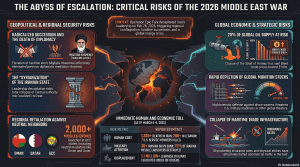
The assassination of Ayatollah Ali Khamenei on the war’s first day was intended to catalyze a regime collapse. Instead, it produced a “Decapitation Paradox.” Rather than surrendering, the Islamic Republic’s leadership radicalized, quickly elevating Khamenei’s son, Mojtaba Khamenei, as the new Supreme Leader on March 8.Mojtaba is no mere dynastic placeholder; he is a hardline cleric whose power is rooted in the “Habib Ibn Mazahir Battalion” of the 27th Mohammad Rasoul Allah Division. These deep-seated ties to the IRGC security apparatus and figures like former intelligence chief Hossein Taeb ensure that the regime’s response will be dictated by its most militant factions. This transition has functionally “burned the off-ramps.” The destruction of centralized command-and-control nodes has led to a “strategic vacuum” where local IRGC units operate with lethal autonomy. This “Syrianization” of the conflict—the collapse of central authority into a mosaic of competing warlords and looted armories—makes any future “Day After” plan nearly impossible to negotiate.”For the Islamic Republic, the strategy is premised on the notion that survival is victory. This time round, that proposition will be tested in extreme fashion.” — International Crisis Group
3. The Myth of the Neutrality Shield: Why the Gulf States Got Hit Anyway
The 2023 Chinese-brokered rapprochement between Riyadh and Tehran was meant to serve as a regional safety net. That illusion shattered within 48 hours of the first strike. Despite official declarations of neutrality and a refusal to allow U.S. forces to use their airspace for offensive sorties, the Gulf Cooperation Council (GCC) states were targeted by over 2,000 Iranian drones and missiles.Tehran’s retaliation represents a deliberate “catastrophic betrayal” of regional diplomacy. By specifically targeting neutral mediators like Oman and Qatar, Iran has systematically destroyed the region’s only diplomatic safety valves. According to CSIS analysis, while Iranian exports of 1.6 million barrels per day (mb/d) are at risk, a staggering 18 mb/d of non-Iranian oil transiting the Strait of Hormuz is now under threat, placing the global energy market in a state of vertical escalation.Key Economic and Civilian Targets Struck:
- UAE: Jebel Ali Port and Dubai International Airport; infrastructure in Dubai saw critical damage.
- Qatar: The Ras Laffan LNG facility, halting operations at the world’s largest gas export site.
- Saudi Arabia: Major refineries and residential areas in Kharj, resulting in civilian casualties.
- Bahrain: Desalination plants and residential buildings near the U.S. 5th Fleet base at Salman Port.
4. The Ukraine Connection: Kyiv as a Middle Eastern Security Exporter
In a remarkable instance of geopolitical arbitrage, Ukraine has emerged as a net exporter of security expertise to the wealthy Gulf monarchies. On March 9, 2026, President Volodymyr Zelensky confirmed that Ukrainian personnel, battle-tested by four years of Iranian-made Shahed drone barrages, were being deployed to the Gulf.Ukrainian firms like SkyFall —capable of producing up to 50,000 interceptors a month—are now offering to export between 5,000 and 10,000 drones monthly to allies like the UAE and Kuwait. There is a profound irony in a nation under active invasion from Russia solving the West’s “munitions industrial base” crisis. Kyiv is effectively leveraging its unique technical institutional knowledge to protect the very energy corridors that the international community has struggled to secure.
5. Strategic Incoherence: The War Without an Exit Ramp
As the conflict enters its second week, a glaring strategic incoherence has emerged. While the Trump administration has set maximalist goals—annihilating the Iranian Navy and “razing the missile industry to the ground”—there is no credible successor elite in place to manage the resulting void.This has resulted in what analysts call “alliance entrapment.” The imminent threat used to justify the war was not an unprovoked Iranian strike, but rather the anticipated response to an inevitable Israeli “wildcard” attack. By joining the campaign to maintain control over the trajectory, Washington has inherited a maximalist agenda of regime overthrow without a viable endgame.”The imminent threat was the Iranian response to an Israeli attack… This is the textbook definition of entrapment, in which an ally drags a great power into a conflict.” — Daniel DreznerWhile Secretary of State Marco Rubio publicly justified the strikes as a pre-emptive necessity to protect U.S. lives, the internal logic remains circular: Washington struck first to mitigate the fallout of a war it felt it could no longer prevent its ally from starting.
6. The “Digital Panopticon” Strategy: Punching Holes in the Sky
A distinct feature of “Epic Fury” has been the systematic targeting of Iran’s surveillance and cyber infrastructure. On March 9, the combined force struck the Sahab Pardaz Company, the firm responsible for the regime’s internet filtering, surveillance, and “espionage tools.”The tactical rationale was to “punch holes in the digital sky,” disabling the regime’s ability to monitor its citizens during what was already the 10th consecutive day of a nationwide internet shutdown. However, instead of sparking a coherent pro-democracy uprising, the destruction of the state’s “digital panopticon” has mostly generated localized chaos. Without a centralized digital or physical authority, the country risk sliding into a fragmented landscape of ethnic militias and regime remnants, further complicating any stabilization efforts.
7. Conclusion: The Inertia of Escalation
With 1,900 Iranian commanders and soldiers killed and at least 1.6 mb/d of oil removed from the market, the logic of force has achieved its own momentum. The participants are no longer masters of the event; they are caught in the inertia of escalation.As the “monstrous power” of the conflict continues to expand, the fundamental question for the coming weeks is whether the international system can survive a protracted showdown that possesses no clear definition of victory. As the map continues to catch fire, the Middle East is no longer standing at a crossroads—it is navigating a geography that is being rapidly unmade.