
Your Smartphone’s Next Roaming Partner is 350 Miles Up: 5 Surprising Realities of Starlink’s “Cell Towers in Space”
March 8, 2026 /Mpelembe Media/ — The provided sources examine the emergence and rapid expansion of Direct-to-Cell (D2C) technology, specifically focusing on Starlink’s efforts to provide Supplemental Coverage from Space (SCS). Research highlights that these satellite-based networks allow unmodified 4G LTE smartphones to connect directly to orbiting satellites, effectively eliminating terrestrial dead zones in remote areas like national parks. While initial commercial services in the United States and New Zealand focused on text messaging and emergency alerts, the technology is evolving to support voice, high-speed data, and IoT applications. Significant milestones include Airtel Africa and MTN Zambia partnering with SpaceX to launch services across the African continent, successfully piloting the first satellite-based fintech transactions. Despite technical hurdles like lower signal power and Doppler shifts, regulatory bodies worldwide are modernizing frameworks to accommodate this hybrid orbital-terrestrial model. Ultimately, these sources position D2C as a transformative tool for global digital inclusion, promising near-universal connectivity without the need for traditional ground infrastructure.
Direct-to-Cell (D2C) technology, also known as Direct Satellite-to-Device (DS2D), represents a shift in telecommunications where Low Earth Orbit (LEO) satellites function as “cell towers in space”. This system allows standard, unmodified LTE/4G/5G smartphones to connect directly to satellite constellations without requiring specialized hardware, apps, or firmware updates.
Commercial Availability: Messaging services are currently live in the United States (via T-Mobile) and New Zealand (via One NZ.
Performance Metrics: Technical studies indicate a current median throughput of approximately 4 Mbps per beam in outdoor conditions. While signal power (RSRP) is significantly lower than terrestrial networks due to distance, signal quality (RSRQ) is often higher in remote areas because of minimal interference.
Future Growth: Performance is expected to improve to 24 Mbps through increased radiated power, wider spectrum allocation, and the deployment of next-generation V2 satellites launched by Starship.
MTN Zambia: In March 2026, MTN Zambia became the first African operator to successfully complete field testing of the service. Notably, they conducted the country’s first satellite-based fintech transaction using the MoMo platform, demonstrating the technology’s potential for financial inclusion. Commercial rollout is expected within weeks.
Airtel Africa: Airtel has partnered with SpaceX to launch D2C services in 2026 across 14 African markets, serving a combined 174 million customers. The rollout will begin with SMS and basic data, eventually scaling to broadband.
Emergency Utility: D2C has already proven critical during natural disasters, such as hurricanes in the US and blackouts in Ukraine, by providing a lifeline when ground-based towers fail.
Regulatory Evolution: Regulators like the FCC (US) and ZICTA (Zambia) are modernizing frameworks to include “blanket licensing” for satellite terminals and managing spectrum sharing to prevent interference with existing terrestrial services.
1. Introduction: The Death of the “No Service” Screen
Imagine encountering a severe car crash on a desolate stretch of New Zealand road, only to look at your phone and see the dreaded “No Service” text. For decades, this silence was the accepted price of remoteness—the result of an economic reality where a $150,000 terrestrial cell tower simply doesn’t make sense in a canyon or a floodplain. That era of isolation is ending.
We are currently witnessing a fundamental re-architecting of global infrastructure, transitioning from ground-reliant relay networks to a space-based mesh architecture. Direct-to-Cell (D2C) technology allows the satellites of the Starlink constellation to function as “cell towers in the sky,” erasing the very definition of a dead zone. By synthesizing the latest field data from the U.S. and Africa, we can see how this hybrid space-terrestrial network is about to change our relationship with the planet.
2. Your Current Phone is Already a Satellite Phone (No Upgrades Required)
The most profound technical achievement of Starlink’s D2C system is its total transparency to the end user. You do not need to purchase a specialized handset with a bulky antenna or wait for a firmware update. If you own a standard, unmodified 4G LTE or 5G smartphone, you already own a satellite phone.
This is made possible by an onboard eNodeB (evolved Node B) modem payload on Starlink’s “Gen2” satellites. These satellites essentially act as “roaming partners” in orbit. Using advanced phased array antennas and custom silicon, the satellite “tricks” your phone into thinking it has connected to a traditional ground-based tower, managing the extreme Doppler shifts caused by a satellite traveling at 17,000 miles per hour.
“Direct-to-Cell works seamlessly with the LTE-compatible phone you already have. Your phone’s existing hardware, firmware, and apps function just as they do now. The satellites act as cell towers in space… meaning no upgrades or special modifications are necessary.” — Starlink Direct to Cell Basics
3. The Technical Paradox: Lower Power, Higher Quality
Analytical data from recent crowdsourced measurement studies in the U.S. reveals a fascinating paradox. Satellite signals are objectively “weaker” than terrestrial ones, with a median Reference Signal Received Power (RSRP) that is 24 dB lower than traditional networks. However, in the wilderness, “less power” from space often outperforms “more power” from the ground.
Because these signals operate in remote areas where the airwaves are “unloaded” and free from terrestrial interference, they exhibit a 3-dB higher median Signal Quality (RSRQ) compared to crowded ground networks. While the current SMS-only testing phase offers a throughput of roughly 4 Mbps per beam, the technical ceiling is much higher. With increased radiated power and wider bandwidth, this architecture is projected to hit 24 Mbps—enough for full high-speed broadband in the middle of a national park.
“Based on SINR measurements, we estimate the expected performance of the announced DS2D mobile data service to be around 4 Mbps per beam in outdoor conditions. This is a game-changer for underserved regions.” — arXiv Measurement Study
4. Africa is the Front Line of the Satellite Fintech Revolution
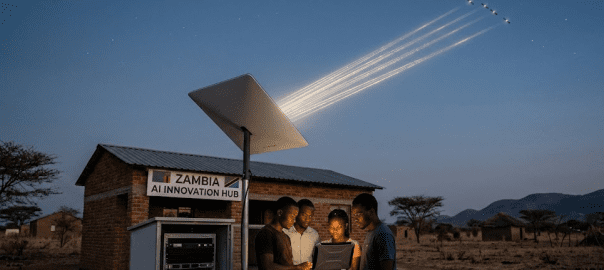
While the U.S. focuses on emergency texting, Africa is using the orbital layer to solve the “last mile” of financial inclusion. In March 2026, MTN Zambia beat rivals to the punch by completing the first-ever field test of a fintech transaction conducted entirely via satellite. Using the MoMo (Mobile Money) platform, the test proved that a satellite 350 miles up can act as a financial gateway for the unbanked.
This is the visionary core of D2C: the convergence of space tech and affordable hardware. A strategist sees the real impact when this technology meets the GSMA-led $40 smartphone coalition. When a low-cost handset can process a MoMo transaction in a remote village where a terrestrial tower is economically impossible, the satellite becomes a primary driver of economic empowerment.
“Starlink’s Direct-to-Cell technology complements the terrestrial infrastructure and even reaches areas where deploying terrestrial network solutions are challenging. It will establish a new standard for service availability.” — Sunil Taldar, Airtel Africa CEO
5. Scaling from SMS to “Full 5G” via Starship
The transition from simple SMS (2024/2025) to full voice and data (2026) is a matter of launch physics. Current Falcon 9 rockets have reached their limit for deploying the massive “Gen2” satellites required for high-speed connectivity. The key to the promised 20x improvement in data speeds is SpaceX’s Starship vehicle, which is required to loft the heavier, more powerful satellite payloads into orbit.
This rollout also introduces a new “Reciprocal Global Access” business model. Under this framework, a T-Mobile user from the U.S. could travel to Japan and use KDDI’s spectrum via Starlink’s orbital mesh without switching SIMs or paying traditional roaming fees. The partnership pipeline already includes:
North America: USA (T-Mobile), Canada (Rogers)
Oceania: New Zealand (One NZ), Australia (Optus, Telstra)
Africa: Zambia (MTN, Airtel), Nigeria (Airtel)
Asia & Europe: Japan (KDDI), Switzerland (Salt), Ukraine (Kyivstar)
6. The Regulatory “Safety Net” and Emergency Impact
The “space towers” have already proved their worth during Hurricanes Helene and Milton and the Los Angeles wildfires. When fiber lines were cut and ground towers lost power, the FCC granted “Special Authority” for D2C. This enabled over 1.5 million people to stay connected, and crucially, allowed Wireless Emergency Alerts (WEA) to be transmitted to every subscriber in the area, regardless of their specific carrier.
To maximize this impact, regulators are beginning to loosen technical constraints. In March 2025, the FCC granted a conditional waiver allowing Starlink to increase its out-of-band emission (OOBE) limits by 10 dB. This “analytical win” for the industry allows for higher radiated power, which is essential for maintaining stable connections through weather and terrain—effectively hardening the orbital safety net.
7. Conclusion: A Planet Without Dead Zones
We are witnessing the permanent erasure of the word “remote.” The transition from ground-reliant relay networks to a space-based mesh architecture means that “remoteness” will soon be a choice, not a technical limitation.
Whether it is a rural health worker in Zambia accessing records via the MoMo app or a traveler in the Rockies receiving an emergency alert, the gap is closing. As the entire planet becomes a functional cell zone, we must ask: how will our relationship with the “great outdoors” change when the silence of the wilderness is no longer a given?