Navigating Zambia’s Digital Payment Landscape
Wed, July 29 2026 /Mpelembe Media/ — The Zambian digital payment ecosystem historically struggled with severe fragmentation, relying heavily on bilateral agreements between financial institutions and routing domestic card transactions through expensive international networks. To address these structural inefficiencies and lower the cost of domestic electronic payments, the Bank of Zambia, the Bankers Association of Zambia, and the Zambia Electronic Clearing House Limited initiated the National Financial Switch project in 2013. The system was designed as a shared public utility to interconnect various payment streams, including automated teller machines, point-of-sale systems, and mobile money platforms, thereby eliminating the need for institutions to build and maintain costly bilateral connections.
The National Financial Switch operates under a joint public-private ownership model managed by the Zambia Electronic Clearing House Limited, where the Bank of Zambia holds a fifty percent stake and commercial member banks collectively own the remaining fifty percent. To manage technical risks and build industry consensus, the infrastructure was rolled out in two distinct phases. The first phase, launched in 2018, successfully migrated automated teller machine transactions to the local switch, which was subsequently followed by point-of-sale functionality in 2019. The second phase, completed in 2020, integrated interoperable electronic money and mobile wallets into the ecosystem. This expansion allowed for seamless wallet-to-bank, bank-to-wallet, and wallet-to-wallet transfers across different service providers, significantly expanding the reach of digital payments.
Architecturally, the National Financial Switch functions as a cross-domain interoperability platform operating twenty-four hours a day, seven days a week. It calculates net settlement positions for its participants, which are then settled once daily on a deferred basis at 4:30 PM through the Bank of Zambia’s real-time gross settlement system, known as the Zambia Interbank Payment and Settlement System. The switch boasts diverse direct participation, successfully connecting commercial banks, mobile money operators, microfinance institutions, and non-bank payment service providers. For digital wallet mapping and routing, the system currently utilizes mobile phone numbers as temporary proxy identifiers, with long-term plans to integrate biometric national identity numbers as secondary proxies to enhance security.
Despite its achievements in establishing physical connectivity, the architecture of the National Financial Switch faces several technical constraints. A primary limitation is its continued reliance on the legacy ISO 8583 messaging standard. While the high-value Zambia Interbank Payment and Settlement System upgraded to the modern ISO 20022 standard in October 2023, the retail-level switch’s older messaging format complicates integration with modern third-party fintech applications and regional fast-payment schemes, such as the Southern African Development Community’s Transactions Cleared on an Immediate Basis network. Furthermore, electronic funds transfers remain siloed on a separate batch-processed clearing system rather than being integrated into the main card and mobile switch. The switch also currently lacks support for advanced use cases such as tokenization and card-not-present e-commerce transactions, which restricts the growth of innovative digital retail capabilities in the domestic market.
Economically, while the shared infrastructure successfully reduced network acquisition and integration costs for financial providers, these savings have not yet translated into lower transaction fees for everyday consumers. The business model of the switch itself also faces sustainability issues, as revenue generated from application, participation, and transaction fees currently covers only about sixty percent of its operating costs, leaving the system reliant on supplementary funding. Looking ahead, the Zambia Electronic Clearing House Limited plans to expand the switch’s capabilities by introducing a standardized Quick Response code system, integrating agent banking, and deploying a centralized electronic Know Your Customer platform. Ultimately, transitioning the retail switch to the ISO 20022 standard will be essential to resolve current integration friction, enable cross-border interoperability, and fulfill the Bank of Zambia’s vision of a fully inclusive, round-the-clock digital economy.
Beyond the Rails: 7 Surprising Truths About Zambia’s Digital Money Revolution
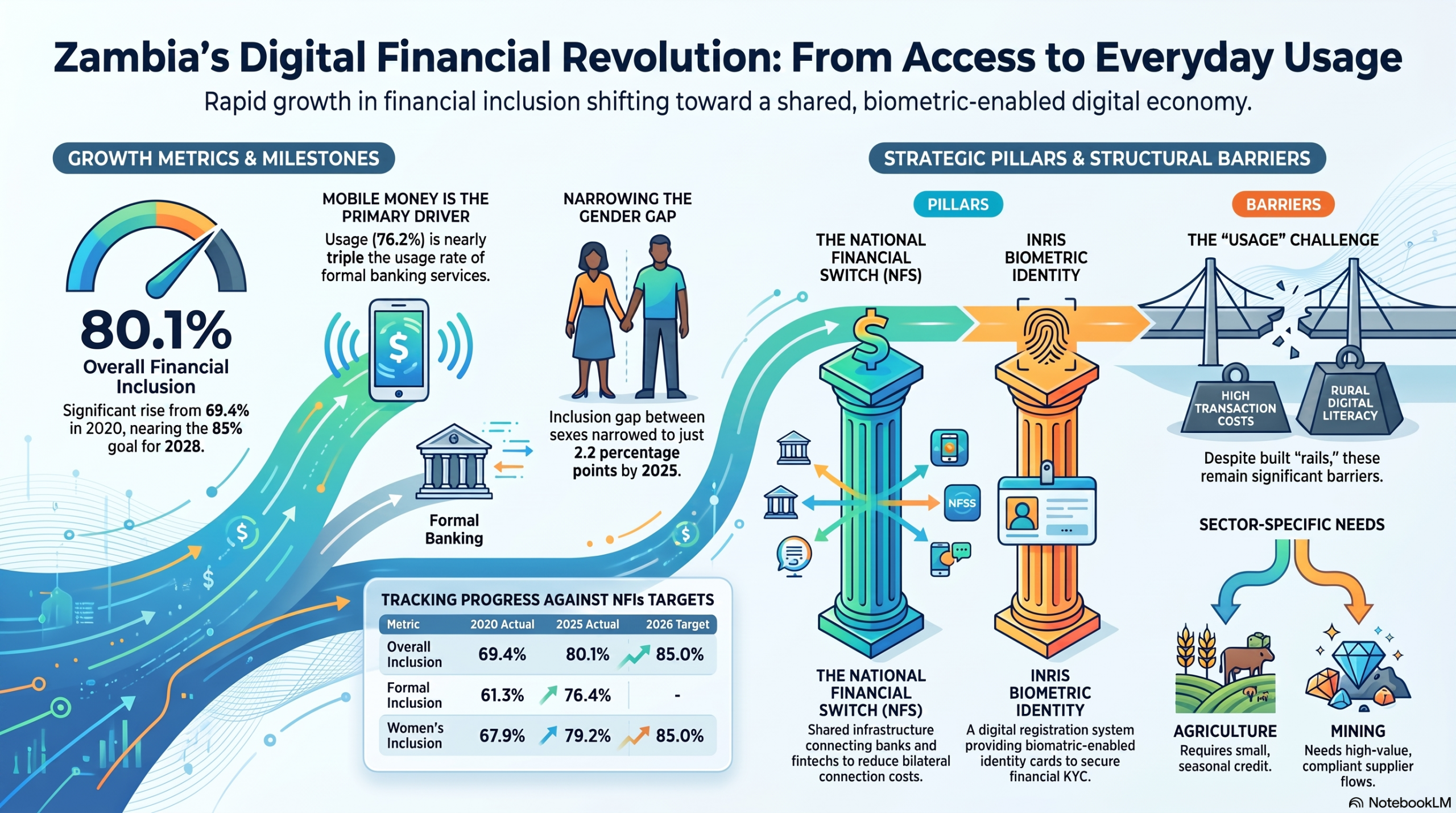
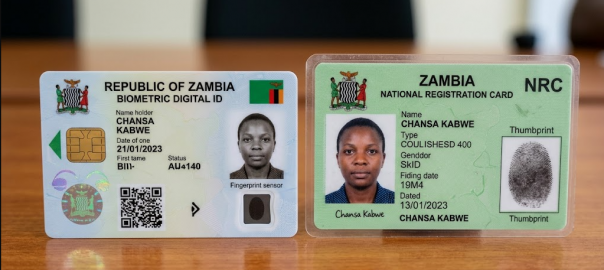
Until very recently, a Zambian citizen’s formal identity was tethered to a manual, paper-based system established in 1965. National Registration Cards (NRCs) were issued based on affidavits—a process prone to identity duplication and fraud. Today, that manual past is being rapidly overwritten by a high-tech present. In just five years, Zambia has undergone a profound structural transformation, moving from 69.4% financial inclusion in 2020 to a staggering 80.1% in 2025.As a Senior Digital Development Strategist, I view this shift as more than a statistical victory; it represents a transition from a low-access financial system to a mobile money-driven model. How did Zambia move from the fringes to becoming a regional leader in digital finance? The answer lies in seven counter-intuitive realities that define the nation’s current digital surge.
1. The 80% Milestone: Mobile Money is the Economic Engine, and Gender is the Catalyst
According to the Zambia FinScope 2025 Survey , overall financial inclusion has reached 80.1%. However, the core of the story is the rise of mobile money usage to 76.2%—nearly triple the 20.7% usage rate of traditional banking.Strategic Analysis: This is no longer about “moving money”; it is about “productive integration.” For the first time, we are seeing a significant narrowing of the gender inclusion gap, which shrank from 11.4 percentage points in 2017 to just 5.3 points in 2024. Policy has pivoted under the National Financial Inclusion Strategy (NFIS) II , which sets an ambitious target of 85% inclusion for women by 2028. By prioritizing gender-disaggregated data, regulators are now treating women as a high-potential segment rather than an underserved one.”Zambia’s payments story is no longer just about moving money from one bank account to another,” notes Stephen Mulenga, Regional Manager for Sybrin. “It’s about how people, businesses, farmers, miners, SMEs and government participate in the digital economy.”
2. The Infrastructure Paradox: Connecting “Rails” is Not the Same as Lowering Costs
Zambia’s technical architecture is highly sophisticated. The National Financial Switch (NFS) connects banks, mobile operators, and fintechs into a shared ecosystem, eliminating the need for expensive bilateral connections.Strategic Analysis: While the “rails” are built, the expected dividend of lower transaction costs for the end consumer remains an active regulatory battleground. There is an “unspoken” gap between technical interoperability and consumer affordability. While the NFS has moved Zambia toward a shared infrastructure arrangement, the Bank of Zambia is currently focusing its efforts on driving down those transaction costs to ensure that the backend efficiencies finally reach the average citizen’s wallet.
3. A $14 Billion Engine: Remittances as a Risk-Sharing Mechanism
In 2023, domestic remittances in Zambia reached USD 14.1 billion—a figure representing over half of the nation’s GDP. This massive flow of funds is facilitated by a network of mobile money agents that 53.6% of the population can reach on foot in under 30 minutes, outperforming traditional bank accessibility by a factor of three.Strategic Analysis: Beyond simple transfers, mobile money has become a vital “risk-sharing mechanism” that protects households from macroeconomic vulnerabilities and climate-related shocks. When drought or flooding hits rural regions, the immediate infusion of digital cash from less affected areas acts as a decentralized safety net. This digital resilience is essential in a country where climate shocks are increasingly frequent.
4. The Migration Catalyst: Digital Wallets are Powering Urbanization
Data from the 2022 Labour Force Survey reveals a striking correlation: daily mobile money users are over four times more likely to have moved districts in the last 12 months compared to non-users.Strategic Analysis: Mobile money is a primary tool for “structural transformation,” lowering the barriers for workers to move from low-productivity subsistence agriculture (which accounts for 59% of employment but only 3.4% of GDP) into more productive urban sectors. By allowing migrants to maintain financial links and participate in group insurance schemes in their home villages from a distance, digital wallets lower the perceived risk of migration, facilitating the movement of labor toward growth centers.
5. The “Regressive” Tax Challenge: When Policy Distorts Behavior
The Mobile Money Transaction Levy Act No. 25 of 2024 introduced a tax structure ranging from 0.04% to 0.21%. Because the fee percentage is higher on smaller transactions, it hits low-income users hardest.Strategic Analysis: Predictably, the market is responding to this tax distortion. In Q1 2025, while transaction volumes increased by only 14%, the total value of those transactions soared by 128%. Consumers are consolidate their activity—sending one large payment instead of several small ones—to minimize the tax burden. Strategists and the International Growth Centre (IGC) suggest that a more progressive fee structure, where larger, less price-sensitive transactions carry a higher burden, would be more equitable and potentially more lucrative for domestic revenue mobilization.
6. Identity is the New Currency: The NRC at Birth
Zambia is moving away from the manual paper-based cards of the 1960s toward the Integrated National Registration Information System (INRIS). Unlike the old system, which required citizens to wait until age 16 for a National Registration Card, INRIS assigns a national identity number at birth.Strategic Analysis: This biometric database is the essential “missing link” for “Know Your Customer” (KYC) guidelines and credit access. By issuing digital NRCs that include “financial wallets,” the government is creating a foundation for instant identity verification. This will allow financial institutions to prudently manage risk and finally extend credit products to the previously unbanked population based on a verifiable, biometric-backed identity.
7. The Farmer’s Choice: Simplicity Over Specialization
Development programs often focus on “climate-smart” or specialized agricultural loans. However, the ADA/SSNUP Stakeholder Survey involving AB Bank Zambia found that while 92% of farmers reported improved quality of life from loans, nearly 45% preferred general microloans over specialized ones.Strategic Analysis: For the smallholder farmer, flexibility is the ultimate feature. Using platforms like the eTumba mobile wallet—which served approximately 77% of these clients—farmers utilize general credit to navigate the seasonal and unpredictable income patterns of rural life. Specialized products often fail to account for immediate household needs, whereas general-purpose digital wallets provide the liquidity required for both agricultural inputs and daily survival.
Conclusion: From Rails to Routine
Zambia has successfully built the “rails” for a digital revolution. The leap to 80.1% inclusion is historic, but the next frontier is “usage-driven inclusion” and “financial health.”The ultimate success of this revolution will depend on embedded finance —the integration of financial services into the daily activities Zambians are already doing, such as buying produce, paying suppliers, or ordering stock. The challenge now is to transition from the ability to transact to the habit of transacting. Will digital tools alone drive development, or will the “human” factors of trust, transaction cost, and product simplicity be the ultimate deciders? The infrastructure is in place; the next chapter will be written by how effectively we turn these rails into the routine fabric of Zambian life.