
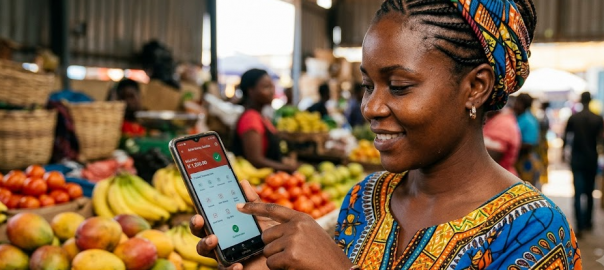
Zambia’s Digital Payment Landscape: Bridging the Gap from Rails to Routine
Wed, July 29 2026 /Mpelembe Media/ — Zambia has made remarkable strides in expanding financial access, achieving a financial inclusion rate of 80.1% by 2025, a significant increase from 69.4% in 2020. A cornerstone of this progress is the National Financial Switch (NFS), a shared infrastructure that connects banks, payment service providers, fintechs, and mobile money operators. By facilitating wallet-to-bank, bank-to-wallet, and merchant transactions, the NFS eliminates the need for institutions to build expensive bilateral connections. However, despite these foundational achievements, Zambia faces a critical new challenge: transitioning these digital “rails” into an affordable, trusted, and everyday routine for its citizens.
The primary obstacle in this next phase is that the anticipated drop in domestic electronic transaction costs has not yet materialized for the average customer. Establishing shared infrastructure is only a starting condition, and high costs continue to deter widespread daily usage. Furthermore, physical and educational barriers persist, particularly in rural regions. These areas struggle with limited agent networks, low smartphone penetration, weak internet connectivity, and lower levels of digital literacy.
Beyond infrastructure, a major systemic flaw lies in the design of the financial products themselves. Currently, the system is predominantly modeled for consumers who receive a predictable, salaried monthly wage. This design completely mismatches the reality of rural and agricultural populations, whose incomes are often small, seasonal, and unpredictable. This disconnect highlights the vastly divergent needs of Zambia’s two defining economic engines: copper mining and agriculture. The mining industry requires a system built for high-value, heavily compliant financial flows, such as cross-border trade, tax payments, and massive payrolls. In contrast, the agricultural sector desperately needs “last-mile” digital solutions tailored to prompt farmer payouts, seasonal credit, and input financing.
To bridge this economic divide, industry experts point to the necessity of embedded finance. Instead of solely targeting end consumers, technology providers must digitize entire value chains by integrating financial services directly into the daily activities people are already doing, such as buying produce or paying suppliers. In this model, Small and Medium Enterprises (SMEs) become the vital bridge between digital payments and real-world economic activity. SMEs require sophisticated but accessible tools for reconciliation, inventory finance, and working capital, rather than just basic payment acceptance.
The success of this transition relies heavily on the foundational layer of digital identity. The Integrated National Registration Information System (INRIS) is designed to manage civil registration and identity, which is essential for fraud detection, credit access, and government disbursements. However, this project is still a work in progress, with only about 1.5 million biometric enrolments completed in a population of roughly 20 million.
Looking ahead, the Bank of Zambia has established a vision for a round-the-clock digital economy by 2027. Reaching this milestone will require the full financial ecosystem to become entirely interoperable, utilizing common languages and standards like ISO 20022 to seamlessly connect banks, wallets, government platforms, and regional settlement rails. Ultimately, the future of Zambia’s digital payment landscape is not just about replacing cash, but about engineering an inclusive system that accelerates economic activity for everyone from the last-mile farmer to the large-scale miner.
Why Building the “Rails” Was the Easy Part: 5 Surprising Truths About Zambia’s Digital Economy
Introduction: The Infrastructure Paradox
Zambia has achieved a milestone that is the envy of many emerging markets: the construction of a world-class, interoperable payment architecture. With the National Financial Switch (NFS) now handling domestic card traffic and connecting disparate financial silos, the country has reached a significant milestone. According to the 2025 FinScope survey, financial inclusion has surged to 80.1%, with mobile money usage alone sitting at 76.2%.Yet, a paradox defines the current landscape. While the “rails” are polished and the population technically has the “ability” to pay digitally, the “habit” of doing so remains elusive. Cash continues to dominate daily life. For the digital transformation strategist, the lesson is clear: building the pipes was the engineering challenge; convincing the economy to flow through them is the systemic one.
The Invisible Savings Gap: Why Efficiency Isn’t Reaching the Bottom Line
The NFS was engineered to move Zambia from a fragmented landscape of bilateral connections toward a centralized, shared infrastructure. In theory, by removing the need for banks and fintechs to build individual bridges to one another, the cost of transacting should plummet. However, shared infrastructure is a starting condition, not a guaranteed outcome.Despite the technical efficiencies gained, consumers have yet to see a significant reduction in fees. This gap exists because infrastructure savings are often swallowed by the high costs of “last-mile” agent networks, bank margins, and the operational overhead of maintaining liquidity in rural areas. As Stephen Mulenga, Regional Manager for Zambia at Sybrin, notes:”There is something that is sort of unspoken when it comes to our National Financial Switch. One of the drivers was that it was going to drive down transaction costs for customers. That hasn’t happened yet, but the central bank has got some focus on that.”
Designing for Paychecks in a Harvest-Cycle World
The secondary gatekeeper to digital adoption isn’t just cost—it is product-market fit. A recurring failure in digital finance is the tendency to design products for the “salaried customer” who receives a predictable, monthly wage.This creates a fundamental mismatch in a country where income is often seasonal and arrives in small, irregular increments. While digital literacy is frequently blamed for low adoption, the deeper issue is often structural. If a digital wallet is built for a lifestyle the user does not lead, the friction of switching from cash outweighs the benefit. To move from ability to routine, providers must pivot toward digitizing the entire value chain rather than just the individual transaction.
The Copper-Maize Divide: Why One Size Fits No One
Zambia’s digital economy is effectively a tale of two industries, each requiring a completely different strategic approach to liquidity and risk.
- The Mining Sector (Copper): This industry demands “high-value compliance.” The digital needs here center on high-volume supplier payments, complex payroll systems, tax obligations, and seamless cross-border trade flows.
- The Agricultural Sector (Maize): This sector requires “last-mile micro-credit.” Success here depends on farmer payouts, input financing, seasonal credit cycles, and weather-indexed insurance.A unified digital ecosystem must solve for both. One requires heavy institutional security and international interoperability, while the other demands extreme accessibility for the small-scale producer at the edge of the network.
Identity: The Broken Foundation Under the Rails
A sophisticated payment rail is only as strong as the “layer underneath”—identity. Without a robust digital ID system, KYC (Know Your Customer) protocols become a bottleneck, fraud detection remains reactive, and credit scoring stays rudimentary.Zambia’s Integrated National Registration Information System (INRIS) is intended to be this foundation, but the implementation remains a significant strategic hurdle. Currently, biometric enrollment stands at only 1.5 million people in a population of roughly 20 million. While the Smart Zambia Institute aims for full digital ID issuance by the end of 2026, the reality is that identity has been a “work in progress for quite some time.” Until this gap is bridged, the rails will continue to carry the weight of an inefficient identity verification process.
Beyond Cash Replacement: The SME Bridge to Embedded Finance
The endgame of Zambia’s digital evolution isn’t merely the disappearance of physical banknotes; it is the rise of “embedded finance.” This means moving beyond standalone payment apps and placing financial services directly into the tools people use for their livelihoods—whether that’s an app to order fertilizer or a platform for a merchant to restock inventory.SMEs are the critical “bridge” in this transition. If an SME cannot use digital payments to simplify reconciliation, access working capital, or manage inventory finance, they will continue to prefer cash, and the consumer’s digital habit will never form.”SMEs are the bridge between digital payments and real economic activity.”
Conclusion: Moving from Ability to Routine
Zambia has the infrastructure, and its 2027 vision for a round-the-clock digital economy is ambitious. However, achieving this requires a shift from technical existence to ecosystem-wide interoperability. For the system to truly scale, banks, wallets, and government platforms must speak a common technical language through global standards like ISO 20022 .As the technical rails become a standard part of the background, the final barrier to a truly digital Zambia may not be technological at all. It is a question of trust and reliability. Only when digital payments are cheaper, faster, and more reliable than the cash in a person’s pocket will the “routine” finally catch up to the “ability.”