
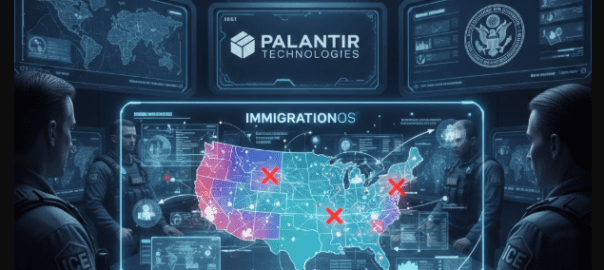
Jan. 9, 2026 /Mpelembe Media/ — On January 7, 2026, the fatal shooting of 37-year-old Renee Nicole Good by an ICE agent in South Minneapolis ignited a national firestorm, exposing the lethal intersection of mass deportation policies and AI-driven surveillance. While federal officials, including President Trump and DHS Secretary Kristi Noem, have labeled Good a “domestic terrorist” who weaponized her vehicle, eyewitness accounts and independent video forensics suggest a far different reality: a U.S. citizen and mother of three attempting to steer her SUV away from a chaotic federal enforcement action.
The crisis has deepened into a constitutional standoff as the FBI seized sole control of the probe, barring Minnesota state investigators from accessing evidence. At the heart of the legal battle is ImmigrationOS, the Palantir-developed AI system that reportedly “flagged” Good’s vehicle due to a clerical data mismatch. As Minneapolis Mayor Jacob Frey and Governor Tim Walz demand the immediate withdrawal of federal agents, the upcoming January 12th hearing by the Hennepin County Attorney represents a pivotal moment for state sovereignty, digital privacy, and the demand for human accountability in an age of algorithmic policing.
In 2026, U.S. Immigration and Customs Enforcement (ICE) is operating under a significantly expanded mandate.1 The agency has shifted from a “priorities-based” enforcement model (which focused on specific threats like violent criminals) to a “mass deportation” strategy that targets a much broader population of undocumented individuals and non-citizens.
ImmigrationOS has become the central nervous system for U.S. immigration enforcement. Developed by Palantir Technologies under a $30 million contract awarded in early 2025, it is an AI-driven “super-network” designed to automate the identification and removal of non-citizens.
Here is the breakdown of how the system functions and the legal firestorm it has created:
The “Digital Dragnet”: How It Works
ImmigrationOS is not a single database; it is a platform that integrates disparate streams of information to create comprehensive, real-time profiles of individuals.
Data Aggregation: The system pulls from the IRS (tax records), Social Security Administration, DMV (driver’s licenses), and passport activity.
Real-Time Surveillance: It integrates license plate reader data and geolocation info to track movements. Reports from late 2025 also indicate that ICE is using the system to monitor social media identifiers to map out “gang affiliations” or “community ties.”
Targeting Logic: The AI “flags” individuals based on specific triggers, such as a visa overstay or a discrepancy between tax filings and immigration status.
The Three Pillars of the System
According to government contract documents, ImmigrationOS has three primary functions:
Enforcement Prioritization: Automatically ranks individuals for arrest, officially prioritizing “violent criminals” and “visa overstays,” though critics argue the criteria for “criminality” are opaque.
Self-Deportation Tracking: Monitors whether individuals who were ordered to leave actually do so, providing “near real-time visibility” on departures.
Lifecycle Management: Streamlines the entire process from the first “flag” to the final boarding of a deportation flight.
Legal Challenges and “The Black Box”
As of January 2026, the American Immigration Council and the ACLU have filed several major lawsuits challenging the system.
The “Black Box” Problem: Lawyers argue that because the algorithm’s weighting is a “trade secret” of Palantir, they cannot see why their clients were flagged. This makes it nearly impossible to challenge a deportation order if the underlying data is incorrect (e.g., a clerical error at the DMV).
Racial Bias: Advocacy groups point to past AI failures, like the COMPAS sentencing tool, which was twice as likely to incorrectly label Black individuals as “high risk.” There are active legal claims that ImmigrationOS is replicating these biases by over-weighting data from over-policed neighborhoods.
U.S. Citizen Impacts: A significant privacy concern is that the system scans the data of everyone (including citizens) to identify those without status. In December 2025, a class-action lawsuit was filed in California alleging that ImmigrationOS illegally harvested the data of millions of U.S. citizens.
Summary of the Conflict (Jan 2026)
| Feature | Government Stance | Advocate Concern |
| Efficiency | Saves time/resources by automating case management. | Leads to “deportation quotas” and rushed due process. |
| Accuracy | AI reduces human error in identifying threats. | “Garbage in, garbage out”—bad data leads to wrongful arrests. |
| Privacy | Only targets those “under investigation.” | Creates a state of “total social control” for all residents. |
The Minneapolis shooting mentioned earlier has added urgency to these cases, as protesters claim the agent who shot Renee Nicole Good was acting on a “high-priority flag” generated by an algorithmic error.
Here is the current legal and operational state of ICE as of January 2026:
Shift to “Expedited Removal”
One of the most significant legal shifts is how ICE handled court cases.
Dismissing Court Cases: ICE attorneys are increasingly moving to dismiss existing immigration court cases.5 While this sounds positive, it is often a tactical move to strip individuals of their right to a full hearing before an immigration judge.
Fewer Due Process Rights: Once a court case is dismissed, the individual is often funneled into “Expedited Removal.” This process allows ICE to deport someone within days without them ever seeing a judge or having a chance to present an asylum claim.
Massive Expansion of Detention
Congress recently authorized unprecedented funding for ICE, leading to a “Deportation-Industrial Complex.”
100,000 Bed Capacity: Funded detention capacity has been scaled up from roughly 41,000 to nearly 100,000 people.
Conditions in Detention: Reports from January 2026 describe “warehouse-style” detention facilities, particularly in border states. Human rights organizations (like the ACLU) have documented severe medical neglect and overcrowded conditions in centers like California City and Fort Bliss.
Deaths in Custody: December 2025 was recorded as one of the deadliest months for detainees in decades, with six deaths reported in a single month due to inadequate healthcare.
Increased Interior Enforcement
ICE has been “unleashed” in cities across the U.S., leading to high-profile incidents.
Workplace & Courthouse Raids: Workplace enforcement has returned as a core tool, with operations yielding hundreds of arrests at a time. ICE has also rescinded previous memos that restricted arrests near courthouses.
Manpower Increase: A massive recruitment campaign in 2025 added over 12,000 new officers, a 120% increase in manpower.
Recent Incidents: Just yesterday (January 8, 2026), an ICE officer fatally shot a woman during an enforcement action in Minneapolis, sparking nationwide protests and renewed legal scrutiny over the agency’s use-of-force policies.
The Use of “ImmigrationOS” (AI)
In 2026, ICE is utilizing a new AI-driven case management system called ImmigrationOS.
Data Integration: This system aggregates data from the IRS, DMV, Social Security, and license plate readers to identify and locate individuals for arrest.
Algorithmic Profiling: Critics argue this system automates racial profiling, while the government maintains it is necessary to streamline the “millions” of pending removals.
Comparison: ICE Enforcement Strategy (2024 vs. 2026)
| Feature | 2024 Policy | 2026 Policy |
| Primary Target | Convicted violent criminals | Any person without legal status |
| Court Access | Full hearings before a judge | Move toward “Expedited Removal” |
| Detention Bed Cap | ~41,500 | ~100,000 |
| Enforcement Style | Targeted operations | Mass raids & AI-driven surveillance |
The legal community is currently responding with a surge of Habeas Corpus petitions, where lawyers are asking federal courts to force ICE to justify why individuals are being held without a trial.
The legal and social situation involving ICE and “Sanctuary Cities” has reached a boiling point this week, specifically due to a fatal incident in Minneapolis that has triggered a major constitutional showdown.
As of January 9, 2026, here are the details on the shooting and the broader legal battle:
The Killing of Renee Nicole Good (Minneapolis, Jan 7, 2026)
A 37-year-old U.S. citizen named Renee Nicole Good was shot and killed by an ICE Enforcement and Removal Operations (ERO) agent in South Minneapolis.
The Incident: Witnesses and bystander video show Good in her Honda Pilot being approached by several ICE agents. As she attempted to drive away, an agent fired three shots into her windshield and side window.
The “Two Narratives”: * Federal Government: The White House and DHS Secretary Kristi Noem have labeled her actions “domestic terrorism,” claiming she tried to run over officers.
Local Officials: Minneapolis Mayor Jacob Frey and Governor Tim Walz have called the federal narrative “propaganda” and “garbage,” stating the video shows she was driving away from, not toward, the agents.
Legal Conflict: In a rare move, the FBI took over the investigation yesterday, blocking the Minnesota Bureau of Criminal Apprehension (BCA) from the evidence. Governor Walz stated he no longer believes a “fair outcome” is possible due to this federal takeover of the probe.
The Sanctuary City Legal “War”
The federal government has shifted from verbal threats to aggressive legal and financial maneuvers against cities that refuse to cooperate with mass deportations.
The “Sanctuary Lawsuit”: The DOJ has filed a series of lawsuits against Boston, New York, and Chicago, arguing that local “Sanctuary” laws interfere with federal law.
Funding Withholding: As of early 2026, the administration has begun trying to withhold Commerce, Justice, and Science (CJS) grants from cities like Denver and Los Angeles. Denver’s legal bill for defending its status has already hit a $2 million limit this month.
State Defiance: In contrast to sanctuary cities, states like Texas have passed new laws for 2026 that require local sheriffs to partner with ICE or face criminal charges themselves.
Proposed Federal Reforms: The “Murphy Package”
In response to the Minneapolis shooting, Senator Chris Murphy (D-CT) announced yesterday (Jan 8) a major legislative push to restrain ICE. The proposed laws would:
Require Warrants: Mandate a judicial warrant for all interior arrests (currently, ICE often uses administrative warrants).
Ban Masks: Prohibit ICE agents from wearing tactical masks during enforcement operations to ensure accountability.
Geographic Limits: Limit Border Patrol’s ability to operate in cities more than 100 miles from the border.
Comparison of Jurisdictional Powers (January 2026)
| Entity | Strategy | Current Action |
| Federal (ICE/DHS) | “Mass Deportation” | Deployed 2,000 extra agents to Minneapolis; using AI “ImmigrationOS” for tracking. |
| Sanctuary Cities | “Shield Laws” | Refusing to share DMV/Medicaid data; filing for emergency injunctions against funding cuts. |
| Courts | “Habeas Corpus” | Federal judges in CA and IL are currently hearing cases on whether ICE can hold U.S. citizens “by mistake.” |
The situation is incredibly fluid. In Minneapolis, hundreds of protesters are currently surrounding the federal building, and “non-violent emergency protests” are scheduled for the weekend in at least 12 major cities.