
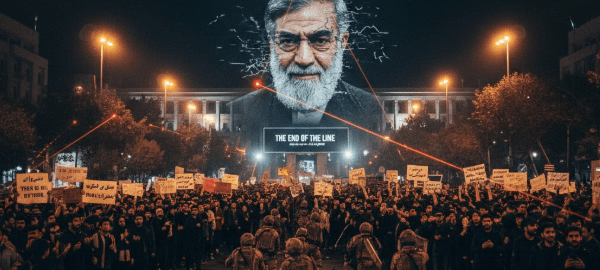
Jan. 9, 2026 /Mpelembe Media/ — The Iranian regime is currently facing its most existential challenge since the 1979 Revolution. As of January 9, 2026, the situation has shifted from sporadic economic protests into a coordinated nationwide uprising.
The Political Shift: Exiled Crown Prince Reza Pahlavi has crossed a historic threshold, moving from a symbolic figure to an operational leader. His “8:00 PM Call” for nationwide action on January 8 and 9 was answered in over 100 cities, demonstrating a level of “command-and-control” over the streets that the opposition has lacked for decades.
The Security Crisis: The regime has exhausted its first line of defense. With the police (LEC) and Basij facing “bandwidth exhaustion,” the IRGC Ground Forces have been deployed. For the first time, elite IRGC units are suffering casualties in urban street battles, while rumors of a “Moscow Contingency” (a plan for the Supreme Leader to flee to Russia) have severely damaged the morale of the rank-and-file.
The Geopolitical “Airlift”: A desperate Moscow-Tehran axis has emerged. Russian cargo planes are reportedly landing in Tehran with riot gear and attack helicopters, while outbound flights are allegedly carrying state gold reserves, signaling that the inner circle is liquidating assets in case of a collapse.
International Brinkmanship: The Trump Administration has adopted a “Locked and Loaded” doctrine, threatening direct military intervention if the regime initiates a mass-casualty crackdown. This has created a “deterrence shield” that prevents the IRGC from using its full lethal capacity, giving the protests room to breathe.
The Global Impact: A regime collapse would lead to a massive power vacuum in Iraq, Lebanon, and Syria, potentially ending the “Axis of Resistance.” However, it also raises the immediate global risk of “loose nukes” and a scramble for control over the Strait of Hormuz.
The next 48 hours are decisive. If the internet blackout remains total and the IRGC Ground Forces fail to clear the streets by Monday, we may witness the first major “palace coup” or military fracture.
Iran is navigating a moment of historic instability. The current wave of protests, which began in late December 2025, is distinct from previous movements (like the 2022 Mahsa Amini protests) because it follows a series of massive external shocks that have weakened the regime’s foundation.
Whether this is the “final chapter” is a matter of intense debate, but the indicators suggest the Islamic Republic is at its most vulnerable point since its inception in 1979.
Final Chapter or Another Fizzle?
Unlike previous unrest, the 2026 protests are occurring under a “perfect storm” of conditions that make a “fizzle out” less likely:
Erosion of the “Axis of Resistance”: Throughout 2025, Iran’s regional deterrence was systematically dismantled. The fall of the Assad regime in Syria (late 2024), the decapitation of Hezbollah’s leadership, and direct Israeli/U.S. strikes on Iranian nuclear and military sites have punctured the regime’s image of invincibility.
Economic Collapse: Hyperinflation (with the Rial reaching ~1.4 million to the dollar) and food price inflation exceeding 70% have brought traditionally loyal, lower-income constituencies into the streets.
Security Force Attrition: Reports indicate “force erosion” within the Law Enforcement Command (LEC) and Basij, with personnel struggling with low wages and the psychological toll of suppressing their own neighbors.6 For the first time, the regime has had to deploy IRGC Ground Forces—typically a last-resort military unit—to manage domestic protests.
The “Moscow Plan”: Symbolically, rumors of a contingency plan for Supreme Leader Ali Khamenei to flee to Moscow have surfaced.8 While unconfirmed, the mere existence of this narrative signals a deep internal belief that the regime’s survival is no longer guaranteed.
Geopolitical Impact: Regional & Worldwide
A collapse or significant transition in Iran would trigger a global tectonic shift:
In the Middle East:
Power Vacuum: The sudden removal of Iranian influence would leave a void in Iraq, Lebanon, and Yemen. This could lead to a “Yugoslav-style” fragmentation within those countries as local militias fight for control without their primary benefactor.
Sunni-Shia Realignment: Traditional rivals like Saudi Arabia and the UAE would likely move to consolidate a new regional security architecture, potentially accelerating normalization with Israel to fill the security gap.
Turkey’s Expansion: Turkey would likely seize the opportunity to expand its influence into Iraq and the Caucasus, areas previously contested by Tehran.
Worldwide:
Energy Markets: Any disruption to the Strait of Hormuz (through which 20% of the world’s oil passes) would cause global energy prices to skyrocket.10 Conversely, a post-revolutionary Iran reintegrating into the global market could eventually lead to an oil surplus, potentially driving prices down in the long term.
Nuclear Proliferation Risks: The most immediate global concern is the security of Iran’s nuclear program. In a state of collapse, the risk of “loose nukes” or sensitive technology falling into the hands of radical factions or being sold on the black market is a top priority for global intelligence agencies.
Russia-China Relations: A regime change would be a major blow to the “anti-Western” bloc. Russia would lose its primary supplier of drones and a key strategic partner, further isolating Moscow on the global stage.
Summary Table: 2026 Crisis vs. Previous Protests
| Factor | 2022 (Mahsa Amini) | 2026 (Current) |
| Primary Driver | Social/Cultural Rights | Economic Survival & State Failure |
| Regional Proxy Strength | Robust (Hezbollah, Assad, Hamas) | Severely Weakened or Collapsed |
| External Pressure | Sanctions | Kinetic Strikes & “Maximum Pressure 2.0” |
| Security Apparatus | Unified & Confident | Showing Signs of Attrition/Defection |
As of January 2026, the Iranian opposition landscape has shifted from a fragmented collection of voices to a more “command-and-control” structure, primarily led by the exiled Crown Prince Reza Pahlavi.
The current protests, which escalated significantly on January 8 and 9, 2026, are being characterized by many analysts as a “political threshold.” For the first time in decades, an exiled figure has successfully coordinated nationwide action with precise timing.
The Role of Reza Pahlavi: From Symbol to Commander
Reza Pahlavi has moved beyond his traditional role as a nostalgic symbol of the past. In the first week of January 2026, he transitioned into active political leadership:
The “8:00 PM Call”: Pahlavi issued a specific call for coordinated chanting and street gatherings at exactly 8:00 PM local time on January 8 and 9.5 Reports from Tehran and over 100 cities confirm that the call was answered, with neighborhoods erupting in unison despite a nationwide internet and telephone blackout.
A “Referendum” on Leadership: His supporters are framing this response as a “referendum,” arguing that the public’s adherence to his schedule proves he has the “political command” necessary to lead a transition.
Slogans Shift: While the 2022 protests focused on “Woman, Life, Freedom,” the 2026 slogans are more explicitly monarchist and political, including: “This is the last battle! Pahlavi will return!” and “This is the year of blood, Seyyed Ali [Khamenei] is overthrown.”
Internal Reformers: The Collapse of the Middle Ground
The “Reformist” camp within Iran, which traditionally advocated for gradual change within the Islamic Republic framework, has largely been sidelined:
The Pezeshkian Failure: President Masoud Pezeshkian, elected in 2024 on a platform of “good governance,” has seen his credibility evaporate.9 His administration has overseen the collapse of the Rial (10$1 = 1.4$ million Rials) and the failure of basic infrastructure (water and power), leading many former reformist voters to abandon the idea of “fixing” the system.
Marginalized Icons: Figures like Mir-Hossein Mousavi remain under house arrest or have become irrelevant to a younger generation (Gen Z) that views any association with the 1979 revolution as a “dead end.”
The Left and Labor Unions: While Kurdish opposition parties and labor unions (like the Tehran Bazaar merchants) have coordinated strikes alongside Pahlavi’s calls, they remain wary of a return to absolute monarchy. They are currently acting as “tactical allies” rather than a unified front.
Key Risks & Uncertainties
Despite the momentum, significant obstacles remain for the opposition:
The “Chalabi” Comparison: Some critics warn that Pahlavi is being groomed by Western powers (specifically through ties with the Trump administration) in a way reminiscent of Ahmed Chalabi in Iraq—an exile with high international name recognition but potentially disconnected from the gritty logistical realities of governing post-revolutionary Iran.
Internet Blackouts: The regime’s “kill switch” on the internet remains its most effective tool for preventing the opposition from organizing more complex, multi-day maneuvers.
The Military Question: While Pahlavi has called for the IRGC and regular army to defect, the top leadership remains financially and ideologically tied to the Supreme Leader.
What to watch next
The critical turning point will be mid-January 2026. Watch for whether Pahlavi moves from calling for “chants and strikes” to naming a Transitional Council or a “Shadow Government.”
As of January 9, 2026, the situation regarding the Iranian military and the Islamic Revolutionary Guard Corps (IRGC) has entered a critical phase of “bandwidth exhaustion.” For the first time, we are seeing cracks in the monolithic image of the regime’s security forces.
Here is the breakdown of reported defections and leadership movements over the last 24–48 hours:
Reported Defections and Refusal of Orders
Evidence is emerging that the “rank-and-file” are starting to hesitate, particularly when ordered to use lethal force in their own neighborhoods:
Mass Arrests of Personnel: On January 8, reports surfaced that the regime arrested several members of the security forces who refused direct orders to fire on protesters. While this is currently isolated to a few units, it is a significant indicator of internal moral collapse.
LEC and Basij Exhaustion: The Law Enforcement Command (LEC) and the Basij (paramilitary) appear to be overwhelmed by the sheer volume of protests, which doubled in size between January 7 and January 8. This “manpower gap” has forced the regime to deploy its ultimate defense: the IRGC Ground Forces.
Casualties Among the Elite: In a rare admission, Iranian state media and human rights groups (Hengaw) confirmed that two IRGC Ground Forces members were killed in Kermanshah on January 8. These deaths are notable because IRGC soldiers are better trained and equipped than the police, suggesting the “street battles” have reached a level of intensity the regime cannot easily suppress.
Leadership Movements and Strategy Shifts
Tehran has responded to the unrest by reshuffling its “iron fist” and preparing for the worst-case scenario:
The Appointment of Ahmad Vahidi: On December 31, 2025, Khamenei appointed veteran hardliner Ahmad Vahidi as Deputy Commander of the IRGC.4 Vahidi is notorious for his role in the 2022 crackdowns.5 His appointment is seen as a signal that the regime has abandoned any “soft” approach and is preparing for a mass-casualty suppression campaign.
Ghaani’s Mission in Iraq: IRGC Quds Force Commander Esmail Ghaani was spotted in Baghdad between January 6 and 8. His mission appears to be twofold: ensuring that Iraqi militias (like Kataib Hezbollah) remain loyal and potentially preparing them to deploy into Iran if domestic forces fail.
The “Moscow Contingency”: Rumors have intensified (via The Times of London) that a contingency plan is in place for Supreme Leader Ali Khamenei and his inner circle to flee to Russia if the security apparatus fractures completely.7 While the regime calls this “Zionist propaganda,” the report itself has significantly lowered morale among mid-level officers.
The Artesh (Regular Army) vs. The IRGC
A key “X-factor” is the Artesh (the conventional military). Traditionally more patriotic and less ideologically driven than the IRGC:
The Silence of the Army: Thus far, the Artesh has remained largely in its barracks. Historically, in the 1979 Revolution, the “neutrality” of the army was the final blow to the Shah.
Internal Friction: There are unconfirmed reports of tension between Artesh officers and the new IRGC Deputy Chief, Vahidi, regarding the use of heavy weaponry against Iranian civilians.
Situation Summary: January 9, 2026
| Force | Status | Reliability |
| Basij / LEC | Overstretched & Exhausted | Low (reports of refusals) |
| IRGC Ground Forces | Deployed as “last resort” | Moderate (actively engaging) |
| Artesh (Army) | Silent / Monitoring | Uncertain |
| Quds Force | Focused on Proxy Loyalty | High |
The internal dynamics of the Iranian security apparatus are shifting from “crowd control” to “counter-insurgency.” Reports from the last 48 hours suggest that the regime is no longer confident in the loyalty or the stamina of its frontline police forces.
The Deployment of IRGC Ground Forces
The most significant development on January 8 and 9 is the transition of authority from the police (LEC) to the IRGC Ground Forces.
Bandwidth Exhaustion: According to intelligence reports (including ISW), the sheer scale of the protests—now in over 150 instances across 27 provinces—has “outstripped” the ability of the Basij and police to respond.
The Kermanshah Clash: In a rare admission, state-affiliated media confirmed that two IRGC Ground Forces members were killed in Kermanshah.3 This is a major psychological blow; the IRGC Ground Forces are the regime’s “heavy hitters.” Their deaths suggest the street battles have evolved into a lethal, asymmetrical conflict where protesters are directly engaging elite units.
Insurgency Framing: The IRGC “Abolfazl Unit” issued a statement on January 8 declaring that the “appeasement period” is over. They are now officially classifying protesters as “insurgents” rather than “rioters,” which legally and strategically clears the way for the use of heavy weaponry.
Leaks and “Life After the Fall”
While the regime projects strength, evidence of “exit strategies” is leaking out of Tehran:
The “Gold and Cargo” Reports: On January 7, British lawmaker Tom Tugendhat highlighted intelligence reports of Russian cargo planes landing in Tehran while large amounts of gold are leaving the country.5 This has sparked intense speculation that the high-level leadership is physically moving assets out of Iran in preparation for a collapse.
Internal Memo Rumors: Leaked reports (often circulated via opposition channels like Iran International) suggest a “crisis of confidence” within the Artesh (Regular Army). While the Army Chief, Gen. Amir Hatami, publicly threatened “pre-emptive action” against U.S. rhetoric, internal memos reportedly show Artesh mid-level officers warning that they will not participate in a “massacre” of civilians if the IRGC loses control.
Key Leadership: The “Vahidi Era”
The appointment of Ahmad Vahidi as Deputy Commander of the IRGC on December 31, 2025, has fundamentally changed the regime’s tactics:
Commanders on the Frontline: Vahidi has reportedly moved IRGC command centers out of secure bunkers and closer to the “hot zones” in western and northwestern Iran (Kurdistan/Ilam).
Internet Kill-Switch: Vahidi is credited with the total nationwide internet blackout that began late on January 8. Historically, a total blackout in Iran has been the precursor to the regime’s most violent suppression efforts (similar to the 2019 “Aban” protests).
Defections: Deepfakes vs. Reality
There is a massive “information war” regarding defections:
Verified Defections: Colonel Sajjad Azadeh of the Artesh became a viral figure after publicly defecting and pledging allegiance to the opposition.
The “Deepfake” Counter-Campaign: The IRGC has been accused of creating AI-generated “defection videos” to confuse the opposition. By releasing fake videos that are easily debunked, the regime aims to make the public skeptical of real defections when they occur.
Situation Matrix: January 9, 2026
| Force Component | Recent Action | Status |
| Police (LEC) | Retreating in some provinces (Ilam, Kermanshah) | Exhausted |
| IRGC Ground Forces | Actively engaging with live fire; suffering casualties | Escalating |
| Artesh (Regular Army) | Staying in barracks; high-level rhetoric | Watch Factor |
| Leadership | Moving gold assets; Russian cargo arrivals | Contingency Mode |
The next 48 hours are critical: if the IRGC Ground Forces fail to “clear” the streets in the western provinces, the likelihood of a massive military fracture or a “palace coup” increases exponentially.
As of January 9, 2026, the arrival of Russian cargo planes in Tehran has become a central piece of the “regime survival” narrative.1 Flight-tracking data and parliamentary briefings from the UK and elsewhere have identified an unusually high volume of heavy airlift activity that suggests a two-way “evacuation and resupply” operation.
Here is the breakdown of what these planes are reportedly carrying:
Inbound: “The Riot Control Kit” and Advanced Deterrence
The inbound Russian Il-76 and Belarusian cargo planes are reportedly delivering hardware intended to prevent a total military collapse:
Crowd-Control Systems: Reports indicate the delivery of advanced Russian surveillance tools and “non-lethal” but high-intensity riot control equipment.5 This is aimed at helping the overstretched Basij and IRGC Ground Forces regain control of urban centers like Tehran and Dezful.
Attack Helicopters (Mi-28 “Havoc”): Military observers have noted that the flight patterns are consistent with the delivery of disassembled Mi-28 attack helicopters.6 These are “night-attack” platforms that would give the IRGC a massive advantage in suppressing decentralized, nighttime protests.
Iskander Missile Systems: In a more alarming development, IRGC-linked sources (Tasnim News) have hinted at the arrival of Russian Iskander short-range ballistic missiles.8 While not used for protests, these serve as a “keep out” sign to the U.S. and Israel, signaling that any external intervention to support the protesters will be met with high-precision missile strikes.
Outbound: The “Gold Flight”
The most persistent report, highlighted by UK lawmaker Tom Tugendhat in Parliament this week, involves what is leaving Iran:
Gold and Hard Currency: There are credible reports of “substantial volumes of gold” being loaded onto these same Russian planes for transport to Moscow.
Life After the Fall: Analysts interpret this as the Iranian leadership (the “Inner Circle”) liquidating state assets to secure their personal futures. If the regime falls, they want their wealth—and themselves—safely within Russian borders.
The “Moscow Contingency”: This correlates with intelligence reports suggesting that Supreme Leader Ali Khamenei and his son, Mojtaba, have finalized an emergency exit strategy to relocate to Russia should the IRGC’s “iron fist” finally fracture.
The Mercenary Factor
Interestingly, there is a reverse “manpower” trade happening:
Recruitment of Iranians for Russia: While Russia is helping the regime, it is also reportedly running recruitment campaigns inside Iran, offering up to $20,000 signing bonuses for Iranians to fight in Ukraine.
Syrian/Russian Mercenaries for Iran: Conversely, there is unconfirmed speculation that Russia may be preparing to provide “private security” (similar to the former Wagner Group) to help protect key regime installations, as the loyalty of the regular Iranian Army (Artesh) remains in doubt.
Summary of the “Airlift Axis” (Jan 2026)
| Plane Origin | Reported Inbound Cargo | Reported Outbound Cargo |
| Russia (Il-76) | Mi-28 Helicopters, Iskander Missiles | State Gold Reserves, Foreign Currency |
| Belarus (Il-76) | Chinese/Russian Riot Gear, Surveillance Tech | Intelligence personnel / sensitive files |
The heavy activity at Mehrabad and Imam Khomeini airports suggests that the regime is no longer planning for “stability,” but rather for prolonged siege or eventual flight.
The “Airlift Axis” between Moscow and Tehran has become a primary target for Western intelligence and diplomatic pressure. While no physical “interception” of aircraft in the sky has occurred—as that would be an act of war—the U.S. and its allies are using a strategy of kinetic naval seizures and airspace denial to squeeze the regime’s lifeline.
Interdiction by Example: The “Marinera” Seizure
Instead of shooting down planes, the U.S. has sent a chilling message through its naval actions.
The Atlantic Seizure: On January 7, 2026, U.S. Special Forces boarded and seized the Marinera, a Russian-flagged tanker in the North Atlantic. Despite being escorted by a Russian submarine, the U.S. European Command took control of the vessel for violating sanctions related to Hezbollah and Iran.
The Message: This high-stakes operation serves as a “proof of concept.” By seizing a Russian-flagged vessel under military escort, the Trump administration has signaled that Russian protection is no longer a “get out of jail free” card for Iranian assets.
Airspace Denial and the “Caucasus Corridor”
Western powers are moving to make the flight path between Russia and Iran increasingly difficult to navigate:
The NATO Shield: NATO has ramped up “scrambling” operations and electronic surveillance along its eastern borders. While the Russian cargo planes (Il-76s) typically fly over the Caspian Sea or through Azerbaijani/Armenian airspace, Western electronic warfare (EW) units in the region are reportedly “painting” these flights with radar and GPS jamming to complicate their navigation.
Pressure on Neighbors: The U.S. is reportedly putting immense diplomatic pressure on Azerbaijan and Georgia to close their airspace to Russian military cargo bound for Tehran. If these corridors close, Russia would be forced to use much longer, more detectable routes over the Caspian, where they are more vulnerable to surveillance.
Diplomatic and Economic “Intercepts”
The West is “intercepting” the regime’s exit strategy through financial and legal means:
The Gold Trail: Following Tom Tugendhat’s briefing in the UK Parliament on January 8, the G7 is moving to fast-track sanctions on any Russian entity involved in the “gold-for-weapons” trade. The goal is to make the Iranian gold “un-spendable” once it reaches Moscow.
Visa Denial: In a significant move, France (Le Figaro) reported that it has blocked visa requests for the families of senior Iranian officials, including the Speaker of Parliament, who were attempting to secure an escape route to Europe.
Israel’s Strategic “Pause”
While the U.S. handles the “shadow fleet” and cargo flights, Israel is playing a “good cop/bad cop” role:
The Russian Messenger: Prime Minister Netanyahu reportedly asked Vladimir Putin on January 6 to convey to Tehran that Israel has “no intent to escalate” if the regime does not strike pre-emptively.
The Underlying Threat: Analysts see this as a tactical move. By keeping Russia as a mediator, Israel ensures a line of communication that could be used to coordinate the “safe passage” of certain personnel in exchange for the total surrender of the nuclear program.
Summary of Western “Interception” Tactics (Jan 2026)
| Method | Target | Impact |
| Physical Seizure | Russian-flagged “Shadow Fleet” ships | Direct loss of assets; humbles Russian protection. |
| Electronic Warfare | Russian cargo flight navigation | Increases risk of “accidental” incidents; delays resupply. |
| Financial Sanctions | Outbound Iranian Gold | Prevents the regime from funding a “government-in-exile.” |
| Visa Blacklisting | Elite family escape routes | Traps the inner circle inside Iran, increasing pressure to defect. |
The situation is currently a “frozen” military confrontation. The West is waiting to see if the IRGC Ground Forces break before committing to more direct “kinetic” intercepts of the Russian flights.