Middle East in Turmoil: US-Israeli Strikes Kill Khamenei, Triggering Iranian Retaliation and Global Transit Paralysis
March 2, 2026 /Mpelembe Media/ — On February 28, 2026, the United States and Israel launched a massive, coordinated military campaign against Iran, targeting the country’s leadership, nuclear facilities, and military infrastructure. The strikes resulted in the assassination of Supreme Leader Ali Khamenei and dozens of top Iranian military and government officials, severely degrading the regime’s command-and-control structure.
In response, Iran initiated “Operation True Promise 4,” launching waves of ballistic missiles and drones at Israel and US military installations across the Persian Gulf, including bases in Qatar, Bahrain, the UAE, Kuwait, and Jordan. However, Iran’s retaliatory strikes on sovereign Arab territory backfired politically, prompting strong condemnations from Saudi Arabia, the UAE, and Bahrain, effectively uniting these Gulf states against Tehran. The outbreak of war also abruptly destroyed a highly anticipated nuclear diplomatic breakthrough that was nearing completion in Geneva just 48 hours prior.
The conflict has triggered a severe global logistical crisis. It has paralyzed international aviation, leading to widespread airspace closures across the Middle East and the suspension of flights at major transit hubs like Dubai, Abu Dhabi, and Doha. This has left hundreds of thousands of travelers stranded, prompting nations like the UK, Spain, India, and China to activate large-scale emergency evacuation plans for their citizens. Furthermore, the crisis has spilled over into global energy markets, with the Islamic Revolutionary Guard Corps (IRGC) moving to close the Strait of Hormuz, severely disrupting international shipping and causing oil prices to spike.
Beyond the Barrage: 5 Surprising Realities of Iran’s New Missile Strategy
For decades, the projection of Western power in the Middle East was defined by “warship diplomacy.” The sight of a U.S. carrier strike group appearing off the coast was often enough to settle regional nerves or freeze an adversary’s hand. Today, however, that strategic playbook has been shredded. As the U.S. surges military assets into the region to compel negotiations, it is finding that the “surge” itself is the target of a sophisticated, asymmetric reality.Supreme Leader Ayatollah Ali Khamenei recently underscored this shift, taunting that “more dangerous than the American warship is the weapon that can send it to the bottom of the sea.” It is a remarkable, if chilling, curiosity: how has a nation under the crush of international sanctions managed to build the Middle East’s most lethal arsenal? The answer lies in a strategy that has moved past simple “saber-rattling” into a doctrine of high-tempo precision and rapid recovery.
1. The “Archer” is the Achilles’ Heel: Why Launchers Matter More Than Missiles
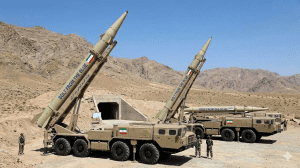
While international headlines obsess over the sheer volume of Iran’s stockpile—which ballooned from 2,000 to a projected 8,000 projectiles between 2024 and 2026—military strategists focus on a different metric. The real bottleneck is not the “arrow,” but the “archer.”During the 12-Day War in June 2025, Israel demonstrated this by targeting the chokepoint of Iranian launch capacity. Israeli strikes successfully neutralized 293 launchers and blocked access to 92 more, leaving Tehran with fewer than 100 operational units by the conflict’s end. This forced a regime that still held thousands of missiles to the negotiating table simply because they lacked the means to fire them.”Iran’s ballistic missile launchers form a chokepoint which, if properly targeted, can have outsized effects in degrading the size and rapidity of its salvos.”However, that vulnerability is closing. By February 2026, Iran had aggressively expanded its capacity. Current maximum estimates suggest the regime has recovered to between 200 and 260 launchers . Tehran is now diversifying its launch infrastructure, utilizing both road-mobile Transporter-Erector-Launchers (TELs) , which are difficult to track, and “hardened stationary” underground missile cities that provide significant protection against preemption.
2. The “Bolt-from-the-Blue” Threat: The Solid-Fuel Revolution
Public anxiety usually focuses on Medium-range Ballistic Missiles (MRBMs) capable of striking Tel Aviv. Yet, the more immediate, lethal threat to U.S. bases and Gulf partners is the Short-range Ballistic Missile (SRBM) and the “solid-fuel revolution.”Unlike older liquid-fueled systems that require visible, lengthy aboveground fueling, modern Iranian SRBMs—including the Fateh family, Zolfaghar, and Dezful—utilize solid propellants. This means they can be readied in secret and fired in seconds. This technical shift has converted the “mass precision” of the Fateh family into a “bolt-from-the-blue” scenario.In the Gulf, where strategic depth is minimal and air defense layers are less robust than in Israel, this compresses decision-making time to near zero. An Iranian SRBM fired from the coast can arrive at a U.S. installation or a Saudi energy hub in minutes, leaving defenses with no time to react.
3. The End of the “Nuclear Card”: Tehran’s New Incentive to Strike
Tehran’s strategic calculus has undergone a counter-intuitive and dangerous shift.Historically, the nuclear program was the regime’s ultimate “trump card,” a leverage point used to prevent total war.Now, perceiving that the nuclear card has been played or neutralized, and facing existential internal threats, the regime’s restraint has evaporated.Tehran is moving from “deterrence by possession” to “deterrence by punishment.”The regime is now more incentivized to execute “maximum cost” attacks—multi-vector fires designed to inflict catastrophic damage—rather than the limited, telegraphed strikes of the past.
4. Reconstitution at Warp Speed: The Global Invisible Hand
Perhaps the most startling reality of the post-June 2025 landscape is how quickly Iran erased its losses. Despite having its MRBM stockpile depleted by 40% to 60% during the war, Iran recovered to pre-war levels of approximately 2,000 systems by February 2026.This “warp speed” recovery was fueled by an invisible hand of external support:
- China: Provided massive shipments of solid-fuel materials throughout 2025, allowing for the rapid manufacture of advanced motors.
- Russia: Provided technical assistance to upgrade the lethality and Circular Error Probable (CEP) of the Khorramshahr MRBM, Iran’s most dangerous long-range system.This rapid recovery challenges the very foundation of “deterrence by denial.” If an arsenal can be more than half destroyed and then fully replaced within eight months, traditional military attrition loses its efficacy.
5. Learning from Failure: The Proxy Laboratory
Iran’s missile evolution is a story of lethal trial and error. In June 2017, an Iranian strike on Syria was a laughingstock; six missiles missed their marks by hundreds of meters.Contrast that with the October 2024 attack. Iran launched roughly 200 advanced missiles , including the Fattah-1 and Kheibar Shekan . Despite advanced defenses, roughly 50% of those missiles hit their intended targets.This evolution was made possible by treating regional conflicts as research laboratories. Iran has used the Shahed-136/131 drones in Ukraine and Houthi strikes in the Red Sea as real-world data collection points. By observing how their technology performs against Western interceptors in proxy hands, they have refined the Maneuverable Reentry Vehicles (MaRVs) on their own premier missiles to evade modern defenses.”Iran amasses an overall threat to U.S. forces, assets, and partners that is greater than the sum of its projectile parts.”
A Precarious Future
The technological gap between Iranian offense and regional defense is closing at an alarming rate. While systems like Arrow, David’s Sling, and Patriot remain the gold standard, they are facing a crisis of industrial attrition.Interceptor replenishment has become the “pacing factor.” In a sustained conflict, Iran can produce “arrows” faster than the West can produce “shields.” As we move into an era where “minutes” define the difference between a successful interception and a catastrophic hit, we must ask: Can diplomacy ever outpace the speed of a solid-fueled missile?