
A defining structural achievement of the play is its use of parallel plots, which intensifies the tragedy’s impact. The primary plot of Lear and his daughters is mirrored by the subplot of the Earl of Gloucester and his sons, demonstrating that familial betrayal and the breakdown of the natural order are universal rather than isolated events. Both aging patriarchs share a fatal flaw of figurative blindness; they make rash, prideful decisions that lead them to banish their truly loyal children (Cordelia and Edgar) while placing their trust in deceitful, power-hungry offspring (Goneril, Regan, and Edmund).
As explored in our previous discussions, the play heavily relies on the motifs of blindness and madness as pathways to truth. Shakespeare inverts traditional tropes, creating a world where characters with healthy eyes are ignorant, and those who are physically blind or mentally shattered see reality the clearest. Lear’s descent into madness and Gloucester’s physical blinding at the hands of Cornwall force both men to confront their own limitations and the brutal realities of “unaccommodated man”.
Ultimately, scholars debate whether the play’s relentless suffering offers Christian redemption through newfound self-knowledge or if it is a profoundly nihilistic work. The recurring motif of “nothing” and the brutal, senseless death of Cordelia at the play’s end reinforce an existential despair, suggesting a universe devoid of cosmic justice where the gods kill humans for “their sport”. As noted in our earlier conversation, the play maximizes emotional devastation by repeatedly promising an end to suffering, only to brutally deny it.
Because Shakespeare’s tragic ending was deemed too shocking and unendurable for 17th- and 18th-century audiences, Nahum Tate rewrote the play in 1681 as a tragicomedy. Tate’s adaptation omitted the Fool entirely, manufactured a romance between Cordelia and Edgar, and restored Lear to the throne. This sanitized version supplanted Shakespeare’s original text on the English stage for over 150 years. It was not until the 19th century that actors like Edmund Kean and William Charles Macready restored Shakespeare’s tragic ending, paving the way for modern, existential interpretations of the play.
Beyond the Crown: 5 Surprising Truths About Shakespeare’s Most Brutal Masterpiece
Among the vast expanse of the Western canon, King Lear stands as William Shakespeare’s most harrowing achievement—a profoundly domestic schism over an inheritance that spirals, with terrifying velocity, into a cosmic, “apocalyptic” tragedy. Written between 1605 and 1606, the play has been lauded by Percy Bysshe Shelley as “the most perfect specimen of dramatic art existing in the world.” Yet, to the modern spectator, its perfection lies in its brutality. To interrogation of the subtexts that lie beneath the canonical surface reveals a work far more radical, political, and psychologically volatile than the image of a mere “foolish old man” suggests.
1. The “Happy Ending” Was the Original Plan
It is a testament to Shakespeare’s transformative genius that he took a traditionally redemptive legend and steered it into an existential void. In the original sources—Geoffrey of Monmouth’s 12th-century Historia Regum Britanniae and the anonymous 1605 play The True Chronicle History of King Leir —the narrative concludes with restoration. Cordelia successfully reinstates her father to the throne, and both survive the ordeal.Shakespeare’s decision to “apocalyptically” extinguish both characters was a heretical departure from tradition. By destroying the lineage entirely, he moved the story from moralizing history into a realm of absolute ontological crisis. This ending was so distressing to the human spirit that for nearly a century and a half, the “original” tragic text was effectively banished. As noted by critics like Harold Bloom, Nahum Tate’s 1681 revision—which featured a happy ending and a romance between Cordelia and Edgar—was the version the world preferred to see. “Tate’s version held the stage for almost 150 years, until Edmund Kean reinstated the play’s tragic ending in 1823.”
2. Lear Was a Failed Machiavellian, Not Just a Foolish Father
While scholars frequently focus on Lear’s senility, a Historicist analysis reveals him as an “insufficient Machiavellian.” As Janne Lilkendey and Charles R. Forker have argued, Lear’s “love test” was not a senile whim but a failed attempt to manipulate the “Body Politic” (the immortal office of the crown) while indulging the “Body Natural” (his aging, physical self).Lear’s fatal error was violating Niccolò Machiavelli’s primary rule: a ruler must never make himself dependent on the goodwill or gratitude of others. He attempted to retain the authority —the name and a hundred knights—while discarding the responsibility and revenue of governance. He sought to separate the power of the crown from the burden of the kingdom, a strategy that invited the very “human lust for power” he hoped to stabilize. The Fool captures this strategic bankruptcy perfectly: “Thou hadst little wit in thy bald crown when thou gav’st thy golden one away.”
3. The Fool’s Comedy Is an Engine of Tragedy
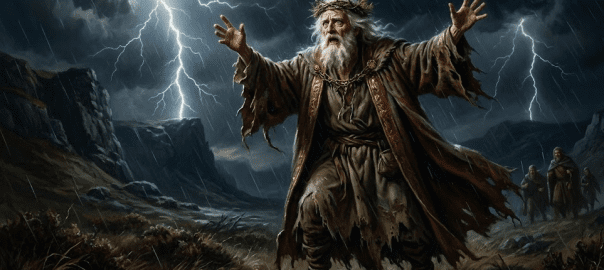
The Fool is far more than a decorative jester; he functions as a vital engine of tragedy through what Susan Snyder identifies as a “syncopated rhythm.” He uses “reductive nonsense” and slapstick imagery to systematically jar Lear’s heroic pathos. By juxtaposing Lear’s cosmic rages with the prosaic reality of a “bare, forked animal,” the Fool prevents Lear from becoming a distant, mythic figure, grounding his madness in the agonizingly commonplace.When Lear commands the heavens to “singe my white head,” the Fool dryly observes that “a dry house is better than this rainwater out o’ door.” He constantly reduces Lear’s titanic suffering to the absurd, using the imagery of the kitchen to highlight the futility of the King’s commands: “Cry to it, nuncle, as the cockney did to the eels when she put ’em i’ th’ paste alive… ‘Down, wantons, down!'” This grotesque comedy does not provide relief; it intensifies the horror by suggesting that Lear’s “world-shattering” pain is as ineffective as a stick beating back wriggling eels.
4. Dover is a Psychological “Edge,” Not Just a Cliff
In the mental geography of the play, Dover acts as a “boundary site” where the familiar world ends and an alien deep begins. It is a magnet-site for characters seeking an extremity of vision. For Gloucester, the “suicide leap” is a masterpiece of the grotesque—what Snyder describes as a “clown’s pratfall” that nevertheless serves a “serious moral climax.” By falling on his nose in a moment of comic degradation, Gloucester achieves a radically new vision of acceptance.For Lear, Dover represents the “return of the repressed.” His “sovereign shame” stings him as he nears Cordelia, the daughter he tried to erase from his conscious mind. The journey to the cliff is a confrontation with the unknown self. Paradoxically, the arrival of the French army at Dover brings both the “fear” of invasion and the “deliverance” of Cordelia’s love. It is only at this geographical and psychological edge that the characters can confront their own limitations.
5. The Play Was Veiled Political Propaganda
Beneath its pre-Roman setting, King Lear served as a stark warning to King James I, who was then struggling to unify the kingdoms of England and Scotland. As Graham Osborne notes, the theme of a divided kingdom was a direct cautionary tale about the “seed of division.” However, the propaganda runs deeper into religious allegory.Scholar Gaylie Bowles argues that the play functions as an origin story for the divine authority of the English crown at the expense of the Jews. In this allegorical reading, Lear represents the “ancient Jewish ruling class” (Pharisees and Sadducees), blinded by pomp and pride, who reject the Christ-figure (Cordelia). This rejection justifies the transfer of divine authority from the “Jewish leaders” to a new, more loyal “Gentile” line—the English predecessors represented by Edgar. The play thus reinforces the legitimacy of the Stuart line as the righteous heirs to God’s mantle. James I’s own words on the subject serve as the play’s haunting subtext: “Dividing your kingdomes, yee shall leave the seed of division and discord among your posteritie.”
Conclusion: The Suffering That Refuses to Stop
The enduring power of King Lear lies in its “beyond the end” dynamic. The play repeatedly promises a limit to pain or a redemptive closure, only to frustrate those expectations with a finality that feels random and amoral. The order to save Cordelia comes “too late,” and the play ends not with a restored kingdom, but with an exhausted slogging toward an uncertain future.We are left to grapple with the “promised end” that was denied. In a universe that offers only silence to our cries, is the arrival at an “ethic of love” a meaningless human gesture, or is it the ultimate victory to have loved at all before the “darkness and the deep” take us?