Tag Archives: Tom

29Aug/26

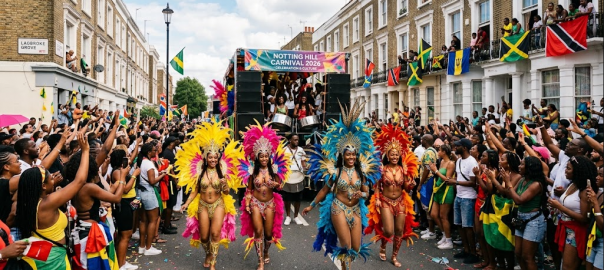
Notting Hill Carnival’s Radical DIY Roots

Sixty Years of Resistance, Culture, and Celebration: Proposed Headlines

Sat Aug 29 2026 /Mpelembe Media/ — From Resistance to Revelry: How Racial Justice and the Windrush Generation Birthed Europe’s Greatest Street Festival The Sound of Sovereignty: Claudia Jones, Duke Vin, and the Radical Pioneers of Carnival Claiming the Streets: The Sixty-Year Journey and Diamond Jubilee of the Notting Hill Carnival

The Notting Hill Carnival was born out of a crucible of racial tension, discrimination, and active community resistance during the post-war Windrush era. Following the arrival of Caribbean migrants to West London, systemic prejudices such as the informal “colour bar” and housing exploitation in overcrowded slums created an increasingly hostile environment. In August 1958, these racial tensions erupted in violent riots across Notting Hill and Nottingham as white mobs attacked Black residents and their homes. The crisis deepened in May 1959 with the brutal, racially motivated murder of Kelso Cochrane, a thirty-two-year-old Antiguan carpenter. Cochrane’s death became a historic symbol of racial injustice, prompting over 1,200 people to march in solidarity at his funeral, which galvanized Black British civil rights activism across London. Continue reading


07Jun/26

The Hidden History of the Cockney Accent

The Cockney Identity: A Cultural Heritage Profile

To the cultural historian, the “Cockney” represents one of the most enduring paradoxes of the London landscape. It is at once a  demonym —a fiercely localized geographic label—and a  linguistic marker  that has echoed through the city’s alleyways for over half a millennium. Unlike the class-bound tones of Received Pronunciation (RP) or the regionally distinct “Scouse” of Liverpool, the Cockney identity is a narrative of the soil, born from the laboring classes of the East End. It is a cultural stratigraphy that has survived the fires of 1666, the industrial soot of the Victorian age, and the high-explosive trauma of the Blitz. To truly understand the Cockney is to trace the evolution of the city itself, beginning with a medieval insult that grew into a badge of defiance. Continue reading

24Mar/26

The Anatomy of Disintegration: Madness, Blindness, and Nihilism in King Lear

Historical Context and Sources
March 24, 2026 /Mpelembe Media/ — Shakespeare adapted King Lear from a variety of historical and literary texts, most notably Geoffrey of Monmouth’s 12th-century Historia Regum Britanniae, Raphael Holinshed’s Chronicles, and an anonymous 1605 play titled The True Chronicle History of King Leir. While these earlier legends traditionally featured a happy ending where the king is restored to power by his loyal daughter, Shakespeare radically altered the narrative by introducing a bleak, catastrophic conclusion. This shift allowed Shakespeare to explore the political anxieties of Jacobean England, specifically the fears surrounding succession, the division of kingdoms, and the “Divine Right of Kings” following the death of Queen Elizabeth I. 

Continue reading

21May/23

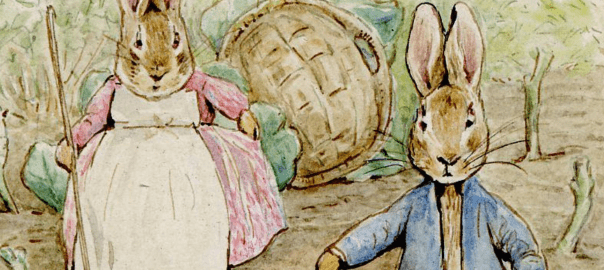
Beatrix Potter’s famous tales are rooted in stories told by enslaved Africans – but she was very quiet about their origins

Emily Zobel Marshall, Leeds Beckett University

Peter Rabbit, the cute and wily bunny who wears a bright blue jacket, is the best-selling creation of English author Beatrix Potter. Originally published in 1902, the Tale of Peter Rabbit – the first of 23 tales in the series – has since been translated into more than 45 languages and sold over 45 million copies.

Continue reading