
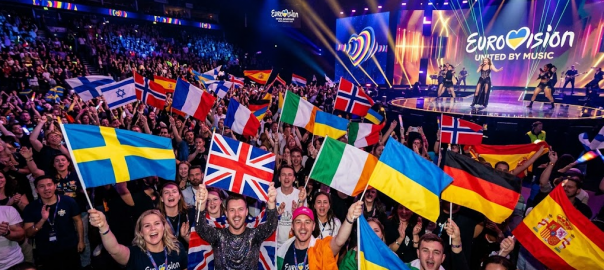
Sat, May 16 2026 /Mpelembe Media/ — The 70th edition of the Eurovision Song Contest is taking place in Vienna, Austria, following JJ’s victory for the country in 2025. While it marks a major milestone for the longest-running annual international televised music competition, the 2026 event is defined by profound geopolitical crises, sweeping rule changes, and intense musical competition.
- Unprecedented Boycotts and Political Crisis: The 2026 contest is heavily overshadowed by the EBU’s decision to allow Israel to compete amid the ongoing war in Gaza. This has resulted in the largest boycott of the contest since 1970, with five nations—Spain, the Netherlands, Ireland, Slovenia, and Iceland—withdrawing entirely. The loss of Spain is particularly significant, as it is a “Big Five” financial contributor to the EBU. The controversy has led past winners, including 2024’s Nemo and 1994’s Charlie McGettigan, to return their trophies in protest. During the first semi-final, Israel’s entrant, Noam Bettan, faced audible boos and pro-Palestinian chants, though he still qualified for the Grand Final. The boycott has also significantly impacted the event’s reach, with viewership for the first semi-final dropping by 22.7% on YouTube compared to the previous year.
- Major Voting and Rule Changes: In response to previous voting controversies and allegations of mass-voting campaigns, the EBU has overhauled the voting system. Professional juries have been brought back to the semi-finals to restore a 50/50 split between jury and public votes, and national juries have expanded from five to seven members (mandating two members be aged 18 to 25). Additionally, the public televote limit has been reduced from 20 to 10 votes per payment method. However, critics have pointed out that this limit can still be easily bypassed by viewers using multiple credit cards or email addresses.
- Participating Countries and Musical Trends: This year features 35 competing countries, the lowest number since the semi-final format was introduced in 2004, though it welcomes the return of Bulgaria, Moldova, and Romania. Musically, the entries in the final are heavily dominated by minor keys, strict 4/4 time signatures, and a lack of key changes. However, there is some unique experimentation, such as the UK’s tempo-changing track by Look Mum No Computer, and Finland’s genre-blending performance featuring classical violinist Linda Lampenius.
- Current Favorites: Heading into the Grand Final, Finland has emerged as the clear betting favorite to win, followed closely by Australia and Greece.
Suggested Headlines
- “United by Music” Divided by War: How Boycotts and Geopolitics Overshadowed Eurovision’s 70th Anniversary
- Missing Nations and Plunging Views: Inside the Most Controversial Eurovision Since 1970
- Eurovision 2026 in Vienna: Finland Leads the Odds as the Contest Faces a Historic Political Crisis
- From Sequins to Sanctions: How the Gaza Conflict Triggered Eurovision’s Biggest Boycott
- Eurovision Overhauls Voting Rules for 2026, But Will It Be Enough to Save the Contest’s Integrity?
The 70th Anniversary Crisis: 5 Surprising Realities Shaping Eurovision 2026
The Eurovision Song Contest arrives at its platinum jubilee in Vienna, Austria, not with a fanfare of unity, but with the clashing chords of a geopolitical and structural identity crisis. While the contest’s “United by Music” slogan was recently minted as a permanent brand, the 2026 edition reveals a stage that is more fractured than at any point since the Cold War.How did a celebration of seven decades of European pop culture become a lightning rod for mass boycotts, radical censorship defiance, and a technological “voting revolution” aimed at state-sponsored interference? As the EBU struggles to maintain its apolitical facade, five defining realities are reshaping the contest’s future, proving that at 70, Eurovision is experiencing its most volatile mid-life crisis yet.
1. The Great Participation Shrink: A Geopolitical Revolving Door
The 2026 roster has settled at 35 countries, a number that marks a deceptive milestone. While it represents the lowest participation level since before the semi-final era began in 2004, the figure masks a significant “revolving door” shift between Western and Eastern Europe.The headline is the exodus: Iceland, Ireland, the Netherlands, Slovenia, and Spain have officially withdrawn in a coordinated boycott regarding Israel’s continued participation. For the contest’s “Reference Group”—the administrative body that oversees the rules—this represents a financial nightmare. The withdrawal of Spain, a “Big Five” member, directly threatens the event’s fiscal stability. This fragility is further underscored by internal union pressure in Italy (RAI) , where the USB union’s petition for a boycott has signaled that even the contest’s financial pillars are resting on shaky ground.To mitigate this loss, the EBU has leaned on the return of the “Outsiders”: Bulgaria (BNT), Romania (TVR), and Moldova (TRM) . This Eastern European influx allows Contest Director Martin Green to maintain a veneer of continuity. Green recently framed the 35-country roster as a beacon of hope, claiming the contest remains a space where “in a difficult world a better one is possible.”
2. The Jury Overhaul and the “Government Promotion” Ban
In an aggressive bid to restore “integrity,” the EBU has implemented a major overhaul of the voting system, characterized by a return to professional juries in the semi-finals for a 50/50 split with the televote. However, these are not the industry panels of old.The EBU has expanded juries from five to seven members, diversifying the pool to include not just performers, but music journalists, critics, teachers, choreographers, and stage directors. Most notably, the “Youth Requirement” mandates that every national jury must include at least two members aged 18 to 25 to bridge the gap with Gen-Z demographics.More critically, the EBU is targeting a specific geopolitical threat: the “instrumentalization” of the contest by state actors. New regulations within the Code of Conduct now explicitly limit disproportionate promotion campaigns organized or supported by governments or governmental agencies. This “anti-lobbying” measure is a direct response to the perceived “art-washing” of recent years, where state-funded digital campaigns were seen as skewing the public vote.
3. The Musical Template: The Scientific “Death” of the Happy Song
The data provided by the Press Association (PA Media) regarding the 2026 finalists suggests that the “Eurovision Spirit” is being choked by a standardized digital formula. The 25 songs in the final are almost entirely uniform in their technical construction:
- The Minor Key Monopoly: Only one artist—Belgium’s Essyla with “Dancing on the ice” —is performing in a major key. The “happy” song has become a strategic liability; major-key entries from Portugal, Estonia, and Luxembourg were all ruthlessly eliminated in the semi-finals, proving that the audience now associates Eurovision success exclusively with minor-key drama.
- The Key Change Extinction: Once the contest’s signature gimmick, the key change is nearly extinct. Only three finalists have dared to use it: Australia’s “Eclipse” (Delta Goodrem), Croatia’s “Andromeda” (LELEK), and Norway’s “Ya Ya Ya” (Jonas Lovv).
- Rhythmic Rigidity: Every song in the 2026 final adheres to a strict 4/4 beat. The musical experimentation that defined the contest’s early years—rhythms in 3/4 or 5/4—has been replaced by a metronomic 4/4 standard.The few outliers are technical: the UK’s entry, “Eins, Zwei, Drei” by Look Mum No Computer, and the Bulgarian entry are the only tracks featuring tempo changes—a rare act of defiance against the contest’s current rhythmic stagnation.
4. Host Broadcaster Defiance: A New Policy on Transparency
Perhaps the most significant shift in the 2026 contest is the political stance taken by the host broadcaster, ORF (Austria). In previous years, the EBU and host broadcasters utilized sophisticated “anti-booing” sound technology and strict flag prohibitions to maintain a sanitized, “apolitical” atmosphere. ORF has officially scrapped this playbook.ORF has announced it will neither prohibit Palestinian flags in the audience nor use audio technology to mask booing during controversial performances. Executive Producer Michael Kroen’s reasoning marks a watershed moment for the contest:”Our task is to show things as they are. We will not sugarcoat anything or avoid showing what is happening, because our task is to show things as they are.”This policy signals an end to the era of “art-washing,” where the broadcast attempted to manufacture a joy that didn’t exist in the arena. ORF is betting that transparency, however messy, is the only way to save the contest’s remaining credibility.
5. The “Anti-Spam” Voting Revolution
To secure the public result, the EBU and its technical voting partner, Once , have halved the maximum voting power of the audience. The previous limit of 20 votes per payment method has been cut to 10.This measure is specifically designed to stop “power-voting,” where dedicated fanbases or coordinated agencies concentrate massive numbers of votes on a single favorite. Alongside this, “Once” has deployed expanded security systems to monitor and block “coordinated voting activity” in real-time. This move reflects a deep-seated trust issue between the EBU and its global audience; by restricting the fans’ ability to vote, the EBU is attempting to prevent the contest from being “bought” by digital mobs or state-sponsored bot farms.
Conclusion: Can the “Eurovision Spirit” Survive?
As Eurovision marks its 70th year, it finds itself in a state of terminal paradox. It is a contest that is more technologically secure and administratively modernized than ever before, yet it remains politically fractured and musically homogenized.The 35 nations left in the competition represent a smaller, more defensive “Eurovision Family.” As the EBU fights to uphold the “United by Music” slogan against a backdrop of state-sponsored influence and mass boycotts, one must ask: is the world’s stage becoming too small for its own politics, or are these radical shifts the only way to ensure the contest survives to see a 100th anniversary?