
Zambia’s Tourism Renaissance: Record Arrivals, Open Borders, and Economic Revival
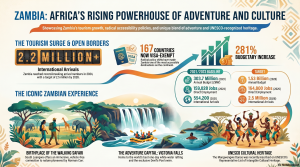
Sun, May 17 2026 /Mpelembe Media/ — Booming Tourism and Economic Growth Zambia is experiencing a tourism renaissance, recording a historic 2.19 million international arrivals in 2024—a 35.3% increase from the previous year. The government has strategically positioned tourism as a primary engine for economic diversification away from copper mining, increasing the sector’s budgetary allocation by 281% since 2021.
Enhanced Accessibility and Visas To invite the world in, Zambia has adopted highly liberal travel policies. The country now offers visa-free entry to citizens of 167 countries. Additionally, the KAZA Univisa allows tourists from 65 countries to travel seamlessly between Zambia and Zimbabwe for 30 days, while also permitting day trips to Botswana. Regional connectivity has also improved, with airlines like Proflight Zambia launching direct routes connecting Lusaka and Livingstone with Cape Town and Windhoek.
Premier Safari Destinations Zambia is celebrated for its raw, uncrowded, and authentic wildlife experiences:
- South Luangwa National Park: Known as the birthplace of the walking safari—pioneered by conservationist Norman Carr in the 1950s—this park allows visitors to experience the bush on foot. It is also famous for having one of the highest densities of leopards in Africa.
- Kafue National Park: As Zambia’s largest and oldest park, Kafue offers incredible diversity. Its northern Busanga Plains are famous for hot air ballooning, tree-climbing lions, cheetahs, and massive herds of red lechwe.
- Lower Zambezi National Park: This park is a pioneer in water-based safaris, offering spectacular canoeing trips where elephants can frequently be seen swimming across the river channels.
Adrenaline and Adventure Activities Victoria Falls is the undisputed adventure capital of the region. Thrill-seekers can swim on the lip of the falls in the famous Devil’s Pool (safest during the dry season), brave world-class Grade 5 white-water rafting in the Batoka Gorge, or leap from the Zambezi Bridge on a 111-meter bungee jump. Furthermore, the Zambezi River is a globally renowned destination for catching the aggressive Tiger Fish, hosting the annual Kariba International Tiger Fish Tournament.
Seasonality and Safety Zambia offers distinct seasonal experiences. The Dry Season (May to October) is the classic safari period, offering excellent visibility and wildlife concentrated around water sources. The Emerald/Green Season (November to April) brings lush, vibrant landscapes, dramatic skies, baby animals, and migratory birds. In terms of safety, Zambia is highly rated, ranking as the 8th most peaceful country in Africa on the 2025 Global Peace Index.
Cultural Heritage Zambian tourism is deeply rooted in local culture, hosting over 70 traditional ceremonies annually. In 2024, the Mangwengwe dance—a traditional performance by the Mambwe and Namwanga people used to celebrate, critique leaders, and mourn chiefs—was officially inscribed on the UNESCO Representative List of the Intangible Cultural Heritage of Humanity.
Suggested Headlines
Focus on Economic Growth & Accessibility:
- Zambia’s Tourism Renaissance: Record Arrivals, Open Borders, and Economic Revival
- The KAZA Univisa & Beyond: How Zambia is Opening its Doors to the World
- From Copper to Conservation: Zambia’s Strategic Shift to a Wildlife Economy
Focus on Safaris & Wildlife:
- Beyond the Falls: Exploring Zambia’s Untamed Wilderness from Kafue to South Luangwa
- The Birthplace of the Walking Safari: Retracing Norman Carr’s Footsteps in South Luangwa
- The Emerald Season vs. The Dry Season: When is the Best Time to Safari in Zambia?
Focus on Adventure & Victoria Falls:
- The Smoke That Thunders and Rapids That Roar: The Ultimate Zambian Adventure Guide
- Devil’s Pool to Grade 5 Rapids: Why Victoria Falls is Africa’s Adrenaline Capital
- Chasing the Striped Water Dog: A Guide to Tiger Fishing on the Mighty Zambezi
Focus on Culture & Overall Destination Appeal:
- Unveiling the Real Africa: Heritage, Wildlife, and the Magic of Zambia
- The Mangwengwe Dance to the Mosi-oa-Tunya: Discovering Zambia’s Natural and Cultural Wonders
Why Africa’s “Wildest” Destination is Suddenly Its Most Accessible: 5 Surprising Takeaways from Zambia’s Tourism Revolution
The rust-red dust of the Copperbelt is settling, replaced by the vibrant emerald of a nation reinventing its soul. Long defined by the heavy industrial rhythm of its mines, Zambia is undergoing a radical pivot toward a “wildlife and heritage economy.” This isn’t just a change in branding; it is a structural revolution. In 2024, the country shattered records with 2.2 million international arrivals, a figure that climbed to 2.3 million in 2025. With a government target of 2.5 million for 2026, the world is finally waking up to what safari purists have called Africa’s best-kept secret.What sets the “Zambian experience” apart is its refusal to succumb to mass-market commercialization. Even as it scales, Zambia prioritizes the raw and the unfiltered. It is a destination that feels like Africa did fifty years ago—vast, untamed, and deeply authentic—yet it is now supported by a sophisticated infrastructure that makes the “wildest” bush more reachable than ever before.
1. The 167-Country “Open Door” Policy
The most visible catalyst for this growth is a radical liberalization of Zambia’s borders. In a bold move to slash travel friction, the government recently added 53 countries to its visa-exempt list, bringing the total to 167 nations—including the UK, USA, China, and India—whose citizens can now enter visa-free.Complementing this is the KAZA Univisa , a $50 breakthrough that allows 30 days of seamless travel between Zambia and Zimbabwe, including day trips to Botswana. It has effectively turned the region into a single, cohesive destination.But accessibility is about more than just paperwork; it’s about connectivity. Proflight Zambia has revolutionized regional travel with its “three-city corridor,” linking Lusaka, Livingstone, and Windhoek. With new direct flights from Livingstone to Cape Town, a traveler can now enjoy an urban lunch in the shadow of Table Mountain and be on a sunset cruise on the Zambezi by evening.”One of the key strategies behind Zambia’s growing arrival numbers is its liberal travel policies that make it more accessible.”
2. The Birthplace of the “Walking Safari” is Going Silent
Zambia is the spiritual home of the walking safari. In the 1950s, the legendary Norman Carr revolutionized conservation in South Luangwa National Park by swapping rifles for “Wilderness Trails.” He taught guests to “read the bush”—to interpret the flick of a kudu’s ear or the medicinal secret of a Leadwood tree. Today, Zambian guides undergo what is widely considered the most rigorous training on the continent, ensuring that walking among lions is a masterclass in safety and sensory immersion.However, the modern revolution is found in the transition to “Silent Safaris.” Led by innovators like Green Safaris , the industry is trading the roar of diesel engines for the quiet hum of electric Land Rovers and e-boats.The Evolution of the Zambian Safari
- The 1950s Legacy: Norman Carr prioritizes photographic safaris over hunting, emphasizing community empowerment and the “participant” experience.
- Modern Eco-Luxury Standards: The shift to electric fleets allows for a non-intrusive encounter. In a “Silent Safari,” the barrier between human and habitat dissolves; you hear the subtle warning call of a bird or the snap of a twig long before the animal is seen.
3. The Devil’s Pool and the World’s Wildest Grade 5 Rapids
Victoria Falls ( Mosi-oa-Tunya ) remains the anchor of the adventure economy, but the Zambian side offers the most intimate proximity to the “Smoke that Thunders.” Only here can travelers access the Devil’s Pool , a natural rock basin balanced on the very lip of the 100-meter drop. Accessible between August and December, the experience requires a guided swim from Livingstone Island to the literal edge of the abyss.Beneath the falls, the Batoka Gorge hosts what is arguably the most intense white-water rafting on Earth. Navigating the 23 notorious rapids—including “Stairway to Heaven” and “Gulliver’s Travels”—is a rite of passage for adrenaline seekers.| Feature | Low Water (Aug–Dec) | High Water (Jan–July) || —— | —— | —— || Start Point | The “Boiling Pot” (directly under Falls) | Rapid #11 (10km downstream) || Technicality | Higher: Rapids are technical and stronger. | Lower: Volume is high, but less technical. || Safety | Safer: More predictable navigation. | Dangerous: Extreme volume; upper rapids unsafe. |
The physical demand is real: the “7-story hike” out of the gorge at the end of the day is a badge of honor that separates the tourists from the travelers.
4. Tiger Fishing: A 100% Catch-and-Release Thrill
For the dedicated angler, Zambia offers the ultimate challenge in the form of the Tiger Fish ( Hydrocynus vittatus ), or the “striped water dog.” The Barotse Floodplain in the Upper Zambezi is the premier theater for this battle. Because the area lacks permanent settlements, the water remains pristine and free from commercial over-fishing, allowing species like the “Barotse Express” bream and trophy Tiger Fish to flourish.Sustainability is the new gold standard. The Kariba International Tiger Fish Tournament (KITFT), which has seen records of fish exceeding 16kg, is now a 100% catch-and-release event. Anglers use the innovative Keepnet app to photograph and measure their catch against a formula that converts length to points before the fish is returned to the deep-water dam.”Catch and release fishing improves native fish populations by allowing more fish to remain and reproduce in the ecosystem.”
5. The Cultural Soul: UNESCO’s Newest Inscription
Zambia is increasingly marketing its “intangible heritage” with the same fervor as its wildlife. In 2024, UNESCO inscribed the Mangwengwe dance of the Mambwe and Namwanga people on the Representative List of the Intangible Cultural Heritage of Humanity.The performance is a hauntingly unique spectacle. The rhythm isn’t created by traditional drums, but by the rubbing of wooden stools against the bottoms of clay pots , accompanying circular movements of the shoulders and waist. This ancient dance serves a dual role in modern Zambia:
- The Sacred: It is the only dance permitted at the funeral and burial of a chief.
- The Political: It remains a living tool for social critique, used in political gatherings to praise successes or communicate community challenges to leadership.
Conclusion: Beyond the Falls
The Zambian government’s commitment to this revolution is backed by hard currency. The 2026 approved budget includes K1.53 billion for tourism, a staggering 281% increase since 2021. This capital, alongside a $100 million World Bank-financed GREAT-TDP project, is being used to develop “nature-based locales” like the Liuwa Plains and Nsumbu National Park, ensuring the country’s future isn’t tied solely to Victoria Falls.In an era of sanitized, over-touristed experiences, Zambia offers a provocative luxury. As the nation pivots from the extraction of copper to the conservation of its soul, it poses a question to every modern traveler: Is a raw, silent, and authentic journey through the African bush the ultimate modern luxury?
Source: visitzambia.co.zm