The Dragon and the Copper Belt: The Complex Realities of China-Zambia Relations
Fri, Jun 18 2026 /Mpelembe Media/ — The relationship between China and Zambia is deeply complex, evolving from historical solidarity into a modern partnership defined by massive economic investment, sovereign debt crises, and significant labor controversies.
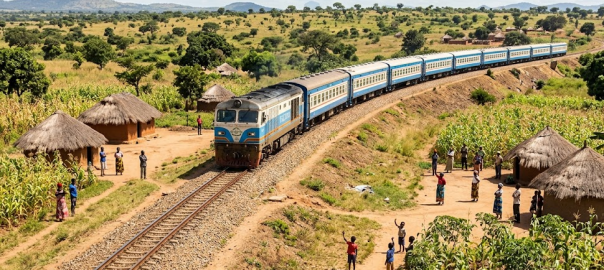
Historical Ties and “All-Weather Friendship” Diplomatic relations began immediately after Zambia’s independence in 1964, championed by Zambia’s first president, Kenneth Kaunda, and Chinese Chairman Mao Zedong. The cornerstone of this early alliance was the TAZARA railway (the “Great Uhuru Railway”), built between 1970 and 1975 to eliminate landlocked Zambia’s dependence on white-minority-ruled Rhodesia and South Africa for its copper exports. Funded by an interest-free loan and built by thousands of Chinese workers, TAZARA remains a powerful symbol of South-South cooperation. In recent years, China’s Confucius Institutes have furthered this cultural exchange, with Mandarin becoming a highly sought-after skill for Zambians pursuing scholarships and employment opportunities connected to Chinese businesses.
Economic Investment and Infrastructure Today, Zambia is a key player in China’s Belt and Road Initiative, with extensive Chinese investments in infrastructure, agriculture, and manufacturing. The heart of this investment lies in the copper mining sector, where Chinese state-owned enterprises like the China Non-Ferrous Metals Mining Corporation (CNMC) have resurrected dormant mines and built state-of-the-art smelting facilities. Zambia’s political stability, democratic elections, and liberalized economic environment have made it highly attractive for this influx of foreign direct investment.
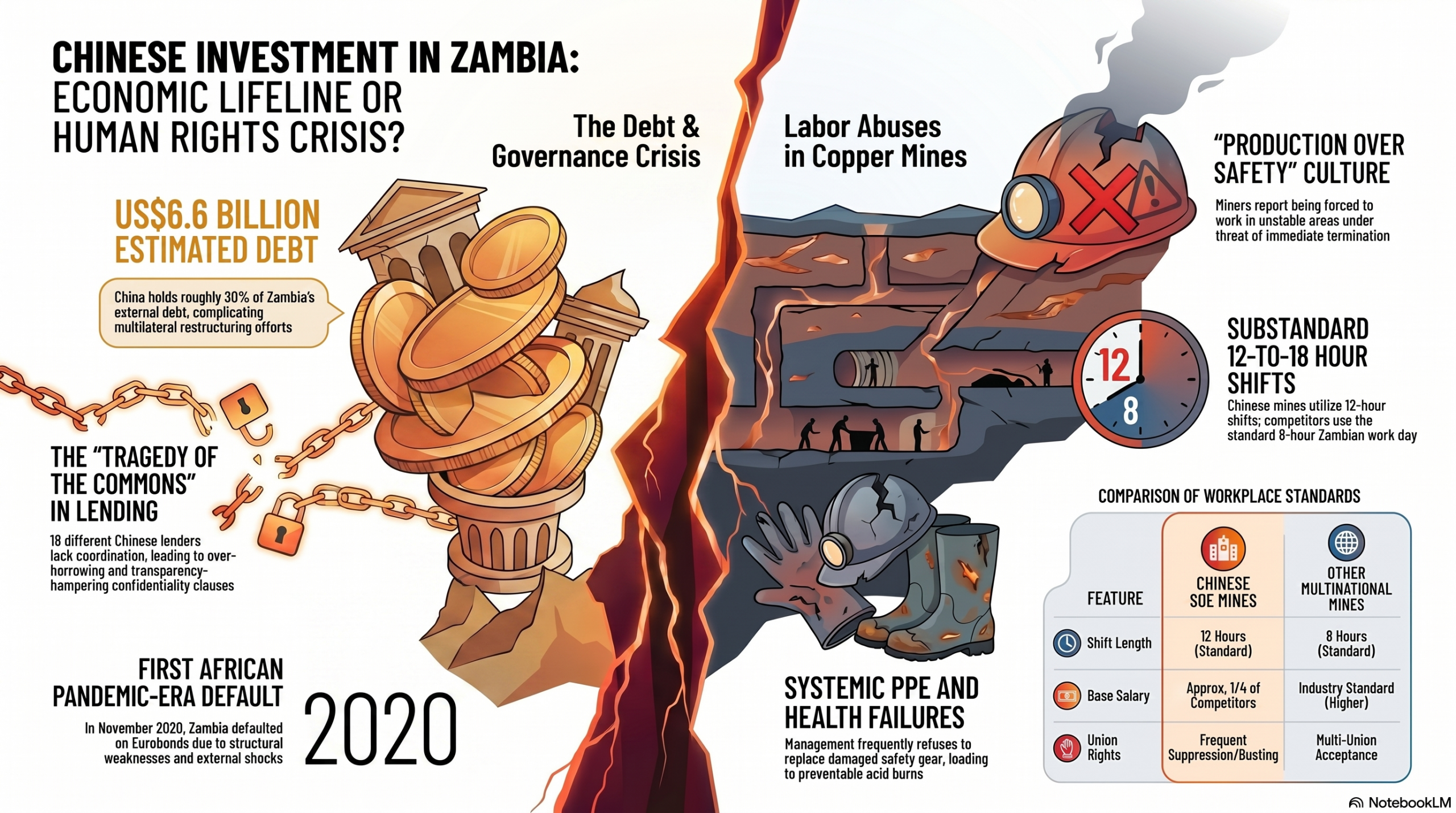
The Sovereign Debt Crisis This infrastructure boom has come at a severe cost. In 2020, Zambia became the first African country to default on its Eurobonds during the COVID-19 pandemic, heavily burdened by debt owed to at least 18 different Chinese lenders. This debt crisis is described as a “tragedy of the commons”—where an uncoordinated multitude of Chinese contractors and lenders over-exploited Zambia’s public resources—and a “moral hazard,” fueled by a history of frequent debt cancellations that encouraged reckless borrowing. While China has historically preferred secretive, bilateral debt negotiations, it has recently shown a willingness to engage in multilateral governance by co-chairing Zambia’s restructuring committee alongside France under the G20 Common Framework.
Labor Abuses and Safety Controversies Despite the economic injection, Chinese-run copper mines in Zambia are heavily criticized for severe labor rights violations. Workers report abusive conditions that fall far below domestic and international standards, including grueling 12- to 18-hour shifts, and in some cases, being forced to work 365 days a year without adequate overtime pay.
Health and safety standards are routinely flouted. Miners suffer from acid burns, preventable rock falls, and long-term lung diseases like silicosis due to poor ventilation and management’s refusal to replace damaged personal protective equipment (PPE). Workers who refuse to enter unsafe areas are frequently threatened with termination by Chinese managers. Furthermore, Chinese companies have been accused of suppressing union activities, intimidating representatives, and deliberately underreporting accidents to the government. These abuses are compounded by a weak, understaffed, and allegedly corrupt Zambian Mines Safety Department that fails to effectively enforce local labor and mining laws.
Copper, Cash, and Conflict: 5 Surprising Realities of China’s Billion-Dollar Bet on Zambia
Zambia is the “canary in the coal mine” for the modern age of global sovereign debt. In November 2020, it upended expectations by becoming the first African nation to default on its Eurobonds during the COVID-19 pandemic, signaling a crisis that has since reverberated across the Global South. As a pivotal test case for international finance, Zambia’s struggle reveals the intricate, often messy reality of China’s role as a global creditor. This is not a simple story of “debt-trap diplomacy,” but a complex narrative of modernization clashing with 19th-century labor standards and a fragmented lending machine that even Beijing struggles to control.
1. The “Monolith” is a Myth (The Chaos of 18 Lenders)
The prevailing Western narrative of a monolithic, top-down Chinese lending strategy is a fiction. In Zambia, the reality is a model of “Fragmented Authoritarianism.” Rather than a single state-directed effort, Zambia’s debt crisis was fueled by a “Tragedy of the Commons,” where a swarm of Chinese state-owned enterprises and banks competed fiercely for contracts, leading to an “overfishing” of the country’s debt capacity.The mechanics of this spiral were often subterranean. Under the Patriotic Front (PF) government, various Zambian ministries bypassed the Ministry of Finance to sign deals via Borrowing Advance Payments and Contractor-Facilitated Financing (CFF) . These CFF deals allowed private companies to build and operate facilities with the promise of future reimbursement—effectively creating massive contingent liabilities that never appeared on the official books.
- 18 distinct Chinese lenders have provided credit to Zambia, the highest number for any African nation.
- 25 different Chinese contractors won loan-financed projects, creating an environment where internal Chinese competition cannibalized fiscal sustainability.
- Chinese firms held a staggering 84 percent share of the construction business in Zambia, compared to an African average of 40 percent.”This multiplication of stakeholders has created fierce competition for infrastructure contracts in Zambia… China’s ‘fragmented authoritarianism’ meant an absence of top-down coordination of firms’ and lenders’ activities and thus few restraints.” — SAIS-CARI Policy Brief
2. The $3 Billion Transparency Gap
Zambia’s fiscal collapse was accelerated by a massive information asymmetry. The conflict between official government reporting and independent research highlights a systemic lack of transparency, fueled by confidentiality clauses that shroud loan terms in secrecy.While critics often invoke “debt-trap diplomacy” to explain this, scholars like Charles Ho Wang Mak of Oxford Law Blogs caution that the empirical evidence for a deliberate trap is contested. Instead, the “gap” suggests a failure of governance on both sides.
- The Discrepancy: As of late 2020, the Zambian government reported US$3.3 billion in debt to Chinese financiers.
- The Reality: The China Africa Research Initiative (CARI) estimated the figure to be closer to US$6.6 billion after tracking disbursements and commitments.
- The Burdens: By 2022, more than half of Zambia’s tax income was swallowed by debt repayment, leaving the state with a budget deficit of 9.5 percent of GDP.”China is estimated to hold about 30 per cent of Zambia’s external debt… This lack of transparency illustrates one of the central challenges in assessing Chinese lending. Unlike traditional creditors, China often operates with confidentiality clauses that prevent disclosure of loan terms and sometimes even the existence of the loans themselves.” — Oxford Law Blogs
3. The “Good Investor, Bad Employer” Paradox
Zambia’s mines are monuments to a modern contradiction: 21st-century smelting technology tethered to regressive labor standards. Chinese capital undeniably saved the industry, reopening dormant mines like Chambishi and Luanshya. Modernization is visible; at sites like China Luanshya Mine (CLM), computers have replaced pencils in planning, and state-of-the-art smelters have replaced dilapidated colonial-era equipment.However, this modernization has not translated into human rights. The “dichotomy” is jarring: the same sites that boast high-tech automation also enforce 12-hour shifts and 78-hour work weeks.
- Labor Abuses: At Sino Metals and the Chambishi Copper Smelter (CCS), 12-hour shifts are standard, with some workers reporting 365 days of labor a year without a single day off.
- PPE Charges: In a practice that flouts international standards, workers at Sino Metals are frequently charged for replacements of Personal Protective Equipment (PPE) damaged during normal work.
- Union Suppression: Management has actively sought to bar the Mineworkers Union of Zambia (MUZ) from establishing branch offices at specific sites, often intimidating representatives with threats of termination.”Human Rights Watch found that while Zambians working in the country’s Chinese-run copper mines welcome the substantial investment and job creation, they suffer from abusive employment conditions that fail to meet domestic and international standards.” — Human Rights Watch
4. Moral Hazard and the High Price of Populism
The road to default was paved with “politically popular” infrastructure projects. Under the leadership of Edgar Lungu and the Patriotic Front (PF) , Zambia ratcheted up Chinese borrowing precisely as copper prices—the nation’s economic lifeblood—began to slide.This behavior was driven by a profound “moral hazard.” Since 2000, Zambia has received more bailouts and debt cancellations from China than almost any other African nation, including six separate interest-free loan cancellations . This history of relief encouraged both the Zambian leadership and Chinese lenders to ignore the warning signs of a debt spiral, assuming the “commons” would always be replenished by another round of restructuring.
- Copper Price Correlation: Borrowing accelerated between 2011 and 2018, even as the London Metal Exchange showed falling copper prices and the IMF labeled Zambia at “high risk” of debt distress.
- Political Pressure: Zambian ministries often negotiated deals for roads and bridges to win local favor, pressuring the Ministry of Finance to approve loans that violated the country’s own debt management rules.
5. The Surprising Multilateral Pivot
In June 2023, Beijing did something that upended decades of diplomatic precedent: it embraced the “Common Framework.” Traditionally, China has preferred strictly bilateral, private negotiations to maintain maximum leverage. However, in the Zambian restructuring, China agreed to co-chair the official creditor committee alongside France .This pivot signals a pragmatic realization in Beijing. As systemic risks in the Global South threaten the stability of the global financial system, China appears willing to work within Western-aligned, rules-based systems to ensure its own long-term interests. By joining forces with Paris, Beijing is testing a new, more cooperative role in international debt governance, even as it avoids formal membership in the Paris Club.
Conclusion: A Precedent for the Global South
Zambia is no longer just a story about copper; it is a laboratory for the future of international financial law. The resolution of its debt—the $3 billion transparency gap, the suppression of labor rights, and the shift toward multilateralism—will dictate the rules of engagement for dozens of other nations currently navigating the Belt and Road Initiative.The question that remains is whether the Zambian experience will finally force a move toward true global transparency, or if we are entering an era of permanently “fragmented” governance. The world is watching the Copperbelt for the answer.