
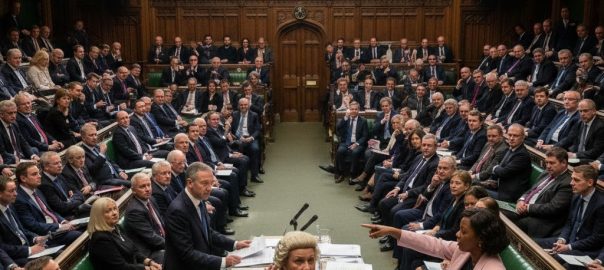
The Brewing Labour Leadership Showdown
Sun, Jun 21 2026 /Mpelembe Media/ — Following Andy Burnham’s decisive Makerfield by-election victory, the Labour Party is on the precipice of a historic and potentially brutal leadership showdown. With Burnham now possessing the required parliamentary seat to launch a challenge, his allies are pushing for an expedited handover of power, arguing that his landslide win proves he is the only politician capable of defeating the populist threat from Reform UK.
However, Prime Minister Keir Starmer has emphatically refused to resign. Despite facing severe cabinet attrition and a plummeting approval rating, Starmer insists he will fight any leadership challenge, warning that a protracted contest will plunge the country into “chaos”. Under party rules, as the incumbent leader, Starmer would automatically be placed on the ballot paper in any formal leadership race. His loyalists are already drafting attack memos, arguing that Burnham has avoided “real scrutiny” and that his support will wane once tested on a national stage.
Complicating the dynamic is former Health Secretary Wes Streeting, who has explicitly stated his intention to run for leader. In his resignation letter, Streeting delivered a scathing critique, telling Starmer directly that “you will not lead the Labour Party into the next general election” due to a “vacuum” of vision and heavy-handed leadership. However, reports suggest Streeting may currently lack the required 81 parliamentary nominations (20% of the Parliamentary Labour Party) needed to formally trigger a contest on his own, leaving him appealing for Starmer to step aside voluntarily to open a “broad” field of candidates.
To avoid a drawn-out, two-month civil war that would ultimately be decided by party members and affiliated trade unions, senior Labour figures are proposing a procedural compromise. Former Deputy Leader Harriet Harman has suggested a “procedural shortcut” where Deputy Leader Lucy Powell and PLP Chair Jess Morden gather Starmer, Burnham, and Streeting in a room to conduct an indicative vote among MPs. This would quickly determine who actually commands the confidence of the parliamentary party and bypass a public contest.
The June Quake: 5 Shocking Takeaways from the Night That Reshaped British Politics
INTRODUCTION: The Breaking Point
On June 18, 2026, the British electorate delivered a verdict that felt less like a routine series of by-elections and more like a structural collapse. For months, the government of Keir Starmer had been hollowing out from within, paralyzed by a sequence of criminal revelations and security scandals that left the administration, in the words of Peter Mandelson’s now-infamous private files, “beleaguered and bereft.”The “June Quake” was not the start of the crisis, but rather the final electoral confirmation of a government in terminal ossification. Following the February arrest of the UK’s Ambassador to the US and the April exposure of a clandestine security override at the heart of the Foreign Office, the voters of Aberdeen South and Makerfield provided the parliamentary bloodletting many had long anticipated. This analysis distills the five most impactful and counter-intuitive takeaways from a night that effectively ended one era of British politics and signaled the turbulent birth of another.
TAKEAWAY 1: The Scottish Tory Resurrection (Aberdeen South)
The result in Aberdeen South was a historic anomaly that shattered decades of political orthodoxy. Conservative candidate Douglas Lumsden secured a decisive victory with 14,308 votes (49.5%), soundly defeating the SNP’s Richard Thomson, who trailed with 8,258 votes (28.6%). This represented a staggering 25.1 percentage point swing—the first Conservative victory in a Scottish by-election since 1967.While the campaign was ostensibly a “referendum on oil and gas,” the underlying pattern reveals a sophisticated consolidation of the right. Lumsden publicly urged Reform UK supporters to back him in a tactical maneuver to oust the SNP, a move that proved devastatingly effective. By framing the election as a battle for the region’s economic lifeblood, the Conservatives successfully synthesized industrial protectionism with Unionist anxiety.”Every time I visit Aberdeen, people tell me that the city is on its knees because Labour and the SNP are killing the oil and gas industry that’s its economic lifeblood… By electing Douglas, who worked in the sector for two decades, voters could give the kiss of life to North Sea oil and gas and help revitalise Aberdeen.” — Kemi Badenoch
TAKEAWAY 2: The Return of the “King of the North”
If Aberdeen South was a resurrection of the Right, Makerfield was a coronation of the resurgent municipalism of the North. Andy Burnham’s landslide return to Westminster—securing 55% of the vote (24,927 votes)—was a direct rebuke to the “vision vacuum” in Downing Street. Burnham’s majority of 9,231 was nearly two-and-a-half times larger than the 3,758 majority enjoyed by his predecessor, Josh Simons, in 2024.This was not merely a local victory; it was the formal paving of a path for a leadership challenge. As Starmer’s authority dissolved under the weight of the Mandelson scandals, Burnham used his victory speech to position himself as the corrective to a “neglected” Westminster politics. The “Burnham effect” has now created a rival power center in the Commons, one that promises a “unity and hope” that the current administration seemingly cannot provide.”There will be no second chance, but it is a chance now from this result tonight to build a new politics based on unity and hope… This is Labour’s final chance to change.” — Andy Burnham
TAKEAWAY 3: The Mandelson Vetting Scandal—A Breach of Protocol
The electoral volatility of June was fueled by the April revelation of a profound breach of national security protocols. In January 2025, United Kingdom Security Vetting (UKSV) formally recommended against granting Peter Mandelson “developed vetting” (DV) clearance for his role as Ambassador to the United States. The independent recommendation cited his association with Jeffrey Epstein and significant professional risks.In an unprecedented move, the Foreign, Commonwealth and Development Office (FCDO) overruled this security recommendation within a mere 48 hours. This clandestine override allowed Mandelson access to the state’s highest secrets despite the explicit warnings of the intelligence community. While Starmer initially maintained that Mandelson had cleared “independent” vetting, he was forced to admit in April 2026 that he was unaware of the official override until the scandal broke, a claim that has done little to mitigate the sense of a government operating in the shadows.
TAKEAWAY 4: The “Vision Vacuum” and the Cabinet Rebellion
The “June Quake” was preceded by a collapse of cabinet collective responsibility. Following disastrous local election losses in May, Wes Streeting led a high-profile rebellion, resigning as Health Secretary with a scathing letter that diagnosed the rot at the heart of the Starmer project. Streeting argued that there was a “vacuum” where “vision” should be—a sentiment echoed by Mandelson’s own leaked WhatsApps.In those private messages, Mandelson mocked the Prime Minister’s leadership style as a repetitive cycle of “advance/buckle/advance/buckle,” suggesting a fundamental lack of “verve” in the Cabinet. This internal critique, paired with the resignation of Streeting and four other ministers, left Starmer isolated long before the first ballot box was opened in June. The by-election results merely provided the public’s signature on a resignation letter that had been written weeks prior.
TAKEAWAY 5: The “Epstein Leak” and the Criminal Fall of the Dark Lord
The most devastating blow to the government’s credibility was the criminal investigation that led to Mandelson’s arrest on February 23, 2026, on suspicion of misconduct in public office. The investigation centered on a series of alleged betrayals of state secrets to Jeffrey Epstein, most notably the leak of a €500bn EU bailout plan in May 2010.Furthermore, files suggested Mandelson had allegedly disclosed the existence of a secret underground tunnel connecting 10 Downing Street to the Ministry of Defence. These revelations, which forced Mandelson’s resignation from the House of Lords and the Labour Party, represent the final, ignominious end of the New Labour era’s influence. The fall of the “Dark Lord” has severed the current administration from its architects, leaving the party in a state of ideological and moral drift.
CONCLUSION: A Country in Search of a Center
As the political dust settles, the landscape heading toward July 2026 is one of profound transition. The center-ground of British politics is currently a vacant lot, contested by a resurgent Scottish Conservatism and a defiant Northern Labour movement led by Andy Burnham. The fall of the Mandelson-Starmer axis has left the public wondering if the “unity and hope” promised by the newcomers can truly take root, or if the “June Quake” is merely the first tremor in a much longer era of national chaos. The question for the reader is simple: has the fever finally broken, or has the infection merely reached the heart?