
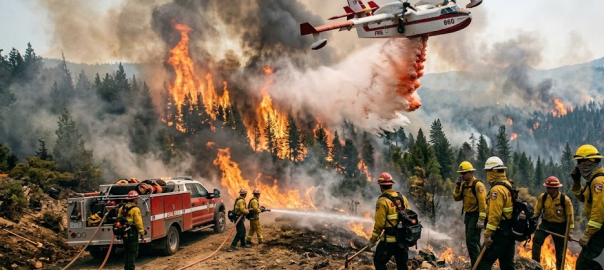
The July 2026 Western European Wildfire Crisis
Mon, July 27 2026 /Mpelembe Media/ — The extreme wildfire emergency that swept across France and Spain in July 2026 represents a historic escalation of climate-driven natural disasters in Western Europe, displacing nearly 300,000 people in some of the largest peacetime evacuations in modern European history. Fueled by successive record-breaking heatwaves, dry vegetation, low relative humidity, and a deep hydrological drought, the concurrent megablazes overwhelmed national containment strategies and prompted massive international mobilization.
Key Facets of the Crisis
1. The Gironde Megablaze and the Threat to Bordeaux (France)
- The Epicenter: Southwestern France’s Gironde department battled a “monster” wildfire originating near the tourist corridor of the Arcachon Bay. The blaze consumed over 42,000 hectares (162 square miles) of pine forest—four times the size of Paris.
- Bordeaux Under Threat: The fire spread to within 15 kilometers (9 miles) of Bordeaux, prompting the city council to actively study scenarios for a total evacuation of the metropolitan area. Over 220,000 people were evacuated from Gironde alone, and at least 240 homes were completely destroyed.
- Infrastructure Interdiction: Shifting, virulent winds forced authorities to close a 60-kilometer stretch of the main A63 highway linking Bordeaux to the Spanish border and completely suspend rail traffic south of Bordeaux.
- Casualties: Tragically, two young firefighters (Anthony Berthôme and Wilfried Schmitter) lost their lives when their tanker truck became trapped by flames on the outskirts of the Bordeaux-Mérignac airport.
2. Spain’s Historic National Emergency
- Unprecedented Emergency: Spain declared a national wildfire emergency for the first time in its history as uncontrolled blazes ravaged central, eastern, and northeastern regions. More than 116,000 people across Spain were evacuated or ordered to lock down.
- The Madrid-Ávila Merger: West of Madrid, two massive wildfires merged into a single 15,000-hectare front, forcing 60,000 evacuations. Prevailing winds carried dense smoke directly into the Madrid metropolitan basin, causing hazardous air quality levels ($PM_{2.5}$) well above WHO safety thresholds and forcing residents to stay indoors.
- Breach of Critical NASA Site: On July 24, the merged Madrid wildfire breached the perimeter of the Madrid Deep Space Communications Complex (MDSCC) in Robledo de Chavela. The tracking station—one of only three globally in NASA’s Deep Space Network—was completely evacuated, seamlessly transitioning its deep-space probe telemetry operations to the Goldstone complex in California. Subsequent onsite inspections confirmed damage was primarily limited to pavement and vegetation, with no significant structural damage to the critical dish antennas or buildings.
- Valencia and Eastern Fronts: A separate, fast-moving fire in Castellón (Vall d’Uixó) forced the evacuation of 16,000 people as it entered the Sierra de Espadán Natural Park. In Manises (Valencia), one civilian was killed after becoming trapped in his vehicle.
- Deadly Almería Fire: These late-July blazes followed a separate, highly lethal fire earlier in the month (starting July 9) in Los Gallardos (Almería), which burned 7,000 hectares and claimed 12 lives.
3. Strategic European Response and Event Disruptions
- Transnational Solidarity: The European Commission activated the rescEU strategic reserve, deploying multiple firefighting aircraft, helicopters, and ground crews from nations like Croatia, Portugal, Greece, and Italy to support French and Spanish forces.
- A400M Heavy Air-Tanker Debut: To rapidly scale up aerial firefighting, France successfully expedited the deployment of a modified military Airbus A400M Atlas transport aircraft. Equipped with a modular, roll-on/roll-off firefighting kit, the plane successfully completed its first real-world mission on July 25, dropping 20 tonnes of water/retardant—a capacity equivalent to three traditional Canadair water bombers.
- Major Event Interruptions:
- Tour de France: The final stage (Stage 21) of the 2026 Tour de France was shortened from 133km to 89km, shifting the start directly to Paris so that the French Ministry of the Interior could redeploy security and policing forces to reinforce firefighting efforts in Gironde.
Baja España Aragón: The prestigious off-road rally scheduled for July 24–26 in Teruel was postponed by regional authorities due to extreme fire risks.
The Ogre in the Woods: 5 Surprising Realities of Europe’s 2026 Wildfire Crisis
1. Introduction: A Summer Beyond Statistics
For travelers standing on the tarmac at Bordeaux-Mérignac airport this July, the climate crisis was no longer a distant projection; it was a sensory assault. Flights were grounded not by mechanical failure, but by a sky transformed into a bruised, yellowed canvas, choked by massive plumes of smoke visible from the runways. Simultaneously, nearly 400 miles to the south, the residents of Madrid navigated a ghostly urban landscape, donning face masks to filter an atmosphere heavy with falling ash and “atmospheric loading” levels that rivaled the continent’s most industrial hubs.Europe has endured three staggering heatwaves in the first half of 2026, a cadence scientists directly attribute to human-driven climate change and the resulting extreme drought. But this summer has revealed a more sinister evolution: the decoupling of fire from the seasons we once understood. We are no longer simply dealing with “forest fires,” but with a systemic shift in the continent’s ecology. To understand this new era, we must look past the headlines and identify the counter-intuitive shifts—the surprising realities—reshaping European life.
2. When Fire Becomes its Own Weather System
The 2026 blazes in France’s Gironde department have demonstrated a terrifying technical evolution in wildfire behavior. In the past, fire followed the wind; today, in Gironde, the fire is the wind. The intensity of these blazes has reached a threshold where they generate massive convection columns—superheated towers of air that draw in oxygen with such force they create localized, high-velocity wind systems.This phenomenon explains the “erratic” advance of the flames toward the Bordeaux metropolitan area, moving with a logic that defies traditional meteorological forecasting. Gironde prefect Sophie Brocas provided a visceral description of this predatory behavior:”The fire is an ogre who can run very fast,” Brocas warned. “It has reached an unprecedented magnitude, advancing erratically toward the metropolitan area.”This is the Information Architect’s nightmare: a system that has moved beyond predictive modeling. When a blaze begins generating its own weather, traditional firefighting strategies—relying on firebreaks and external wind forecasts—become functionally obsolete. The fire does not just spread; it leaps, fueled by its own internal atmospheric engine.
3. The Unprecedented Scale of the “Peacetime Evacuation”
The human displacement of 2026 has reached a scale that challenges modern logistical infrastructure. Across France and Spain, over 300,000 people have been forced to flee their homes. French authorities, including the Interior Minister, have categorized this as the largest “peacetime evacuation” in the nation’s history, drawing sobering comparisons to the upheaval of World War II.The data reveals the immense pressure on civil systems:
- France: Approximately 220,000 residents were moved to safety, including tens of thousands from the western suburbs of Bordeaux.
- Spain: More than 116,000 people were displaced as fires threatened the outskirts of Madrid and the Valencia region.This is a logistical nightmare executed under “smoke-darkened skies.” In Bordeaux, the massive Bordeaux-Lac exhibition centre and various sports halls were repurposed into emergency hubs. This wasn’t merely a temporary relocation of tourists; it was the managed movement of a population equivalent to a major European city, conducted while visibility dropped to near-zero and the Fire Weather Index (FWI) hit record anomalies.
4. The Cultural Sacrifice: When “Tradition” Becomes Too Risky
Perhaps the most poignant reality of 2026 is the moment where European cultural heritage was forced to capitulate to the climate. The Baja España Aragón rally, held in the province of Teruel since 1983, is an event defined by “heat, dust, and hard ground.” In a cruel irony, the very elements that formed the rally’s identity were the ones that defeated it.Technical assessments revealed an environment so volatile—temperatures exceeding 40°C and critically low humidity—that the risk of a single ignition point from a competition vehicle was deemed a threat to regional security. The irony is systemic: the same “security forces” and emergency personnel required to guard the Tour de France peloton were instead diverted to the frontlines of the Gironde and Zaragoza fires. Consequently, the final stage of the Tour de France was shortened, not because of the heat itself, but to free up the human infrastructure required for disaster management. We are entering an era where the traditional European summer calendar is becoming physically and logistically obsolete.
5. The Ultimate Sacrifice: A Tribute to the Frontline
The human cost of this crisis is best understood through the names Anthony Berthôme and Wilfried Schmitter. These two young firefighters were engaged in a “long and very difficult” battle on the outskirts of the Bordeaux-Mérignac airport. In a testament to the “erratic” nature of the 2026 fires, their tanker truck became encircled and trapped by rapidly spreading flames that outpaced their ability to retreat.Interior Minister Laurent Nunez, paying tribute to the men, highlighted the extreme strain on national services:”The battle is long and very difficult,” Nunez remarked, describing the fallen as “exceptional men” within a service currently working at “full stretch.”The scale of the mobilization required to meet this “ogre” is industrial. The EU Civil Protection Mechanism has deployed its largest response ever, including the strategic Airbus A400M Atlas —a massive military cargo plane—and firefighting aircraft from Greece, Italy, Portugal, and Croatia. This is “total war” logic applied to a forest, requiring the coordination of the rescEU reserve and international teams to prevent the fire from breaching city limits.
6. The Paradox of the Atmosphere: Regional Crisis vs. Global Data
For an Information Architect, the most jarring reality of 2026 is the “Atmospheric Paradox.” Data from the Copernicus Atmosphere Monitoring Service (CAMS) indicates that global biomass burning emissions in 2026 actually reached their lowest level since 2003, with CO2 emissions totaling 8.31 million tonnes—below the long-term average.Yet, this statistical lull provides zero comfort to the regional reality. While the global average dipped, the regional intensity skyrocketed:
- Spain: The JRC/EFFIS reported that 152,678 hectares have burned—a staggering six times the amount recorded in 2025.
- France: Nearly 98,000 hectares have been lost, a historic national record.This is the “Architect” at work: explaining how data can be simultaneously true and misleading. A global lull in fire activity means nothing when a specific region experiences a 600% increase in devastation. For the citizen in Madrid wearing a mask, the “average” is an abstraction; the reality is an unprecedented “atmospheric loading” of smoke that has paralyzed the Iberian Peninsula.
7. Conclusion: The Land is Talking—Are We Listening?
As the fires of 2026 continue to burn, the sentiment among those on the frontlines has shifted from a belief in control to a grim acknowledgment of vulnerability. The thematic anchor of this crisis was captured by a firefighter in the Gironde: “Maintenant c’est le terrain qui va parler” —Now it’s the land that’s going to talk.From the closure of the A63 motorway to the evacuation of the Bordeaux suburbs, the land is speaking of a future where our current infrastructure is no longer compatible with the environment. If the “ogre” in the woods can now generate its own weather and outrun our fastest predictions, we must ask: can our airports, motorways, and cities survive a future where fire is no longer a seasonal guest, but the new architect of the landscape?