
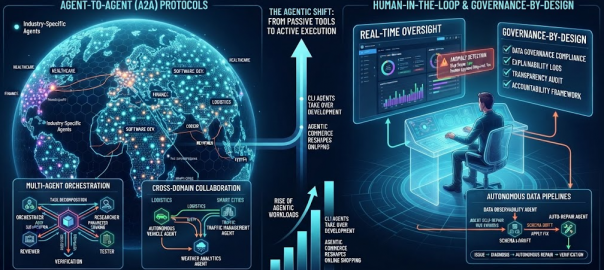
The Tollbooth Trap: Why Commoditized Middlemen Are Losing Ground to Autonomous Intelligence.
The rapid evolution of generative artificial intelligence and autonomous multi-agent architectures is driving a structural transformation across the digital economy, dismantling traditional business models founded on search arbitrage, manual creative services, seat-based software licensing, and intermediation. Legacy stock photography illustrates this vulnerability, highlighted by Getty Images filing for Chapter 11 bankruptcy after losing more than 99 percent of its peak market valuation amid competition from on-demand text-to-image generators that undercut conventional pay-per-image licensing. Similar pressures are impacting online labor markets such as Upwork, where freelancers in occupations exposed to language and image models experienced a 2 percent decline in contracts and a 5 percent decrease in earnings, with high-reputation professionals disproportionately impacted as automated systems compress human skill differentials. Concurrently, commoditized intermediaries across travel booking, online retail, and mid-market SaaS face severe disintermediation. Over 100 publicly listed mid-market software providers are caught in a major squeeze between low-cost AI startups and cloud hyperscalers, prompting enterprises to replace traditional per-seat subscriptions with internal autonomous agents.
Traditional software environments and web-discovery platforms are likewise transitioning from primary gateways into background infrastructure. Established operating systems like Windows, macOS, Linux, and Chrome risk becoming legacy compatibility shells as computing migrates toward agentic systems driven by semantic storage, probabilistic kernels, and multi-agent orchestration frameworks. Concurrently, speculative forecasts anticipate that dedicated web browsers, standalone email clients, manual editing software, app stores, and traditional e-commerce storefronts will be superseded by direct agentic interfaces and machine-to-machine communication protocols. While generative search platforms risk starving the open web of referral visits and the data signals needed to fund original reporting, observed empirical evidence shows a hybrid reality where search engines incorporate agentic actions directly and a majority of users continue to combine AI overviews with conventional search exploration.
Despite the disruption inflicted on legacy platforms, this technological shift is reallocating economic value to end users at unprecedented scale. In the United States, annual consumer surplus from generative AI expanded to an estimated $172.3 billion in early 2026, up from $116.2 billion in 2025 as adoption expanded to 115 million adults and average individual monthly valuations rose to $124.50. Because the vast majority of consumers pay modest subscription fees or access these tools freely, aggregate consumer welfare gains drastically exceed worldwide producer revenues, shifting the balance of economic value away from legacy digital tollbooths directly to end users.
7 Counter-Intuitive Truths About the AI Economy That Industry Leaders Are Missing
1. Introduction: Beyond the Hype and the Panic
Public discourse around artificial intelligence remains trapped in a double-bind of hyperbole. On one side, apocalyptic narratives warn of immediate, structural workforce obsolescence; on the other, enterprise pitch decks promise friction-free productivity gains and effortless corporate margin expansion. Yet behind the headline-driven anxiety and corporate posturing lies a far more complex, surprising, and counter-intuitive economic reality. Rigorous empirical research from leading academic institutions, market data, and corporate financial filings reveal that the real economic mechanics of the AI transition are deviating sharply from conventional technology adoption cycles.
The central battleground of the AI economy is not simply about who owns the largest neural networks or who deploys tools the fastest. Instead, it is defined by a fundamental redistribution of economic rent. Generative models act as supreme optimizers and commoditizers: anything that can be reduced to structured variables, standardized workflows, or easily indexed comparisons is being rapidly priced down to its marginal cost. Consequently, defensive advantage is moving away from intermediate service providers, legacy digital aggregators, and traditional software platforms, shifting toward end-consumers on one end and owners of non-comparable, irreplaceable assets on the other.
This article provides a curated, data-backed synthesis of seven critical structural shifts across macroeconomic research, labor market studies, information economics, and systems architecture. Together, these insights challenge core assumptions regarding consumer surplus, skill defensibility, distribution moats, and enterprise software architecture, providing executives and strategists with a rigorous blueprint for navigating the AI-mediated economy.
2. Takeaway 1: Consumers Are Stealing the Show (Capturing $172 Billion in Unseen Surplus)
A major puzzle confronting modern macroeconomics is a digital iteration of the classical Solow Paradox: despite massive capital expenditures and rapid consumer adoption, generative AI’s economic value is largely invisible in traditional gross domestic product (GDP) accounting and corporate earnings reports. Research from the Stanford Digital Economy Lab (Brynjolfsson et al., April 2026) demonstrates that this disconnect occurs because standard market transactions capture only a tiny fraction of the social value generated by free or low-cost digital tools.
To quantify this off-the-books value, researchers deployed large-scale discrete choice experiments measuring users’ Willingness to Accept (WTA) —the precise monetary compensation an individual requires to voluntarily give up access to generative AI chatbots for one month. Between July 2025 and March 2026, the mean WTA among US adult users expanded by 27%, rising from $98.00 to $ 124.50 per month, while the median WTA rose from $3.40 to $ 11.40 per month.
Key Economic Disparity (Stanford Digital Economy Lab, 2026):
- Mean Monthly User Valuation (WTA): $124.50/month (up from $98.00 in 2025)
- Median Monthly User Valuation (WTA): $11.40/month (up from $3.40 in 2025)
- Aggregate US Consumer Surplus: $172 Billion annually (up from $116 Billion in 2025)
- Global GenAI Producer Revenues: ~$14.2 Billion total
The substantial gap between the median ( $11.40) and mean ($ 124.50) valuations reflects a dramatic power-law distribution driven by usage intensity. While casual users derive modest utility from conversational AI, high-frequency power users, workplace adopters, and paid subscribers form a heavy right-tail skew that drives aggregate value upward. Concurrently, broader demographic tracking by Bick et al. (2026) indicates that the US adult user base expanded from 98 million (48% adoption) to 115 million (56% adoption) over the same period. When scaling these valuation curves across the expanding user base, total annual US consumer surplus grew from $116 billion to $ 172 billion in less than a year.
By contrast, total global producer revenues for generative AI tools stand at approximately $14.2 billion . US consumers alone capture more than 12 times the economic value realized by platform creators globally. This outcome aligns with historical technological trends identified by Nobel laureate William Nordhaus (2004), who calculated that technological innovators historically retain only around 3% of the total social returns generated by major technological breakthroughs, with the remaining 97% passing directly to end-users as consumer surplus.
“This surplus substantially exceeds estimated revenues from generative AI in the United States, suggesting that consumers capture most of the welfare gains from these tools… consistent with Nordhaus (2004), who finds that innovators captured only around 3% of the total social returns from major technological advances.” — Stanford Digital Economy Lab (Brynjolfsson et al., April 2026)
3. Takeaway 2: AI Is Hitting High-Skill Freelancers Hardest by “Leveling the Playing Field”
If end-consumers are capturing the bulk of AI’s economic surplus, where is that value being extracted from? The answer lies in intermediate labor markets. Traditional economic frameworks assume that technological shocks primarily displace lower-skilled, routine labor while complementing and insulating high-skill, highly credentialed professionals. Empirical evidence from the Brookings Institution (Hui et al., 2024/2025), analyzing high-frequency transaction data from the online freelancing platform Upwork, reveals an entirely different labor dynamic.
Following the public releases of visual and text generative models (DALL-E 2, Midjourney, and ChatGPT), freelancers in exposed occupations—such as copyediting, proofreading, and graphic design—experienced an immediate average decline of 2% in monthly contracts and a 5% drop in total monthly earnings .
Freelancer Market Impact (Brookings Institution, Hui et al.):
- Monthly Contract Volume: Down 2% in exposed categories
- Total Monthly Earnings: Down 5% in exposed categories
- Cross-Domain Replication: Image models (early 2022) and text models (late 2022) generated identical magnitude declines across entirely separate labor domains.
Crucially, the study established temporal and cross-domain replication: image generation models released in early 2022 and text-based language models released in late 2022 generated identical percentage declines across completely different worker cohorts.
The most counter-intuitive finding, however, lies in worker distribution dynamics: experienced, top-rated freelancers suffered disproportionately larger drops in contract volume and earnings than lower-rated peers . Generative AI operates as a powerful “skill compressor.” By raising the performance floor for entry-level workers, LLMs allow lower-rated freelancers to produce outputs that closely approximate the quality historically delivered only by elite talent. In doing so, the technology erodes the price premium and pricing power that high-reputation professionals historically commanded.
“Generative AI appears to be ‘leveling the playing field’ by compressing performance differences across the skill spectrum… less experienced or lower-rated freelancers can now produce outputs that in many cases approximate the quality associated only with top-tier talent.” — Brookings Institution (Hui et al.)
4. Takeaway 3: The Collapse of Legacy Visual Moats (Inside the Fall of Getty Images)
The compression of skill premiums in freelance markets mirrors a parallel collapse in commercial digital media distribution. For decades, stock photography giants relied on static visual repositories protected by copyright licensing and distribution scale. The downfall of industry titan Getty Images illustrates how rapidly generative models can dissolve structural moats built on static asset inventories.
On October 21, 2026, Getty Images filed for expedited prepackaged Chapter 11 bankruptcy to restructure over $1.4 billion (HK$ 10.92 billion) in debt , having lost more than 99% of its peak market valuation and fallen into penny-stock territory following the collapse of its planned merger with rival Shutterstock. The primary driver was operational disintermediation: text-to-image platforms (such as Midjourney, DALL-E, and Stable Diffusion) empowered corporate marketing teams to generate bespoke, high-resolution visual assets instantly from simple prompts, undercutting traditional pay-per-image commercial licensing models.
Getty Images Financial Restructuring (October 2026):
- Market Valuation Loss: >99% from peak (penny-stock threshold)
- Restructured Debt Burden: > $1.4 Billion (HK$ 10.92 Billion)
- Legal Status: Chapter 11 prepackaged bankruptcy filing following failed Shutterstock merger
As IT and media analyst Francis Fong points out, defensive measures—such as high-profile copyright lawsuits against AI developers for data scraping and launching commercially indemnified, in-house AI generators—failed to halt customer migration toward cheaper, faster third-party generators.
Fong’s analysis delivers a clear strategic message for enterprise leaders: defensive moats built purely on licensing static digital inventory cannot withstand generative capabilities. To survive in an AI-mediated economy, digital asset providers must pivot away from passive access fees toward offering proprietary model-training datasets, enterprise legal compliance frameworks, and deep integration with automated creative execution tools.
5. Takeaway 4: The Web’s Vicious Feedback Loop (Why the Open WWW Is Threatening to Collapse)
The economic engine of the open internet has long depended on an implicit value exchange: content creators publish original information, search engines index it, and users click through to publisher websites, generating referral traffic that finances ongoing content creation. Research from Harvard Business School (Alex Chan, Working Paper No. 26-088, June 2026) demonstrates that AI answer engines are systematically severing this economic loop.
By synthesizing answers directly within the query interface, AI platforms retain user attention and eliminate outbound referral traffic to primary sources. The core economic failure identified by Chan is that AI answer systems underinternalize future content reproduction . By consuming open-web content without directing economic traffic back to publishers, AI platforms render the costly production of original open-web information “subcritical.”
The Degradation Feedback Loop:
- Zero-Click Answer Retains Users: AI interface synthesizes source content directly, cutting publisher referral traffic.
- Publisher Monetization Starves: Original creators lose ad revenue and digital subscriptions, reducing content budgets.
- Source Quality Signals Degrade: Reduced user engagement erodes the behavioral quality signals used by search indexes.
- Conventional Search Efficacy Fails: Underlying index quality deteriorates due to degraded web inputs.
- Forced AI Dependence: Users are forced into deeper reliance on conversational AI summaries, accelerating the loop.
“AI answer systems can improve user experience while diverting visits that finance publisher content and generate source-level quality signals. I show that an AI platform that underinternalizes future content reproduction retains too little referral traffic and can make costly open-web information subcritical, even with truthful content, accurate answers, and rational users.” — Harvard Business School (Alex Chan, Working Paper No. 26-088, June 2026)
To prevent the total degradation of primary web content, Chan outlines four structural remedies:
- Visitor-Replacement Royalties: Direct financial compensation paid by AI platforms to publishers to offset displaced referral traffic.
- Audited Provenance: Technical tracking frameworks that verify and credit original data sources.
- Human-Information Audits: Independent verification mechanisms to ensure high-quality human data collection.
- Keystone-Topic Compensation: Targeted subsidies designed to preserve non-commercial, highly specialized knowledge creation.
6. Takeaway 5: Multi-Agent Hierarchies Are Beating Monolithic AI Models
As AI adoption shifts from simple content generation to complex business workflow automation, single monolithic Large Language Models (LLMs) hit strict operational limits. When handling multi-step enterprise tasks, monolithic single-agent systems suffer from context drift, error accumulation, high hallucination rates, and multitasking overhead.
Technical research on the Autonoma framework (Reda et al.) demonstrates that modular, hierarchical multi-agent architectures outperform single-model approaches across complex environments. Autonoma separates top-level orchestration from specialized task execution through a clear operational hierarchy:
- Coordinator (GPT-4o): Serves as the gateway, validating user intent, managing entry-point conversations, and filtering invalid prompts.
- Planner (GPT-4o / DeepSeek R1): Decomposes open-ended user requests into structured execution graphs.
- Supervisor (GPT-4o): Manages dynamic execution, dispatches tasks to specialized workers, monitors health, and oversees inter-agent handoffs.
- Specialized Workers: Dedicated single-purpose modules, including the Researcher (web scraping via Tavily, Crawl, DuckDuckGo), Coder (PowerShell and Python execution), Browser (Chrome UI automation), File Manager (I/O operations), Computer (desktop control with OCR and YOLOv8 vision), and Reporter (summary compilation and failure logging).
To isolate execution risk and protect data privacy, Autonoma operates within a secure local-area network (LAN) environment using Docker containerization, FastAPI backends, and LangChain/LangGraph state management. Local containerization keeps frontend user latency down to 1–2 seconds while isolating errors to individual worker modules. Across 500 empirical test cases, this division of labor achieved a 97% task completion rate and a 98% successful inter-agent handoff rate .
Structural Comparison: Monolithic vs. Multi-Agent Systems
Dimension / Monolithic Single-Agent Systems,Autonoma Multi-Agent Architecture
Architecture Type Single large AI agent handling all tasks via integrated tool calls.,Multi-agent system separating orchestration from specialized worker execution.
“Task Distribution One agent manages all execution steps, causing high context bloat.”,”Specialized agents execute narrow, well-defined tasks with high precision.”
“Training & Improvement Updating the core model affects all tasks, making fine-tuning difficult.”,Individual worker agents can be updated or swapped without altering orchestration.
Performance Efficiency Lower efficiency due to frequent context switching in long reasoning loops.,High efficiency with localized optimizations for specific agent functions.
Scalability Difficult to scale; adding tools increases loop complexity and error rates.,Highly scalable; new capabilities integrate as modular plug-and-play agents.
Error Isolation A single execution error cascades through the entire reasoning chain.,”Failures are contained locally within the specific agent, allowing system retries.”
Hallucination Risk Higher; long reasoning chains and multitasking trigger severe context drift.,”Lower; specialized agents operate within focused, bounded context windows.”
Maintenance Monolithic; difficult to debug issues within long execution logs.,Modular; clear audit trails allow simple debugging of individual agent actions.
“Adaptability A single model must generalize across all tasks, causing domain trade-offs.”,”Each agent leverages the specific model, dataset, or tool best suited to its function.”
7. Takeaway 6: Reports of Google’s Death Are Greatly Exaggerated
Despite initial predictions that conversational AI models would quickly render conventional search engines obsolete, empirical user data reveals that consumer search habits are evolving into a hybrid model rather than abandoning established search indexes.
While Google announced that its AI Mode passed 1 billion monthly active users , market research from Gartner indicates that only one-third (33%) of US consumers consider generative AI chatbots as effective as traditional search engines for finding information. Furthermore, while 82% of surveyed users noticed Google AI Overviews , more than two-thirds regularly clicked past the summary to view conventional search results.
Consumer Search Click Behavior (Pew Research Center, March 2025 Study):
- Searches WITHOUT AI Summaries: 15% click-through rate to traditional web results
- Searches WITH AI Summaries: 8% click-through rate to traditional web results
- AI Summary Attribution Links: 1% click-through rate to source links cited inside the summary
A comprehensive browsing study by the Pew Research Center—analyzing 68,879 Google searches across 900 US adults—confirms that while AI summaries reduce total click-through rates, traditional links remain the primary destination for user verification.
As analysis from PRAXIS Labs highlights, consumers are forming a hybrid search journey . Users leverage conversational AI summaries for quick context and complex technical explanations, but quickly return to traditional search for local service intent, proximity verification, provider reviews, and direct commercial transactions. Local search depends on explicit signals of relevance, distance, and prominence that standalone conversational LLMs cannot independently verify or index without traditional search infrastructure.
8. Takeaway 7: The “Big Squeeze” in Mid-Market SaaS and the Emergence of Agentic OS
The enterprise software industry is undergoing a severe structural realignment. Analysis from Aalto Capital and an AlixPartners study highlight a escalating “Big Squeeze” impacting 122+ publicly listed mid-market SaaS companies . Positioned between agile, low-cost AI-native startups and mega-cap platform providers (Microsoft, Salesforce, Oracle) embedding native AI capabilities, traditional mid-market software providers are seeing growth rates slow dramatically.
Mid-Market SaaS High-Growth Proportion (AlixPartners Study):
- 2023 Actual: 57% classified as high-growth
- 2024 Actual: 39% classified as high-growth
- 2025 Projected: ~27% projected high-growth
Enterprises are increasingly moving away from traditional seat-based software licenses in favor of custom, outcome-based AI workflows. A high-profile example is fintech leader Klarna, which publicly phased out legacy enterprise SaaS solutions—including Salesforce and Workday—in favor of custom in-house AI tools. However, the financial upside of adapting is substantial: AlixPartners found that SaaS companies that successfully transition from seat-based pricing to delivering AI-powered outcomes experience a 4x to 6x uplift in valuation multiples .
Concurrently, research from Serious Insights (Daniel W. Rasmus) details a fundamental transition toward the Agentic Operating System (Agentic OS) . Traditional operating systems (Windows, macOS) risk being reduced to legacy compatibility layers as the primary computing interface shifts from human-driven UI inputs to natural language intent orchestration.
TRADITIONAL OS KERNEL vs. AGENTIC OS ARCHITECTURE
====================================================================
Traditional OS: Deterministic Kernel ──► File Pathnames & Read/Write Executions
Agentic OS: Probabilistic Kernel ──► Intent, Policy & Confidence Arbitrations
In an Agentic OS framework, traditional deterministic kernels (which manage explicit file paths and device commands) are superseded by probabilistic kernels that evaluate intent, calculate confidence intervals, and execute policy decisions under uncertainty across a semantic vector substrate. As natural language orchestration, persistent knowledge graphs, and multi-agent swarms replace traditional desktop windows and application icons, competitive advantage shifts from controlling hardware execution layers to managing the agent orchestration layer.
9. Conclusion: Living in an AI-Mediated Reality
The economic realignment brought about by artificial intelligence is far more nuanced than simple predictions of mass job loss or immediate platform dominance suggest. Instead, digital markets are undergoing a fundamental structural transition. Value is shifting dramatically away from intermediate service providers, static content repositories, and seat-based software vendors, reallocating toward end-consumers on one side and owners of non-comparable supply and direct customer relationships on the other.
As autonomous agents become the primary interface between supply and demand, competitive defensibility can no longer be built on easily indexed digital inventory, standardized cognitive work, or arbitrary software complexity. Algorithms excel at commoditizing anything they can compare and optimize. For corporate executives, technology founders, and individual professionals, navigating this transition requires addressing a central strategic question:
Is your organization’s business model or personal skill set built on easily indexed, highly comparable variables that an algorithm can optimize away—or is it anchored in direct customer trust, non-comparable assets, and irreplaceable human value?