
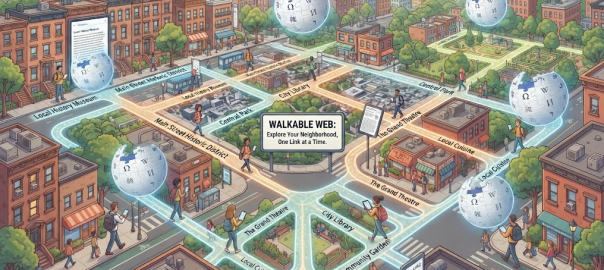
Mapping the Neighborhood: Reimagining Wikipedia as a Proximity-Based Experience
Sat Oct. 24, 2026 /Mpelembe Media/ — Local Wikipedia is an independent, unofficial web application developed by journalist, software developer, and data specialist Ed Jefferson that turns Wikipedia into a proximity-focused, ambient spatial encyclopedia. Conceived during lockdown and released in late 2026, the application operates on the core thesis of displaying geotagged Wikipedia articles located within a thirty-minute walk from the user. Users can set their location using native browser geolocation or manual text queries such as town names, landmarks, and UK postal codes. To balance visual clutter and system performance across varying geographic densities, the platform automatically adjusts its operational scope, expanding up to six miles in low-density rural areas or capping results at five hundred items in dense urban centers. Designed with client-side privacy in mind, positioning coordinates remain strictly within temporary local browser memory, and exported links are sanitized to ensure physical location data is never shared.
Beyond Local Wikipedia, Ed Jefferson’s broader digital portfolio spans data journalism, public transit research, viral micro-games, and custom live event infrastructure. His transport research includes London’s Busiest Bus Stops, an interactive visualization mapping passenger footfall across nineteen thousand bus stops using Transport for London Freedom of Information data, along with Underground navigation games such as Journey Planner Challenge and Play Your Tubes Right. In web tooling and media satire, Jefferson created Letterle, a viral daily Wordle parody requiring players to guess a single letter, which received widespread coverage from outlets including The Guardian and The Wall Street Journal. His work also features What 9 Whos (a geocoding parody of What3Words using Doctor Who cast histories), Maraoke (custom synchronized software powering live video-game comedy karaoke), and empirical pop-culture experiments like contestant survival modeling in The Traitor Data and selecting lottery tickets using Nicolas Cage film statistics.
Technical Architecture & Privacy Design of Local Wikipedia
Conceived during lockdown and finalized for public release in late 2026, Local Wikipedia was built by Ed Jefferson to transform global encyclopedia data into an ambient, proximity-based discovery tool. The system fetches geotagged articles directly from the Wikipedia API based on a user’s geographical anchor. To resolve locations, the web stack utilizes open-source geocoders: Nominatim handles global town and landmark queries, while postcodes.io processes UK postal codes. Interactive maps and tile renders are handled via Leaflet, drawing on basemap data from OpenFreeMap, OpenMapTiles, and OpenStreetMap.
To maintain performance across varying geographic densities, the application implements dynamic bounding rules. The baseline operational scope targets entries within a 30-minute walking distance (roughly 0.5 to 1.5 miles). In rural or low-density locations with fewer than 25 nearby entries, the system automatically expands its search radius up to six miles to retrieve at least 25 items. Conversely, in dense metropolitan environments containing thousands of points of interest, results are strictly capped at the closest 500 items to prevent browser memory bloat and API rate limiting.
Privacy is a core structural feature of the application. Rather than storing user movements on central servers, positioning coordinates exist exclusively in temporary local browser memory. Furthermore, when a user shares or exports a page link, the system executes a sanitized URL state that strips raw latitude and longitude coordinates, retaining only explicitly typed text queries (such as a postcode or city name) to guarantee physical location privacy.
From Walkable Wikis to Synthetic Slop: Navigating the Chaotic, Human, and Bizarre Frontiers of the Modern Web
Navigating the internet today feels like taking an unintended bath in an endlessly rising tide of algorithmic noise, corporate platforming, and synthetic content. We are drowning in engagement-driven feeds designed to capture passive attention, where automated systems spaff out frictionless “slop” faster than any human mind can process it.
Yet beneath this smooth, machine-generated veneer, the web remains a gloriously weird, chaotic, and deeply human laboratory. If you look past the corporate walled gardens, the digital landscape is undergoing a fascinating inflection point: global datasets are re-anchoring us to physical pavement, artificial intelligence is eroding software economics and biological boundaries, and accidental Zoom encounters are rescuing strangers from legal doom. The web isn’t dead—it’s just getting weirder.
Your Own Backyard Is Weirder Than You Think: The Rise of the “Walkable Web”
Ed Jefferson’s viral project, “Local Wikipedia,” offers a delightfully refreshing antidote to the placelessness of modern social feeds. Built to pull Wikipedia entries located within a half-hour walk—or roughly half a mile—of the user’s location, the tool transforms mundane local geography into a dense, hyper-local historic archive. Suddenly, a routine stroll to the corner store becomes an excursion into forgotten lore.
Users exploring their immediate vicinity have uncovered bizarre neighborhood nuggets: discovering their town inexplicably shares a postcode with a community in Sicily, or finding that local commentary regarding the neighborhood “bunny and coyote situation” has remained frozen on Wikipedia since 2006. Others have learned that a forgotten 1910s rail line with extra Sunday service once connected their apartment directly to their brother’s neighborhood, or stumbled upon obscure public art installations like the “Aqua Horological Tintinnabulator” sitting in a local shopping centre. One user even logged on only to discover their city had an ebolavirus strain named directly after it.
This sudden obsession with hyper-local proximity highlights a growing cultural hunger: using global digital data not to escape reality, but to re-anchor ourselves in physical dirt. Rather than plunging users deeper into abstract global feeds, the “walkable web” injects history and friction back into our everyday surroundings. As one user on Bluesky brilliantly summarized its appeal:
“cool idea, like if NextDoor was used for good, rather than speculating about a builder’s van that’s been here for 3 days or blaming everything on the local HMO”
Software “Moats” Are Eroding Overnight Thanks to AI
If tools like Local Wikipedia use digital data to celebrate physical friction, the software industry itself is watching its traditional barriers vanish entirely. The intellectual property “moats” that protected tech monopolies for decades are collapsing at breakneck speed, driven by prompt-driven “vibecoding” and advanced AI reverse-engineering tools.
Inspecting, dissecting, and replicating complex application logic no longer requires a horde of Silicon Valley engineers or access to proprietary source code. The Reverse Engineer Everything GitHub repository exemplifies this shift: its underlying framework allows AI agents to inspect a running application externally without its source code, analyze how specific features operate, present concrete evidence, and autonomously construct working clones for a new project. Combined with prompt-driven workflows, independent builders are now spinning up completely free, functional alternatives that replicate the dense feature sets of legacy commercial behemoths like the Adobe Creative Suite.
- The Reverse Engineer Everything Framework: Enables AI agents to audit external software without original source code, analyze feature mechanics, and generate working functional clones.
- Vibecoded Creative Suites: Individual creators using prompt-driven workflows to instantly replicate complex proprietary tools like Adobe’s ecosystem for zero cost.
Just as AI code generation is breaking down the structural barriers of proprietary software, generative media is executing a similar disruption on the human canvas—dismantling the anatomical boundaries of our physical bodies.
“AI Face” Is Pushing Aesthetic Medicine Beyond Biological Limits
In plastic surgery clinics across Los Angeles, a startling trend reported by Vogue highlights the profound psychological creep of generative media: prospective patients are arriving at consultations clutching AI-generated, photorealistic portraits of themselves, demanding real-world cosmetic procedures to match the synthetic renders.
This phenomenon marks a critical shift from traditional social media filters. Conventional Instagram filters merely smooth or tweak an existing photograph within real human proportions. Generative AI, by contrast, reconstructs facial features from scratch without the slightest regard for biological, skeletal, or anatomical limits. Surgeons report that patients present images that appear deceptively photorealistic and attainable—far more personal than traditional celebrity reference photos—yet depict structural modifications that are physically impossible to achieve through human surgery. We have moved from wanting to look like an idealized movie star to wanting to inhabit a synthetic hallucination that cannot exist in biological reality.
Algorithmic Efficiency Is Causing Bizarre Real-World Bottlenecks
The friction-free promises of AI optimization don’t just glitch in plastic surgery clinics; they create surreal gridlock when unleashed on physical infrastructure. Take the recent trend reported by essayist Mimi Jiang regarding Chinese holiday travelers using generative AI models like DeepSeek to plan their vacations. Eager to avoid suffocating tourist crowds, thousands of individual travelers fed specific prompts into AI agents, demanding “off-the-beaten-path” recommendations and non-peak visiting hours.
The paradox was as instant as it was absurd. Because thousands of uncoordinated citizens relied on centralized AI models drawing from identical underlying datasets, the algorithms spit out the exact same “secret” recommendations to everyone. Consequently, thousands of travelers descended upon the exact same obscure rural locations at the exact same hour, triggering unprecedented traffic jams, mile-long queues, and total operational bottlenecks. By outsourcing decision-making to central algorithms in the name of efficiency, users accidentally engineered the exact chaotic gridlock they sought to avoid, proving that central optimization flattens human serendipity into mass synchronization.
The “Old Web” Spirit Lives On in Accidental Zoom Calls and Weird Niche Archives
Yet, despite corporate consolidation, algorithmic homogenization, and AI slop, the glorious, chaotic spirit of the “Old Web”—rooted in human absurdity, empathy, and hyper-niche curation—refuses to die.
Consider the saga of writer Matt Muir. After repeatedly receiving misdirected official court notices meant for an unrelated namesake facing a DUI charge in Duchesne County, Utah, Muir grew concerned that the stranger would miss his hearing and get “mulched by the process machine.” Driven by sheer human solidarity, Muir logged into the public Utah court Zoom call himself. When the case was called, he turned on his camera to clarify the email mix-up with the bemused judge, confirmed that the actual “Other Matt Muir” was indeed present on the call, raised a fist in solidarity, shouted “I BELIEVE IN YOU, OTHER MATT MUIR!” and signed off. In a magnificent postscript delivered via lingering misdirected emails, Muir later learned that Other Matt Muir got off with a suspended sentence and a fine—successfully avoiding custody as long as he keeps his nose clean.
Equally vibrant is the persistent world of hyper-specific human archiving, where passionate eccentrics curate digital spaces purely for the joy of shared obsession:
- German Stunter : A legendary YouTube channel hosting roughly 2,700 vintage clips of car chases, explosions, and stunt scenes meticulously pulled from old German TV shows and movies.
- r/ladles : A dedicated Reddit community where thousands of users gather for the sole, unadulterated purpose of sharing photos of soup ladles.
These moments prove that no matter how much synthetic noise corporate algorithms pump into our feeds, the true magic of the internet remains irrevocably tethered to hyper-specific, weird, and deeply empathetic human connection.
The Frictionless Void vs. The Human Canvas
We are navigating a profound digital crossroads. On one side lies an internet driven by frictionless automation—where AI agents generate instant software clones, optimize travel into synchronized gridlock, and deliver synthetic “Purification Slop” to passive consumers. On the other side sits the chaotic, irreducible human web: a place where people build walkability wikis to discover local ebolavirus strains, map 2,700 German car explosions, or log into Utah courtroom calls to cheer on a stranger facing a DUI.
As automated efficiency continues to spill over into our physical reality, we have to decide what kind of digital world we actually want to inhabit.
In an internet increasingly constructed by machines for machines, will you surrender your attention to friction-free algorithmic efficiency, or will you actively seek out the weird, human friction that makes the web worth saving?