
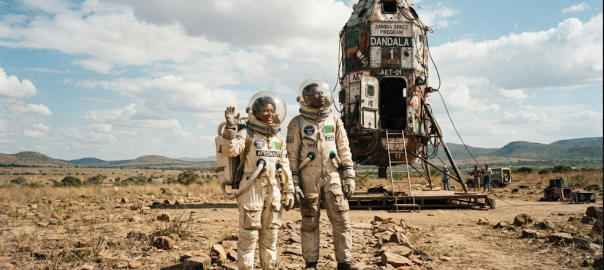
Beyond the Moon: Ryan Calais Cameron and Monique Touko on Ambition, Satire, and Zambia’s Space Dreams
Sun, Nov 01 2026 /Mpelembe Media/ — In 1964, as Zambia emerged from British colonial rule, former schoolteacher and anti-colonial activist Edward Mukuka Nkoloso announced an audacious bid to beat the United States and the Soviet Union to the moon. Establishing the Zambia National Academy of Science, Space Research and Philosophy on an abandoned farm outside Lusaka, Nkoloso trained a cohort of aspiring astronauts—later known as the “Afronauts”—using unconventional methods such as rolling down hills in oil drums and swinging from ropes to simulate weightlessness. His plans included sending a 17-year-old girl named Matha Mwamba to Mars alongside two cats and a missionary. Although the programme never launched due to a lack of funding and institutional support, leaving Nkoloso vulnerable to public mockery, the venture endured as a contested, compelling fusion of sincere anti-colonial optimism and pointed satire.
Now, playwright Ryan Calais Cameron and co-director Monique Touko have reimagined this history in The Afronauts, a major Black sci-fi stage epic closing the Royal Court’s 70th-anniversary season. Cameron was prompted to write the play after encountering racist mockery directed at the Zambian space programme in an online video, prompting him to challenge why Black ambition is trivialized where Western pioneers are celebrated. After travelling to Zambia to ensure authentic representation for a nation frequently sidelined in British theatre narratives, Cameron and Touko developed an expansive, technically ambitious production. Rather than dwelling on failure, the play celebrates the dignity of unapologetic dreaming, the refusal of limitation, and the power of placing Black stories among the stars
History is rarely just a record of who conquered what; it is a canvas reflecting who is permitted to dream, who commands the narrative of the future, and whose grand ambitions are taken seriously. In 1964, as the world watched Cold War superpowers pour billions into rockets and lunar modules, a newly independent African nation launched a space program of its own. Freshly liberated from British colonial rule, Zambia set its sights on the stars, determined to join—and beat—the United States and the Soviet Union in the race to the Moon and Mars.
Decades later, this extraordinary, frequently misunderstood moment in history is receiving a major cultural re-evaluation. Written by associate playwright Ryan Calais Cameron and co-directed by Cameron alongside Monique Touko, The Afronauts brings Zambia’s space race ambitions to London’s Royal Court Theatre, closing its historic 70th-anniversary season. The production transforms an overlooked historical footnote into a soaring exploration of audacity, sovereignty, and cosmic imagination.
Here are four key takeaways from the forgotten story of Zambia’s space program and its modern theatrical rebirth.
Takeaway 1: A Newly Liberated Nation Aimed for the Stars — Post-Colonial Ambition in 1964
In October 1964, as Zambia formally severed colonial ties with Great Britain, a former primary schoolteacher and dedicated anti-colonial independence activist named Edward Mukuka Nkoloso founded the Zambia National Academy of Science, Space Research and Philosophy. Operating from a position of unyielding national pride, Nkoloso publicly announced that his newly sovereign country would not stand idly by while Western and Soviet empires claimed ownership of the cosmos.
Nkoloso’s initiative was far more than an eccentric headline; it was a radical assertion of post-colonial nationhood. In an era when technological advancement was weaponized to signal geopolitical supremacy, Nkoloso asserted that a newly liberated Black nation possessed full sovereignty over its own destiny—and over future spaces. By demanding entry into outer space at the exact moment of national birth, the program declared that freedom was not merely the retrieval of stolen land, but the right to claim a place in the universe without asking for permission.
Takeaway 2: The Astronaut Training Was Wildly Unconventional — Resourceful Imagination vs. Capital Superpowers
Lacking the industrial capital and institutional funding of NASA or the Soviet space program, Nkoloso relied on sheer ingenuity. He established a makeshift astronaut training facility on an abandoned farm just outside Lusaka, recruiting a spirited group of young recruits who became known as the “Afronauts.”
Without access to centrifuges or zero-gravity aircraft, Nkoloso devised physical simulations using everyday materials. To prepare his recruits for the disorienting physical forces of spaceflight and weightlessness, he placed trainees inside oil drums and rolled them down steep hills, or swung them from heavy ropes suspended in the air. His plans were breathtakingly expansive: Nkoloso aimed to send a 17-year-old girl named Matha Mwamba to Mars, accompanied by two cats and a Christian missionary.
While the initiative ultimately grounded due to a complete lack of state and international funding, these simulation methods reveal a striking contrast between Western, capital-heavy technocracy and resource-constrained imaginative resourcefulness. Nkoloso demonstrated that a lack of industrial infrastructure could not constrain raw, improvised ambition.
Takeaway 3: Reframing Mockery into Anti-Colonial Resistance — Racial Double Standards in Historical Memory
Nkoloso’s program faced immediate international skepticism and persistent public mockery. Over the decades, historians and cultural commentators have debated whether his space program was a sincere scientific effort, an elaborate piece of satirical political theatre designed to critique Western hubris, or a beguiling blend of anti-colonial activism and performance art.
Playwright Ryan Calais Cameron first encountered the story during lockdown while watching a YouTube video detailing the “worst ideas of the 20th century.” Browsing the comment section, Cameron was struck not by harmless amusement, but by open racism—a chorus of voices framing a young nation’s celestial dream as evidence of African incompetence. Cameron immediately identified the racial double standard at play:
“Some people think I’m crazy. But I’ll be laughing the day I plant Zambia’s flag on the moon.”
“For me it was always a case of like, well, why is it funny to mock a Black man’s dream of trying to get to the moon, but not these white guys who are trying to build a plane?” Cameron asks. “I’m a dreamer. We’re all dreamers here.”
The story continued to pull at him. In 2022, when curator Ekow Eshun featured the story of the Afronauts in his groundbreaking exhibition In the Black Fantastic at London’s Southbank Centre, Cameron saw it as a decisive sign. He pitched the play to the Royal Court. Re-evaluating Nkoloso’s quote requires dismantling a persistent historical double standard: while early white aviation pioneers are celebrated as heroic visionaries for daring to build contraptions that often failed, Black dreamers operating against far greater structural odds are routinely caricatured.
Takeaway 4: Elevating Sidelined African Histories in Theatre — Expanding the Canvas of Black Storytelling
For co-director Monique Touko, The Afronauts represents a crucial corrective to how African narratives are programmed within British theatre institutions. Touko points out that when African histories are granted space on British stages, they are disproportionately drawn from West Africa, while Southern African nations like Zambia remain systematically neglected. “They’ve kind of been sidelined,” Touko notes. “They’re definitely not at the front like they should be.”
To ensure the production was grounded in authentic local perspective rather than an exoticizing outsider gaze, Cameron and Touko embarked on a field research trip to Zambia, meeting directly with local youth and artists. This commitment to authentic representation echoes their personal artistic journeys. Early in his career, Cameron felt alienated by traditional theatre, recalling the isolation of watching Shakespeare while feeling hyper-aware of “the way that security looked at me in the theatre.” His perspective shifted permanently after discovering raw, contemporary Black British works like Roy Williams’s Fallout and Arinzé Kene’s Little Baby Jesus .
Similarly, Touko abandoned initial plans to pursue a career as a barrister after noticing a complete absence of Black women directing high-profile theatre. She built a career directing work that is unapologetically “Blackity, Black, Black, Black,” while Cameron focused on placing Black characters into expansive, unexpected settings—in this instance, sending them all the way to the stars.
The physical scale of The Afronauts matches its intellectual daring. Discussing the complex mechanics of the set over lunch, Touko hints at the production’s technical ambition: “‘Expensive’ is all you can say… It’s definitely out of this world.”
By putting Black bodies in outer space, the play expands both the geographic and conceptual canvas of contemporary theatre. As Cameron explains, the objective extends far beyond historic preservation: “If someone comes to the theatre for the first time, I want them to be able to think, ‘This is big, now I can think of something even bigger.’”
Conclusion
The enduring story of the Afronauts reminds us that the freedom to dream and defy gravity begins with a deliberate refusal to accept the boundaries imposed by others. Edward Mukuka Nkoloso and his cohort of ambitious recruits may never have left Lusaka’s soil, but their refusal to curb their vision remains a profound testament to unbridled human spirit.
As artists continue to excavate forgotten histories and bring them into the spotlight of modern stages, their work challenges us to reconsider how we measure historical ambition. What other dismissed, ridiculed, or forgotten dreams hidden in our past are simply waiting for us to look up and see their brilliance?