

Eliminating Context Drift: How Hierarchical Micro-Agents Achieve a 97% Workflow Completion Rate.
Sun, Nov 01 2026 /Mpelembe Media/ — Autonoma is a structured, hierarchical multi-agent framework designed to bridge the gap between conversational AI models that merely propose actions and autonomous systems that deterministically execute complex, multi-step workflows from natural language prompts. While traditional monolithic agent architectures attempt to handle planning, context tracking, and tool execution inside a single expanding prompt window, they frequently break down due to severe context drift, tool-selection ambiguities, and unrecoverable error propagation across long reasoning loops. Autonoma overcomes these structural vulnerabilities by enforcing a strict separation of concerns between high-level orchestration logic and specialized task execution, isolating state representations into bounded micro-contexts.
The system organizes orchestration into a clear multi-tiered hierarchy managed by a front-line Coordinator, a strategic Planner, and an active Supervisor. When a user submits requests via text, voice, images, or documents in English or Arabic, the Coordinator validates user intent and filters out casual banter or unsafe requests to prevent unnecessary computational overhead. Validated objectives pass to the Planner, powered by GPT-4o and DeepSeek R1, which restates the intent as an inner thought trace and decomposes it into an acyclic dependency graph of structured subtasks. The Supervisor then assumes runtime control using LangGraph, evaluating prerequisite conditions, auditing state transitions, and dynamically dispatching assignments to plug-and-play worker micro-agents. If an individual worker encounters an execution error, the Supervisor intercepts the failure and initiates localized recovery loops, preventing isolated step errors from corrupting the entire workflow.
Execution is carried out by specialized micro-agents operating in dedicated, sandboxed environments. These include the Researcher for crawling and web data retrieval, the Coder for sandboxed Python and Bash scripting with data science libraries, the Browser for dynamic web automation, the File Manager with guardrails against destructive operations, the Computer agent for desktop graphical UI automation using optical character recognition, and the Reporter for synthesizing multi-source findings into final structured summaries. To address enterprise data privacy and security concerns, Autonoma confines its primary network communication and agent operations within a secure Local Area Network (LAN) using IP filtering, containerization, and granular audit trails. Across 500 benchmark test cases, Autonoma achieved a 97% task completion rate, a 98% inter-agent handoff success rate, and a frontend response latency of 1 to 2 seconds. Furthermore, broader multi-agent benchmarking demonstrates that task allocation efficiency and communication overhead vary significantly with problem scale, underscoring the critical necessity of Autonoma’s resource-aware, adaptive coordination over rigid, static allocation models.
Comparative Architecture: Autonoma vs. Frontier Autonomous Agent Systems
Autonomous agent frameworks are transitioning from reactive conversational models toward goal-directed systems capable of executing complex, multi-step digital workflows. A central design challenge is balancing reasoning depth, execution reliability, context retention, and security.
While contemporary frontier systems like OpenAI Operator, Anthropic Computer Use, and Google Mariner primarily utilize single-model, closed-loop execution loops focused on visual GUI or browser navigation, Autonoma employs a multi-tiered, hierarchical multi-agent architecture orchestrated via LangGraph.
1. Structural Comparison: Feature Matrix
Based on comparative evaluations across modern agentic automation systems, each framework exhibits distinct design philosophies, operational environments, and capability boundaries:
| Architectural Dimension | Autonoma | Anthropic Computer Use | OpenAI Operator | Google Mariner | Monica’s Manus AI |
|---|---|---|---|---|---|
| Architectural Model | Hierarchical Multi-Agent (Coordinator, Planner, Supervisor, 6 Workers) | Single Closed-Loop Agent with tool calling | Single Browser Agent with vision-guided GUI actions | Multimodal Browser Agent (Chrome Extension) | End-to-End Autonomous Agent |
| Underlying Models | Heterogeneous: GPT-4o & DeepSeek R1 | Claude 3.5 Sonnet | GPT-4o | Gemini | Proprietary / Integrated LLMs |
| Primary Interface & Environment | Web (Next.js) & Mobile via QR, running in LAN-confined Linux sandboxes | API-based programmatic action loop (deployed via Docker) | Dedicated Browser GUI | Web Browser / Chrome Extension | Browser-based, operates in Linux sandboxes |
| Execution Scope | Full OS & Web: Browser, CLI/Bash, Python, Desktop GUI, File System | Desktop GUI & Shell: Mouse/keyboard commands, text editor, bash | Web GUI: Form filling, navigation, e-commerce | Web Navigation: Tabs, clicking, typing, scrolling | Cross-domain workflows: Code, APIs, and web tools |
| Context & State Management | Bounded Micro-Contexts: Supervisor audits state; workers have isolated contexts | Customizable via code; susceptible to expanding history overhead | Basic session memory; constrained by browser session | Research phase / single-tab state tracking | Persistent session memory |
| Error Containment | Isolated Subtask Recovery: Failures intercepted by Supervisor without killing graph | Continuous perception-action evaluation; prone to tool-selection drift | Self-correction and explicit human handoff protocols | Vulnerable to web obstacles, modals, and login barriers | Autonomous retry and adaptive behavior |
| Security & Privacy | LAN-only confinement, IP filtering, local sandboxing, no cloud leaks | Containerization required due to unconstrained OS access | Cloud-hosted browser; human-in-the-loop for payments/logins | Cloud browser extension; subject to web privacy policies | Cloud sandbox environment |
| Availability & Customization | Open Source (GitHub), fully extensible plugin architecture | Beta API access | Subscription / Research Preview | Research Phase (Internal/Limited) | Beta (Invite-only) |
2. Core Architectural Distinctions
A. Monolithic Loops vs. Orchestrated Separation of Concerns
Single-agent systems such as Anthropic Computer Use and OpenAI Operator rely on a monolithic action loop. The model captures an environmental observation (such as a screenshot or DOM tree), appends the observation into its active context window, reasons about the immediate step, and emits a tool call.
As task horizon length grows, these monolithic loops suffer from three systemic issues:
- Context Drift: Accumulated tool outputs and visual screenshots expand the prompt window, diluting attention and causing tool-selection misfires.
- Error Cascade: If a single tool call fails or produces an invalid state, that faulty state is written directly into the main prompt memory, frequently derailing the entire sequence.
- Model Homogeneity: A single model must simultaneously perform high-level strategy, spatial vision recognition, code syntax generation, and conversational interaction.
Autonoma breaks this monolithic paradigm by decoupling orchestration from execution:
- The Coordinator acts as a lightweight gatekeeper, validating intent, enforcing safety boundaries, and filtering out small talk before compute-heavy nodes are engaged.
- The Planner leverages reasoning backbones (GPT-4o and DeepSeek R1) to construct an acyclic dependency graph of subtasks rather than executing actions directly.
- The Supervisor acts as an active runtime engine via LangGraph, dispatching bounded subtasks to specialized micro-agents one step at a time.
- Worker Micro-Agents (Researcher, Coder, Browser, File Manager, Computer, Reporter) execute only within their dedicated domains, ensuring prompt context windows remain compact, task-focused, and free of cross-domain clutter.
B. Execution Modality: Direct Visual GUI vs. Hybrid Targeted Tooling
Frontier systems approach automation with different operational targets:
- Anthropic Computer Use standardizes on human-like desktop interactions. It takes desktop screenshots, runs visual coordinate calculations, and simulates mouse clicks and keystrokes. While flexible across arbitrary native desktop software, it incurs notable latency, high token consumption, and sensitivity to resolution or UI changes.
- OpenAI Operator & Google Mariner concentrate on browser automation. They interact with web applications by visually parsing the browser canvas or DOM to navigate consumer workflows (e.g., reservations, retail checkouts).
- Autonoma adopts a hybrid execution strategy:
- For programmatic data and file manipulation, it uses the Coder (Python/PowerShell in isolated sandboxes) and the File Manager, avoiding the overhead of visual UI manipulation.
- For web workflows, the Browser agent navigates DOM elements directly via Chrome automation or HyperBrowser.
- When interacting with legacy native desktop software lacking APIs, Autonoma dispatches its Computer agent, which combines desktop GUI automation with YOLOv8 and optical character recognition (OCR).
C. Enterprise Security and Network Topology
A major barrier to enterprise deployment of systems like Operator or Mariner is data residency: transmitting sensitive host files, internal database credentials, or proprietary documents to external cloud endpoints introduces severe privacy risks.
- Cloud-Tethered Systems: Operator and Mariner operate predominantly within provider-managed cloud browser infrastructure, while Anthropic Computer Use requires developer-orchestrated Docker sandboxing to prevent destructive actions on host machines.
- Autonoma’s Local Defense-in-Depth: Autonoma is engineered to operate within a secure Local Area Network (LAN). Host communication between the Next.js frontend and FastAPI backend is confined locally using IP filtering and QR-code pairing. Outbound internet calls occur only when specific web tools (such as Tavily search or HyperBrowser) are invoked. Furthermore, file system actions incorporate explicit confirmation guardrails before executing irreversible destructive commands. In penetration testing across 500 test cases, this architecture maintained zero unauthorized external breaches.
3. Resilience and Scalability Dynamics
Empirical findings on multi-agent systems indicate that adding agents without structured coordination leads to severe communication overhead and resource competition. In benchmark evaluations of task allocation algorithms (such as Hungarian, Auction, and CBBA), communication message volume and computational time surge non-linearly as problem scale expands.
Autonoma counters communication bloat through hierarchical dispatching. Worker agents do not negotiate peer-to-peer across a broadcast channel; all state transitions and data payloads pass through schema-enforced handoffs governed by the Supervisor. This design enabled Autonoma to achieve a 98% inter-agent handoff success rate and an overall 97% workflow completion rate. When an individual micro-agent encounters an exception, the Supervisor catches the fault and triggers localized self-healing or re-planning, preventing the entire workflow from collapsing.
Would you like to explore a detailed benchmark comparison of the task allocation algorithms (Hungarian, Auction, CBBA, and Auction 2-opt) across problem scales, or analyze the economic impact of agentic workflows on traditional digital service providers?
Building the AI Workforce: 4 Counter-Intuitive Insights on Multi-Agent Architecture and Scale
Artificial intelligence is undergoing a foundational paradigm shift. The software industry is rapidly moving away from traditional, single-agent Large Language Model (LLM) patterns—which operate reactively within isolated prompt-response loops—toward proactive Agentic AI frameworks. These modern architectures exhibit true goal-oriented autonomy: they parse abstract objectives, decompose multi-stage goals into acyclic execution graphs, delegate tasks to domain-specialized nodes, operate external tools, and continuously adapt execution strategies over long-running operational horizons without manual human intervention.
However, scaling these autonomous workforces exposes a critical systems engineering paradox. Software leaders and AI architects frequently observe that simply expanding agent counts or packing complex multi-step workflows into single, monolithic prompts severely degrades performance. As operational scope widens, single-agent setups collapse under the cumulative weight of context drift, compounding step errors, and exponential latency penalties.
Building high-throughput, enterprise-ready AI workforces requires shifting focus from prompt engineering to complex multi-agent systems engineering. By synthesizing empirical benchmarks from recent architectural research—specifically the multi-tiered design of the Autonoma framework alongside static task-allocation scaling evaluations—this article distills four counter-intuitive insights for designing resilient, resource-aware agentic ecosystems.
1. Monolithic AI Suffers from Context Drift: Why Micro-Specialization Wins
Single-agent LLM implementations struggle when forced to manage extended, multi-stage computational workflows. When a single model instance is burdened with concurrent strategic planning, environment monitoring, code synthesis, shell execution, and state tracking, its operational boundary breaks down.
Mathematically, if an automation workflow requires $N$ sequential execution steps, where each step $i$ carries an independent step failure probability $\epsilon_i$ , the overall systemic success probability $P_{\text{success}}$ across an unmonitored monolithic execution loop scales according to:
$$P_{\text{success}} = \prod_{i=1}^{N} (1 – \epsilon_i)$$
In an unstructured monolithic agent context, the step error rate $\epsilon_i$ does not remain static; it grows non-linearly as the step index $i$ advances. This deterioration is driven by context drift . As intermediate thought chains, tool schemas, system messages, and raw execution payloads accumulate within the prompt window, the model’s self-attention mechanisms become diluted by irrelevant historical tokens. Consequently, the agent selects incorrect tools, hallucinates syntax, or misinterprets environmental outputs. Crucially, when a step error occurs early in execution ( $i = 1, 2$ ), an unmonitored monolithic agent carries that corrupted state forward, triggering unrecoverable error propagation across the remaining sequence.
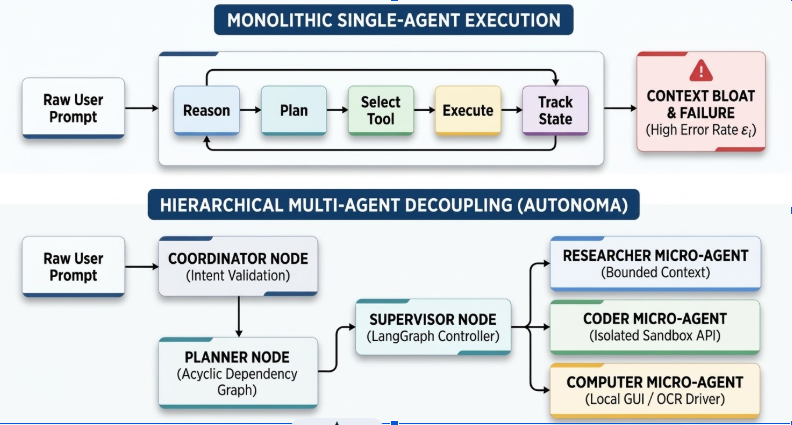
The structural solution is micro-specialization engineered through multi-tiered agent hierarchies that strictly decouple strategic orchestration from micro-task execution. A primary implementation of this design is Autonoma (Reda, Yasser, & El-Metwally, 2026), a hierarchical orchestration framework designed for end-to-end local workflow automation. Autonoma separates operational responsibilities into two distinct architectural tiers:
- Orchestration Tier:
-
- Coordinator (GPT-4o): Acts as the frontline gatekeeper, parsing incoming multi-modal requests, performing intent validation, safety filtering, and bilingual query routing (English/Arabic).
- Planner (GPT-4o / DeepSeek R1): Functions as the strategic engine, decomposing validated goals into structured subtask graphs with explicit data schemas and prerequisite execution conditions.
- Supervisor (GPT-4o via LangGraph): Serves as the central runtime controller and state auditor. It evaluates task readiness, dispatches execution jobs to specialized worker nodes, and manages inter-agent payload transfers.
- Specialized Worker Micro-Agent Tier:
- Autonomous, domain-targeted micro-nodes ( Researcher , Coder , Browser , File Manager , Computer , Reporter ) that execute isolated subtasks using specialized tool stacks.
By confining worker micro-agents to bounded execution windows containing only task-relevant tokens, the step error probability $\epsilon_i$ remains baseline low throughout long-running workflows. Furthermore, if a worker node encounters an unexpected runtime exception (e.g., an altered web DOM or a missing Python package), the active Supervisor node intercepts the failure, resets local context states, and initiates targeted error-recovery loops rather than allowing global workflow failure.
In empirical benchmark evaluations conducted across 500 multi-step computational workflows, Autonoma demonstrated the real-world power of this structural separation, achieving a 97% overall task completion rate and a 98% successful inter-agent handoff rate with initial frontend response latencies of just 1–2 seconds .
“Isolating state representations to bounded micro-contexts keeps step-level error rates stable across extended workflows, effectively decoupling individual step exceptions from overall systemic failure.”
Architectural Takeaway for Engineering Leads
Stop attempting to solve multi-stage operational challenges with hyper-engineered single prompts. Decouple your system architecture into a centralized supervisory graph controller and lightweight, context-bounded worker nodes that execute single-purpose tool schemas.
2. The Scaling Flip: Why Your Favorite Task-Allocation Algorithm Will Fail at Scale
A widespread design mistake in multi-agent engineering is adopting a fixed task-allocation strategy and assuming its performance will remain uniform as the operational workload scales. Comparative allocation benchmarks reveal that algorithm efficiency dynamically flips as problem scale changes.
To understand these scaling dynamics, systems architects must analyze empirical evaluations of established multi-agent allocation methods—including the Hungarian algorithm, distributed Auction protocols, Consensus-Based Bundle Algorithms (CBBA), and Auction 2-opt. Benchmark data compiled by Song et al. (2025) and analyzed by Kalal & Kola (2026) evaluates task allocation performance under static workload conditions across changing scales:
Workload Scale,Best Performing Method (Lowest Total Cost),Key Operational Metrics & Comparative Performance
Small-Scale,Hungarian Method (Cost: $92.2 \pm 26.0$ ),”• 0 communication messages required. • Lowest compute time ( $212.5 \times 10^{-6}\text{ s}$ ). • Outperforms Auction ( $103.5$ ), CBBA ( $103.6$ ), and Auction 2-opt ( $98.1$ ).”
Medium-Scale,Auction Method (Cost: $115.9 \pm 13.5$ ),”• Moderate communication overhead ( $17.4 \pm 3.14$ messages). • Compute time: $3,199 \times 10^{-6}\text{ s}$ . • Outperforms Hungarian ( $121.7$ ), CBBA ( $120.7$ ), and Auction 2-opt ( $122.8$ ).”
Large-Scale,Cost Differences Narrow (Auction: $150.4$ vs. CBBA: $152.7$ ),”• Total allocation costs converge across all methods (Hungarian: $150.8$ , Auction 2-opt: $152.1$ ). • Resource consumption spikes (Hungarian compute: $28,574 \times 10^{-6}\text{ s}$ ; Auction 2-opt compute: $42,380 \times 10^{-6}\text{ s}$ ).”
At small problem scales, centralized mathematical solvers like the Hungarian method achieve optimal task allocation with zero inter-agent network messages and minimal compute effort. However, as the system transitions to medium workload scales, distributed negotiation mechanisms flip the performance balance: the Auction method achieves a lower total execution cost ( $115.9$ ) than the centralized Hungarian algorithm ( $121.7$ ) by leveraging localized bidding among available nodes.
By the time the environment reaches large-scale conditions, total allocation cost variations between algorithms narrow into a tight band ( $150.4$ to $152.7$ ). However, computational time and inter-agent message volumes surge dramatically across all paradigms.
Crucially, systems engineers must recognize an important qualification highlighted by Kalal & Kola: these empirical figures measure static task allocation baselines . In real-world enterprise agentic environments, task arrivals are dynamic, workloads fluctuate continuously, and node availability is fluid. A static task-allocation protocol will inevitably degrade. Advanced multi-agent architectures require dynamic, scale-aware coordination engines that switch allocation strategies based on real-time agent population metrics, network constraints, and workload volume.
Architectural Takeaway for Engineering Leads
Avoid hardcoding fixed task-distribution logic into your agent framework. Implement scale-aware routing engines that utilize centralized assignment solvers for lightweight local workloads, while dynamic auction or consensus protocols trigger as subtask queues and agent pool counts expand.
3. The Hidden Cost of Collaboration: The Multi-Agent Communication Crisis
Scaling an agent network does not yield a linear performance gain. As agent populations expand, inter-agent communication messages and state-synchronization compute times experience exponential growth, introducing a severe collaboration overhead trap.
Synthesizing the empirical data from Song et al. (2025) and Kalal & Kola (2026) brings this non-linear overhead into sharp focus when contrasting centralized assignment methods against iterative distributed protocols:
- Auction 2-opt Network & Compute Explosion:
-
- Small Scale: Generates $10.0$ network messages and requires $628.5 \times 10^{-6}\text{ s}$ of compute execution time.
- Medium Scale: Increases to $105$ network messages and $4,972 \times 10^{-6}\text{ s}$ of compute time.
- Large Scale: Explodes to $780$ communication messages and $42,380 \times 10^{-6}\text{ s}$ of computational overhead.
- Hungarian Centralized Overhead Profile:
- Consistently requires $0$ inter-agent communication messages across all scale tiers due to centralized computation.
- However, central matrix computation time scales non-linearly, rising from $212.5 \times 10^{-6}\text{ s}$ at small scale to $28,574 \times 10^{-6}\text{ s}$ at large scale.
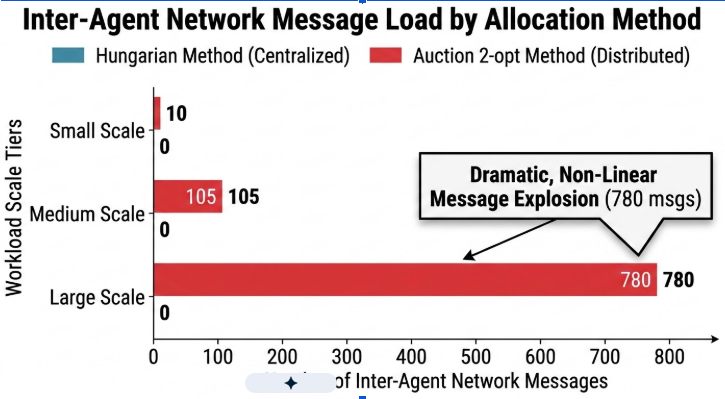
Synthesizing Orchestration Architecture with Overhead Benchmarks
This data explains why structural patterns like Autonoma’s hierarchical Supervisor model succeed in production settings. Fully distributed peer-to-peer negotiation protocols (exemplified by Auction 2-opt) suffer from an $O(N^2)$ message complexity explosion, creating network saturation as agents broadcast bids and negotiation updates back and forth.
Autonoma avoids this $780$ -message bottleneck by coupling a centralized/hierarchical supervisory routing structure with local, micro-context execution:
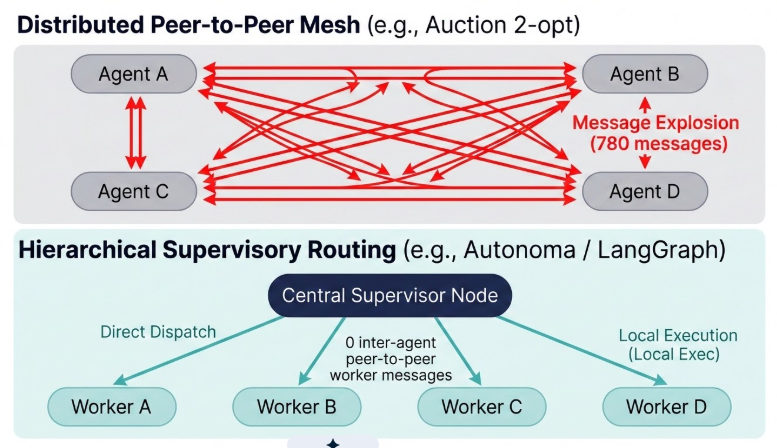
By concentrating state management within a LangGraph-backed Supervisor node, worker micro-agents execute their tasks independently without generating uncoordinated inter-worker network noise. The Supervisor maintains the state graph centrally (achieving $0$ inter-worker message noise, mirroring the zero-message advantage of centralized mathematical models) while delegating bounded execution locally.
Controlling collaboration overhead is especially vital for resource-constrained edge computing environments, Internet of Things (IoT) clusters, and next-generation 6G wireless infrastructure. Specialized architectures such as AgentRAN (Elkael et al., 2026)—which deploys agentic AI across Open Radio Access Networks—and edge intelligence frameworks for Edge General Intelligence (Zhang et al., 2026) depend on minimizing packet overhead and computational footprint to sustain real-time control loops across distributed physical nodes.
Architectural Takeaway for Engineering Leads
Inter-agent message passing is not free. When designing agent networks for edge, mobile, or enterprise infrastructure, enforce centralized or hierarchical state-routing hubs to avoid the exponential message-explosion traps inherent in unconstrained peer-to-peer agent negotiation.
4. Enterprise Reality Check: Why the Best Agents Work Locally, Not in the Cloud
Deploying autonomous agent ecosystems in production enterprise environments requires balancing execution power with data security. Monolithic cloud-hosted AI agents present severe data privacy and compliance risks when granted broad access to internal files, proprietary code bases, local network shares, or host utility credentials over external endpoints.
To resolve these enterprise security barriers, cutting-edge frameworks enforce strict operational containment boundaries. Autonoma addresses this challenge by anchoring its primary backend orchestrator and state-management infrastructure within a Local Area Network (LAN) security boundary. Internal workflow payloads, host environment states, and local directory operations remain strictly confined to local infrastructure, contacting external cloud endpoints only when an outbound web action (such as targeted web search) is explicitly required.
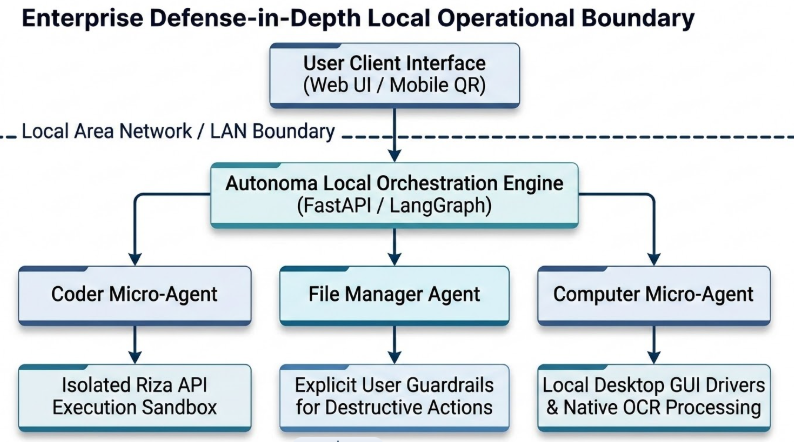
Production-grade agent architectures rely on a multi-layered defense-in-depth model:
- Sandboxed Code Execution Runtimes: The Autonoma Coder agent generates and runs dynamic Python and PowerShell scripts. To prevent unauthorized local system calls or cross-agent process corruption, script execution is routed through isolated sandboxed execution runtimes, such as the Riza API.
- Explicit Confirmation Checkpoints: Autonomous file manipulation by the File Manager agent is governed by mandatory authorization checkpoints. Destructive operations—such as permanent file deletions or bulk directory overwrites—require explicit human confirmation before execution.
- Local GUI & Application Automation: The Computer agent controls legacy desktop utilities and enterprise software lacking API access by combining local mouse/keyboard GUI drivers with Optical Character Recognition (OCR) engines. Screen buffers and visual coordinates are processed locally without exposing raw desktop frames to external cloud vision services.
- Multi-Modal Accessibility & Inclusivity: Enterprise usability is extended by supporting multi-modal input streams (text, voice, images, document attachments) alongside native bilingual processing in English and Arabic.
By combining LAN network isolation, sandboxed execution runtimes, explicit human-in-the-loop guardrails, and local desktop drivers, autonomous multi-agent systems operate within strict regulatory and corporate compliance frameworks.
Architectural Takeaway for Engineering Leads
Enterprise autonomous systems must prioritize local boundary security. Isolate code synthesis inside containerized sandboxes, require explicit human confirmation for destructive host actions, and maintain core orchestration within local network perimeters to prevent data leaks.
Conclusion: Building the Modular, Resource-Aware AI Ecosystem
The future of enterprise automation will not be defined by monolithic LLMs attempting to solve long-horizon problems inside giant, singular context prompts. Instead, scalable automation relies on modular, multi-agent ecosystems designed with micro-specialized roles, scale-aware coordination algorithms, strict communication optimization, and local enterprise security boundaries.
Frameworks like Autonoma , supported by multi-agent task allocation research (Song et al., 2025; Kalal & Kola, 2026), demonstrate that decoupling strategic orchestration from bounded execution micro-agents delivers high operational reliability while containing systemic errors. As computational workloads and inter-agent message volumes scale non-linearly with node counts, system architects must prioritize resource-aware coordination alongside foundational LLM reasoning performance.
Strategic Question for Tech Leaders
As your organization transitions from prompt engineering to multi-agent systems engineering, how will you redesign your software infrastructure to orchestrate micro-specialized agents, mitigate network message bloat, and maintain local execution security boundaries at scale?