
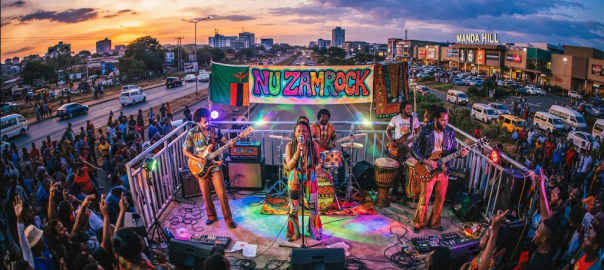
Sampa the Great Reclaims Her Bloodline and Reinvents Zambian Rock on ‘Nu Zamrock’
Sun, Nov 01 2026 /Mpelembe Media/ — Sampa the Great (Sampa Tembo) released her third studio album, Nu Zamrock, on October 30, 2026, through Loma Vista Recordings. Spanning 16 tracks across 37 minutes, the record represents an autobiographical reclamation, an intergenerational dialogue, and a modern sonic expansion of Zambia’s foundational 1970s rock movement. Co-executive produced by Sampa alongside Grammy-winning producer Cadenza, the album was crafted across intensive writing sessions in Botswana, production work in Lusaka with Zambian producers Magnus Mando (Mag44) and Solomon Moyo, and finishing sessions in Los Angeles. Rather than treating the project as retro-nostalgia, Sampa describes the record as “the future remembering where it came from,” blending overdriven psychedelic rock guitars and kalindula polyrhythms with hard-hitting hip-hop, poetry, and soul.
The core inspiration behind the album began when Sampa heard the 1974 song “Living In The Past” by legendary Zambian band WITCH while watching the HBO series Watchmen. Researching the band led to the revelation that her blood uncle, George “Groovy Joe” Kunda, was a co-founder and rhythm guitarist of WITCH. Reconnecting with Kunda transformed her artistic direction from an adopted stylistic interest into an inherited bloodline mandate. Uncle George features prominently across the album as its primary narrator, opening the record with a recorded dialogue on “Intro” about the beginnings of Zamrock and symbolically handing over the cultural and musical baton to Sampa and her sister, alt-R&B vocalist Mwanjé.
Musically and lyrically, the project moves through themes of defiance, systemic critique, and personal healing. Prominent singles include “Can’t Hold Us” (featuring Mwanjé), which secured placement on EA Sports’ FC 26 soundtrack, the rapid-fire industry critique “Simon Says,” and “Location,” which confronts Western music industry extractivism. The tracklist also showcases expansive crossover collaborations, notably “Supernova,” featuring Australian pop star Sia, alongside gentle, vulnerable concluding tracks such as “Star” (featuring KAMAUU) and “I Can Love”. Ultimately, the album celebrates Sampa’s permanent professional return to Southern Africa, establishing a self-sustaining local creative ecosystem and asserting African authorship over rock history.Album Narrative & Structural Arc
Spanning 37 minutes across 16 tracks, the record is sequenced into distinct narrative movements:
- Lineage and Reconnection (Tracks 1–3): Establishes ancestral roots and musical compulsion.
- Defiance and Industry Critique (Tracks 4–8): Channels high-gain fuzz and driving rhythms to dismantle commercial pressures and Western gatekeeping.
- Crossover and Cultural Expansion (Tracks 9–11): Bridges regional roots with widescreen global pop and psych-rock.
- Vulnerability, Healing, and Resolution (Tracks 12–16): Shifts from aggressive percussion to melodic atmospheric spaces, celebrating self-acceptance and quiet strength.
Track-by-Track Breakdown
Act I: Lineage & Foundation
- 1. “Intro” (feat. George Kunda) [1:30]
Opens with a slow-building instrumental swell underneath an intimate, recorded conversation between Sampa and her uncle, George “Groovy Joe” Kunda. Kunda details how WITCH transitioned from covering Anglo-American rock bands to inventing the original Zamrock sound, symbolically transferring the cultural baton to Sampa. - 2. “Prayer In A Dance” [1:45]
Flows seamlessly from the intro, introducing syncopated percussion, kalindula polyrhythms, and cyclical vocal motifs that frame dance and movement as spiritual resistance. - 3. “Can’t Quit Music” [1:08]
A concise, driven continuation that reuses melodic phrases and lyrics from “Prayer In A Dance” over overdriven bass riffs, declaring an enduring devotion to the creative craft.
Act II: Defiance, Autonomy & Industry Critique
- 4. “Simon Says” [2:01]
A rock-rap track built around a stomping bassline, rapid-fire lyrical delivery, and an alarm-siren synthesizer that builds in intensity before cutting off abruptly. The song critiques commercial music executives and algorithm-driven metrics, using “Simon” as a metaphor for the industry system dictating how artists should conform. - 5. “Catch If You Can” [2:52]
Contrasts fragmented, staccato bass riffs in the verses against a sweeping, gospel-choir-styled chorus, exploring creative resurgence and the tension between freedom and burnout. - 6. “Can’t Hold Us” (feat. Mwanjé) [2:46]
Driven by fuzzy garage rock guitars, driving drums, and a chanted vocal hook, Sampa and her sister Mwanjé deliver an anthem of resilience and collective strength. The track earned global sync placements, including EA Sports’ FC 26. - 7. “Location” [2:34]
Features prominent bass guitar, loud drumming, and sharp staccato cadences. Lyrically, Sampa confronts Western music industry extractivism, calling out global entities that embrace African sounds while bypassing the African creators behind them. - 8. “Canary” [2:51]
A heavy-hitting rock cut with high-gain guitar fuzz and aggressive drumming. Acting as a warning against industry traps, Sampa crowns herself with the lyric, “I am the new king of Zamrock,” asserting female leadership in a historically male-dominated rock canon.
Act III: Expansion & Global Resonance
- 9. “Maybe Then” [0:57]
A low-fidelity, atmospheric interlude integrating snippets of casual dialogue, offering a reflective pause on patience and creative timing. - 10. “Supernova” (feat. Sia) [2:48]
A crossover centerpiece pairing delicate synth toplines with thunderous marching-band drums. Sia contributes belted leads and layered harmonies that trade off with Sampa’s verses, creating a cosmic pop-rock synthesis exploring destiny and self-actualization. - 11. “So Mone” [1:59]
Returns to front-and-center rap deliveries anchored by driving staccato synths and heavy sub-bass riffs, centering themes of cultural pride and unapologetic boundaries.
Act IV: Reflection, Restitution & Emotional Peace
- 12. “Star” (feat. KAMAUU) [3:26]
Strikes an understated, melodic groove with gentle instrumentation and vocal trade-offs between Sampa and US vocalist KAMAUU, offering soft affirmations to young African creators. - 13. “The Journey Is Underrated” [1:06]
A spoken-word vignette over minimalist instrumentation that emphasizes honoring the daily process and struggles of artistic growth rather than just the final milestone. - 14. “Gone” (feat. Nicole Gumbe) [3:35]
Substitutes driving drums for layered, airy vocal harmonies and ambient pads, exploring emotional release and peace with lost time. - 15. “Nicole’s Interlude” [3:06]
An atmospheric spoken-word and instrumental transition piece that provides space for interpersonal reflection. - 16. “I Can Love” [2:44]
The album’s gentle conclusion, setting aside rapid flows in favor of soft pads, melodic resolution, and vulnerable vocal performances. The song closes the record on emotional healing and self-acceptance, declaring that personal brokenness does not diminish one’s capacity for love.
Key Featured Collaborations
- George “Groovy Joe” Kunda (“Intro”): Co-founder and rhythm guitarist of WITCH. His spoken-word framing and presence across the project’s prelude material anchor the album’s genealogical authenticity and intergenerational transfer.
- Mwanjé (“Can’t Hold Us”): Sampa’s younger sister and frequent collaborator, providing rich alt-R&B vocal counterpoints and reinforcing the familial bloodline theme.
- Sia (“Supernova”): Sampa and producer Cadenza shared an early demo with Sia’s team during a studio session in Los Angeles. Rather than providing minor background ad-libs, Sia recorded full lead choruses and belting harmonies, bridging Nu Zamrock with global pop.
- KAMAUU (“Star”): Contributes gentle, soulful crooning that anchors the record’s most tender, affirming moment for aspiring artists.
- Nicole Gumbe (“Gone” & “Nicole’s Interlude”): Brings lush vocal harmonies to the contemplative penultimate section of the album.
Sampa the Great’s live rollout for Nu Zamrock bridges grassroots African rehearsals with high-profile global stages, translating the record’s heavy psych-rock guitars, kalindula rhythms, and familial narrative into an electrifying live band experience.
1. The Live Unit: Assembling the Zamrock Band
- The Creative Genesis: Rather than touring with pre-recorded tracks or simple DJ setups, Sampa assembled her Zamrock Band during an intensive week-long residency at a farmhouse in Botswana. In these jam sessions, the musicians actively juxtaposed vintage 1970s Zamrock vinyl pressings with classic hip-hop to build a shared rhythmic and harmonic vocabulary.
- No Translation Needed: Anchoring the live rhythm section in Southern Africa allowed Sampa to bypass the creative exhaustion of having to “translate” African drum patterns, kalindula polyrhythms, and regional references to non-African backing musicians.
2. Festival Previews: Australia’s Move My Way (October 2026)
In early October 2026, Sampa returned to Australia with her Zamrock Band to preview the material at the community-oriented Move My Way Festival in Eora (Sydney) on October 3 and Naarm (Melbourne) on October 4.
- Shared Stage with Ezra Collective: Billed alongside UK jazz heavyweights Ezra Collective (with whom Sampa previously collaborated on their Mercury Prize-winning album Where I’m Meant To Be), the performances served as the world premiere for Nu Zamrock’s live arrangements.
- Testing the Singles: The set showcased live renditions of:
- “Can’t Hold Us”: Delivered as an anthemic, high-energy Afro-rock centerpiece featuring heavy drums and fuzzy garage guitars alongside Mwanjé.
- “Location”: Driven by raw basslines and staccato cadence.
- “Simon Says”: The live debut provoked immediate, enthusiastic crowd interaction. Sampa noted her surprise at how quickly festival audiences picked up and shouted back the sharp, anti-industry lyrics despite the single having just dropped.
3. Intimate World Launch: Blue Note London (November 4, 2026)
Following the album’s release on October 30, Sampa scheduled an intimate international album launch in the UK:
- A Special Double Header: Sampa booked a sold-out, same-night double show (an early and late performance) on November 4, 2026, at London’s newly opened Blue Note venue.
- Roots Up Close: Choosing a relatively compact, legendary jazz and live music room over a standard arena or cavernous theater was an intentional artistic choice. It allowed the band to showcase the raw, analog garage-rock textures and live intergenerational storytelling up close, echoing the sweaty, communal club environments where WITCH originally pioneered Zamrock across Zambia in the 1970s.
- Radio Broadcasts: Preceding the London dates, Sampa took the band into the studio for a live session on BBC Radio 6 Music, performing live cuts from the album to introduce the sound across UK airwaves.
4. Global Tour Outlook (2027)
While festival slots and intimate showcases offered an early taste, Sampa affirmed that she plans to take the complete 16-track album on an expansive global tour across Africa, Australia, and Europe in 2027, fulfilling her vision of establishing Nu Zamrock as a modern, globally recognized live rock movement.
The socio-political journey of original 1970s Zamrock and its modern reclamation on Nu Zamrock represents a profound cycle of post-colonial innovation, structural collapse, and restorative justice.
1. The Post-Independence Genesis: Kenneth Kaunda’s 95% Quota
- The Institutional Catalyst: Following Zambia’s independence from British colonial rule, the original Zamrock movement arose under the administration of President Kenneth Kaunda. Seeking to foster a unified national identity and decolonize public airwaves, Kaunda instituted a strict cultural broadcasting directive requiring national radio stations to air at least 95 percent local music.
- Birth of a Hybrid Genre: Prior to this mandate, local groups primarily performed cover songs of British and American acts like The Rolling Stones. Forced to generate original domestic repertoire, young musicians in urban centers and the mining hub of Kitwe in the Copperbelt region forged a brand-new sound.
- The Pioneers: Groups such as WITCH (We Intend To Cause Havoc), Amanaz, Musi-O-Tunya, and Paul Ngozi fused high-gain Western psychedelic rock and garage funk with traditional Zambian rhythms—most notably kalindula polyrhythms.2. Copper Collapse, Exploitation, and the Erasure of a Movement
Despite Zamrock’s creative vibrancy, the original movement was halted by severe macroeconomic, geopolitical, and public health shocks:
- The Copper Slump and Economic Turmoil: Zambia’s economy was heavily dependent on copper exports. When global copper prices collapsed, the nation experienced severe hyperinflation, economic downturns, and civil instability exacerbated by regional conflicts in neighboring countries.
- Predatory Industry Realities: Early Zamrock musicians worked under predatory contracts with little to no copyright enforcement. Structural poverty and debt forced many foundational artists—including Sampa’s uncle, George “Groovy Joe” Kunda—to abandon music entirely to survive.
- The AIDS Epidemic & Family Silence: In the 1980s, the burgeoning scene was devastated as multiple band members tragically succumbed to the AIDS epidemic. In the aftermath, a culture of silence took hold; Sampa notes that because many of her father’s brothers experienced poverty and debt from music, their history was kept quiet out of family shame regarding what “didn’t happen”.
3. ‘Nu Zamrock’ as Cultural & Financial Restitution
On Nu Zamrock, Sampa transforms historical silence and generational trauma into an active framework for reparation:
- Direct Royalties and Legal Authorship: While 2010s Western archival reissues (such as Now-Again Records) and hip-hop sampling reintroduced vintage Zamrock to niche record collectors abroad, the original artists rarely received proportional commercial equity. By embedding George Kunda directly into the official tracklist, spoken-word interludes, and songwriting credits of a globally distributed major-label release (Loma Vista Recordings / Concord), Sampa ensures her uncle participates as an active, royalty-earning co-creator.
- De-Centering the Western Rock Canon: Standard musicology has long framed rock music as an exclusively Anglo-American invention, treating African iterations as derivative or exotic footnotes. By documenting Kunda’s firsthand testimonies, the album asserts that Zamrock was an autonomous, sophisticated movement born of post-colonial nation-building and traditional African rhythm structures, reclaiming rock as an indigenous African expression.
- Diasporic Reverse Migration & Economic Autonomy: Rather than remaining in Western media capitals to manage her intellectual property, Sampa deliberately relocated her recording operations back to Zambia and Botswana. She re-injected global capital directly into the regional creative economy, hiring local African producers (Mag44, Solomon Moyo), visual directors, stylists, and an all-local 21-year-old film crew.
The creative and thematic foundation for Nu Zamrock was built directly across Sampa the Great’s earlier catalog, charting a decade-long evolution from diasporic displacement in Australia to an empowered, rooted homecoming in Southern Africa.
1. Birds and the BEE9 (2017) & The Return (2019): Diasporic Identity & Global Rise
- The Australian Launchpad: After relocating to Australia to study audio engineering, Sampa’s career accelerated rapidly. Her 2017 breakthrough project, Birds and the BEE9, traversed neo-soul, gospel, hip-hop, and reggae, winning the prestigious Australian Music Prize (AMP).
- The Struggle for Cultural Authorship on The Return: Her 2019 debut studio album, The Return, peaked at #12 on the ARIA Albums Chart and secured her a historic second AMP. With the single “Final Form,” she became the first woman of color to win the ARIA Award for Best Hip Hop Release. Despite these historic milestones, Sampa faced persistent industry frustration over being labeled as strictly “Australian hip-hop”. The disproportionately white Australian industry frequently attempted to claim her as a local export, minimizing her Zambian birth and her upbringing in Botswana.
2. Pandemic Disruption & Reverse Migration (2020)
- The Catalyst: In 2020, as COVID-19 halted global touring, Sampa’s father fell ill with the virus in Southern Africa. Sampa and her sister, alt-R&B vocalist Mwanjé, permanently relocated back home to Botswana and Zambia.
- Reclaiming Home: Faced with ballooning international touring costs and shrinking streaming payouts, Sampa reframed the move from an unexpected disruption into a deliberate reclamation of her professional base. Returning allowed her to create without the burden of cross-cultural translation, bunkering down with local Lusaka producers like Magnus Mando (Mag44).
3. As Above, So Below (2022): The Real Homecoming & Initial Zamrock Spark
- First Project Done at Home: Sampa describes 2022’s As Above, So Below as her genuine “return,” marking the first full-length project written and tracked directly in Africa. It combined South African amapiano, hybrid Zed beats, and conscious hip-hop.
- The WITCH Discovery: While working on the record, Sampa and Mwanjé watched an episode of HBO’s Watchmen and heard WITCH’s 1974 song “Living In The Past” over the credits. Intrigued by the sound of 1970s Zambian psychedelic rock, she and producer Mag44 reached out to WITCH’s surviving lead singer, Emmanuel “Jagari” Chanda. This led to:
- Collaborating with Chanda on the album track “Can I Live?”
- Recording the kalindula-flavored single “Never Forget” as her initial homage to Zamrock (later synced in the trailer for Black Panther: Wakanda Forever).
- The Family Revelation: In conversations with Chanda and her father, Sampa learned that her own uncle, George “Groovy Joe” Kunda, was a co-founder and rhythm guitarist of WITCH. While As Above, So Below was already taking shape around wider Afro-fusion styles, this revelation planted the seeds for her next creative era.
4. Completing the Arc: The Transition into Nu Zamrock (2026)
The conceptual trajectory across her three albums forms a unified thematic progression:
- The Return (2019): Exploring diasporic displacement, searching for belonging, and resisting external industry pigeonholing.
- As Above, So Below (2022): The physical return home, reconnecting with continental sounds and discovering her ancestral ties to Zamrock.
- Nu Zamrock (2026): The full inheritance and evolution. Rather than searching for identity, Sampa steps forward with absolute authority, passing the ancestral baton from vintage 1970s vinyl to the modern world stage.
A comparative overview illustrates how Sampa the Great’s creative base, sonic architecture, and thematic focus evolved across her three full-length studio albums:
| Feature / Dimension | The Return (2019) | As Above, So Below (2022) | Nu Zamrock (2026) |
|---|---|---|---|
| Primary Production & Recording Base | Australia (Eora/Sydney & Naarm/Melbourne) | Southern Africa (Zambia & Botswana) | Multi-continental: Botswana writing retreat, Lusaka tracking, finishing in Los Angeles |
| Core Musical Styles | Conscious hip-hop, neo-soul, jazz, gospel, and Afrobeat | Hybrid Zed beats, South African amapiano, and Afro-fusion | Heavy psych-rock, garage fuzz, kalindula polyrhythms, rock-rap, and pop |
| Key Instrumentation | Horn sections, live neo-soul rhythm sections, sample-based boom-bap drums | Electronic synth pads, log drums (amapiano), and hybrid regional percussion | High-gain overdriven electric guitars, distorted bass riffs, kalindula percussion, alarm synths, and marching-band drums |
| Central Thematic Arc | Diasporic displacement, searching for belonging, and resisting external pigeonholing | Physical homecoming, navigating pandemic disruption, and initial reconnection with regional roots | Generational bloodline inheritance, anti-extractivist industry critique, female leadership in rock, and vulnerable self-acceptance |
| Relationship to Zamrock | Distant or unexamined prior to her return to Southern Africa | Early stylistic exploration via WITCH vocalist Emmanuel “Jagari” Chanda on “Can I Live?” and single “Never Forget” | Direct genealogical reclamation with uncle George “Groovy Joe” Kunda of WITCH serving as primary narrator and co-creator |
| Key Collaborators & Producers | Silentjay, Kwes Darko, Ecca Vandal | Magnus Mando (Mag44), Emmanuel “Jagari” Chanda, Angélique Kidjo, Kojey Radical | Cadenza (co-executive producer), Mag44, Solomon Moyo, Sia, Mwanjé, KAMAUU, and George Kunda |
| Industry & Label Context | Ninja Tune / Big Dada; 2x Australian Music Prize, ARIA Best Hip Hop Release | Loma Vista Recordings; Coachella debut and global touring | Loma Vista / Concord; EA Sports FC 26 sync, guerilla performances, and reverse-migration creative independence |
Unconventional Stars, Family Secrets, and Government Mandates: 5 Mind-Bending Takeaways From Modern Music Culture
1. Introduction: Deconstructing the Modern Music Myth
Behind the immaculate press releases and algorithmic packaging of today’s music industry lies an ecosystem that rarely follows the corporate script. We are relentlessly instructed that global stardom demands weaponized personal branding, hyper-reactive online fan armies, and permanent migration to Northern media capitals. Yet, peeling back the veneer of contemporary pop culture reveals structural dynamics far more counter-intuitive and subversive than traditional industry playbooks allow.
From record-breaking pop juggernauts who flourish by completely eschewing digital toxicity to diasporic hip-hop innovators who discover lost ancestral rock legacies through late-night television credits, the vectors of cultural impact are radically shifting. State broadcasting quotas, diasporic feedback loops, and intergenerational restitution continually intersect to birth transformative movements where conventional marketing frameworks falter. By interrogating these unconventional trajectories, we uncover how artistic autonomy, listener devotion, and sonic heritage are genuinely forged in the modern era. Here are five mind-bending takeaways from contemporary music culture that dismantle our standard assumptions about fame and creative longevity.
- You Don’t Need an Online Army to Build Mega-Fan Loyalty
In an era where high-visibility stardom is routinely policed by aggressive, surveillance-obsessed digital fandoms, Ed Sheeran operates as a staggering anomaly. The British singer-songwriter boasts over 150 million record sales, 14 UK No. 1 singles, and 16 Grammy nominations. Yet his core fanbase—dubbed the “Sheerios”—functions under a paradigm diametrically opposed to the hyper-reactive online armies of the Swifties or the BeyHive.
Where traditional stan culture thrives on digital brawls, obsessive online tracking, and cancel-culture warfare, Sheeran’s listeners cultivate a quiet, deeply tactile loyalty. This dynamic stems directly from Sheeran’s stubborn refusal to perform conventional stardom. Embracing an uncool, aggressively unvarnished persona—self-described as “speccy, ginger hair, really short, English, from the countryside, who stutters and beatboxes”—he dismantles the distant, hyper-polished idol worship that fuels internet toxicity. His universal songwriting and straightforwardly heterosexual, ordinary domesticity offer a safe harbor from the intense parasocial demands and surveillance of contemporary pop fandom.
“Only in Ed’s fandom have I truly felt part of something welcoming.” — Klara, 27-year-old fan
This absence of digital hostility does not equate to passive engagement; it redirects fan energy into profound real-world solidarity. During Sheeran’s high-stakes US copyright infringement trial for “Thinking Out Loud” in New York Federal Court, a dedicated fan named Laura traveled all the way from Brazil to NYC just to sit silently in the courtroom gallery. She sought neither autographs nor viral photos—only to offer quiet support for his artistic integrity. Sheeran’s career demonstrates that mega-scale commercial longevity can be sustained through relatable warmth and real-world community rather than hostile internet mobs.
- A TV Show Soundtrack Revealed an Ancestral Rock Mandate
Artistic awakenings frequently emerge from unexpected cultural collisions, but few carry the narrative force of Zambian artist Sampa the Great’s (Sampa Tembo) genealogical breakthrough. While watching an episode of HBO’s Watchmen , Tembo heard the 1974 track “Living In The Past” playing over the credits—a fiery piece of African psychedelic rock recorded by pioneering Zambian band WITCH ( We Intend To Cause Havoc ). Enchanted by the track’s raw, overdriven energy, she began digging into the genre’s history.
Her research led her to WITCH’s surviving lead singer, Emmanuel “Jagari” Chanda. But when Tembo questioned her father in Botswana about the band, she uncovered a revelation: her blood uncle, George “Groovy Joe” Kunda, was a co-founding member and rhythm guitarist of WITCH.
“Nu Zamrock is not nostalgia. It is the future remembering where it came from.” — Sampa the Great
This discovery fundamentally re-engineered Tembo’s artistic self-conception, transforming what had been an adopted stylistic interest in rock and hip-hop into an inherited bloodline mandate. That ancestral lineage is directly embedded into the sonic architecture of her 2026 album Nu Zamrock . The record opens with “Intro,” a recorded interview set over a rising instrumental swell where Uncle George Kunda personally details WITCH’s historical transition from covering foreign British and American rock records to forging an original Zambian sound. By framing the LP with her uncle’s voice, Tembo turns a studio album into a documented intergenerational transfer of cultural stewardship.
- Government Airplay Mandates Can Accidentally Fuel a Cultural Revolution
While state regulation of media is traditionally viewed through the lens of censorship or creative constraint, cultural history proves that policy mandates can unintentionally ignite radical artistic revolutions. The birth of 1970s “Zamrock” was sparked directly by an institutional directive issued under Zambia’s post-independence President, Kenneth Kaunda.
Seeking to forge a cohesive national identity, Kaunda’s administration mandated that domestic radio stations broadcast at least 95 percent local music. In urban centers and the bustling Copperbelt mining hub of Kitwe—where post-independence optimism met Western records filtering in through regional trade links—young musicians were suddenly thrust onto the airwaves. Stripped of the ability to rely on imported pop hits, bands like WITCH, Amanaz, Musi-O-Tunya, and Paul Ngozi were forced to construct an indigenous sonic lexicon.
The result was an explosive genre synthesis: artists fused heavy Western psychedelic fuzz and garage-funk distortion with traditional Zambian polyrhythms, most notably the syncopated bounce of kalindula . Rather than suffocating local culture, the 95 percent quota served as an accidental catalyst, proving that institutional constraints can force musicians to synthesize localized, groundbreaking movements that outlive the regimes that mandated them.
- True Artistic Freedom Means Bringing International Capital Back Home
For decades, the standard path for musicians from the Global South followed a predictable, extractivist trajectory: permanently emigrate to Western media capitals like London or Los Angeles to access elite recording infrastructure, distribution networks, and industry legitimacy. Sampa the Great’s operational model completely upends this historic “brain drain.”
After moving from Zambia to Botswana, Tembo studied audio engineering in California before relocating to Australia, where she achieved historic acclaim—becoming the first woman to win an ARIA Award for Best Hip Hop Release and the only artist to win the Australian Music Prize twice. Yet, instead of anchoring herself permanently in the Western industry apparatus, she intentionally relocated her primary personal and operational base back to Southern Africa, setting up shop in Lusaka and Gaborone.
This move allowed Tembo to construct a self-sustaining local creative ecosystem while maintaining complete artistic autonomy. In Lusaka, she tapped veteran African producers Mag44 (Magnus Mando) and Solomon Moyo to handle the album’s syncopated drum patterns, regional vocal arrangements, and traditional kalindula melodic structures. She then partnered with West London producer Cadenza (Oliver Rodigan) in Los Angeles to add high-gain analog overdrive, blaring synths, and cinematic sub-bass. By orchestrating this multi-continental production workflow on her own terms, Tembo proved that world-class, globally competitive recordings can be birthed directly from the African continent.
- Modern Albums Can Serve as Practical Restitution for Forgotten Elders
The original 1970s Zamrock era met a tragic economic end. Post-independence structural downturns, hyperinflation, predatory label contracts, and devastating health crises left pioneering musicians stripped of financial security, forcing many into destitution or post-career silence.
Recognizing this generational injustice, Sampa the Great designed her 2026 LP Nu Zamrock as a mechanism for direct financial and historical restitution. Released internationally via Loma Vista Recordings, the project leveraged major commercial platforms—including a lucrative sync placement for the lead single “Can’t Hold Us” (featuring Mwanjé) on EA Sports’ FC 26 video game soundtrack—to capture global capital.
Rather than treating her family’s heritage as passive aesthetic inspiration, Tembo integrated Uncle George Kunda into the album’s composition and publishing structure. By featuring Kunda as the primary narrator on “Intro” and key interludes, she converted him into an active, royalty-earning co-creator on a globally distributed master. Master recording royalties and publishing revenue flow directly back to the elder musicians who built the genre, setting a vital blueprint for ethical intergenerational reparation in the modern music business.
- 1970s Historical Zamrock: Local studio isolation, predatory distribution, severe post-career financial hardship.
- 2026 Nu Zamrock: Multi-continental recording, global streaming support (Spotify, Apple Music), interactive sync monetization (EA Sports FC 26 ), direct lineage profit-sharing.
7. Conclusion: The Power of Authenticity and Heritage
Whether manifested through Ed Sheeran’s unpretentious insistence on remaining an uncool, ordinary singer-songwriter or Sampa the Great’s explosive reclamation of her ancestral rock bloodline, modern music culture reveals an undeniable truth: lasting resonance is anchored in absolute authenticity. True star power no longer requires submission to homogenized industry templates, corporate image-crafting, or the toxic demands of digital fan surveillance. Instead, the most vital movements of our era emerge when artists honor their personal truths, build grounded offline communities, and reclaim their heritage on their own terms.
As the global music industry grows increasingly dominated by predictive algorithms and automated metrics, these stories challenge us to redefine how artistic value and cultural legacy are measured. In an era where machine learning curates our listening habits, will we continue to evaluate stars by their algorithmic metrics, or by their capacity to preserve human lineage and genuine artistic autonomy?