
Digital Crate-Digging: Combining Visual Metadata, Embedded Streaming, and Sample Discovery
Mon, July 26 2026 /Mpelembe Media/ — Digital music archivism plays a vital role in safeguarding 20th-century sound recordings, bridging physical vinyl history with interactive digital crate-digging platforms. A prime exemplar in this domain is a digital repository indexing over 3,282 rare vinyl releases centered on 1970s soul and 1980s boogie, funk, R&B, and jazz. This collection documents a major transition in popular music, capturing the shift from 1970s analog studio arrangements with rich strings and live rhythm sections into 1980s electro-funk, synth-driven boogie, and early digital recording techniques. The underlying platform utilizes multi-tiered indexing by release year, sub-genre taxonomy, and physical release format, including LPs, rare 7-inch 45s, and extended 12-inch maxi-singles crucial to club mix culture. Furthermore, high-resolution front and back cover photography preserves essential historical documentation such as personnel credits, studio locations, track durations, mastering etchings, and sleeve conditions. To link static metadata with active listening, the archive incorporates embedded YouTube playback alongside an algorithmic “Random Spin” discovery feature that replicates the serendipity of digging through physical record bins.
The analytical depth enabled by this cataloging model is illustrated through focused case studies of transitional masterworks, most notably Lamont Dozier’s 1978–1979 album Bittersweet. Recorded after his Motown songwriting tenure with Holland-Dozier-Holland, Bittersweet captures Dozier adapting his classic soul songwriting to late-disco and early synth-boogie soundscapes. Detailed liner note preservation highlights production by Frank E. Wilson, guitar work by studio icons Paul Jackson Jr. and Lee Ritenour, and early songwriting contributions from Angela Winbush and Rene Moore. Beyond individual LPs, the archive encompasses broader vintage releases such as Bobby Womack’s 1985 soul album So Many Rivers and curated compilations like Mr Bongo Record Club Vol. 8, which brings together soul, boogie, jazz-funk, and exclusive producer reworks. Together, these digital tools serve musicologists tracing studio personnel networks, vinyl collectors authenticating rare pressing variants, and modern hip-hop or electronic producers searching for vintage sampling sources.
Crate-Digging the Digital Frontier: 5 Impactful Takeaways on How Modern Archives Preserve Vintage Groove Music
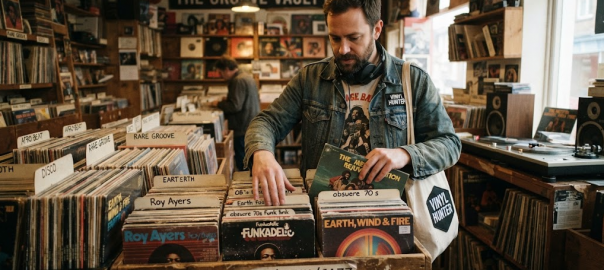
Mainstream commercial music streaming platforms operate primarily on predictive recommendation algorithms designed to maximize immediate engagement. By funneling listeners toward familiar artists, popular singles, and top-tier catalog reissues, these systems inadvertently generate algorithmic confirmation bias and echo chambers. Vast swaths of Black musical heritage remain effectively invisible beneath algorithmic preference loops. This homogenized digital experience stands in stark contrast to the tactile, serendipitous sensation of analog “crate-digging”—the physical act of flipping through dusty record bins in search of private-press pressings, forgotten regional movements, and unheralded session personnel.
To bridge this preserve-and-access gap, specialized digital archives cataloging over 3,282 rare vinyl record releases have emerged as critical historical repositories. Focused predominantly on the transformative golden eras of 1970s soul and 1980s boogie, funk, R&B, and jazz-fusion, these platforms safeguard both physical media artifacts and acoustic sound history. By fusing high-density visual asset scanning with granular discographical metadata taxonomy and integrated streaming audio, these modern archives are resurrecting the lost art of crate-digging for the digital age.
1. The Album Back Sleeve Is an Unsung Historical Goldmine
In physical record collecting, the back sleeve of a album jacket is an irreplaceable historical document. While commercial streaming applications habitually flatten album artwork into low-resolution front cover thumbnails, specialized preservation repositories execute high-density visual captures of both front and back jacket stock. This dual-sided documentation preserves primary source evidence that streaming platforms routinely ignore.
A high-resolution back sleeve capture unlocks four critical categories of discographical metadata:
- Complete Track Listings and Durations: Preserves exact track sequencing and song timings, which were historically critical for radio station DJs and club selectors calculating set transitions.
- Personnel and Production Credits: Identifies arrangement teams, backing vocalists, recording engineers, and backing session musicians whose collective output established regional studio sounds from Philadelphia to Los Angeles.
- Liner Notes and Studio Locations: Documents primary recording facilities, console specifications, and mastering engineers whose physical work can be cross-verified against runout wax etchings.
- Physical Artifact Condition: Allows archivists and collectors to evaluate jacket wear, ringwear, corner dings, import stickers, and regional distributor stamps that trace an individual record’s commercial distribution path.
By archiving back sleeves, historians can map complex studio networks, trace how arrangement teams migrated across record labels, and recognize session musicians who shaped entire sub-genres without ever receiving front-cover billing. Beyond its utility for discographical research, the physical aging of archived sleeve stock captures the tangible passage of temporal history:
“Like an old album cover, we accumulate our share of rust and wrinkles as we pass through this temporal world.”
2. The 12-Inch Single Is Essential for Club Culture History
To construct a rigorous history of modern dance music and club culture, digital archives must index extended 12-inch maxi-singles and promo 7-inch 45s alongside standard 33 1/3 RPM LP albums. During the late 1970s and early 1980s, Black music experienced a dramatic technical transformation: lush, analog studio arrangements characterized by full string sections and live rhythm sections yielded to synth-driven boogie, electro-funk, and early digital drum sequencing.
The 12-inch single emerged as the essential canvas for this sonic evolution. Due to the physical groove geometry and runtime constraints of standard 33 1/3 RPM LPs, album cuts frequently truncated extended dance routines. Standard LPs omitted the full-length disco and boogie mixes, dub passes, instrumental versions, and isolated drum breakdowns that were pressed exclusively on 12-inch maxi-singles to accommodate club DJs who required long intro and outro grooves to blend tracks seamlessly.
Standard 33 1/3 RPM LP Extended 12″ Maxi-Single Rare 7″ Promo 45 RPM
┌────────────────────────┐ ┌────────────────────────┐ ┌────────────────────────┐
│ – Truncated Track Time │ vs │ – Extended Dub Mixes │ vs │ – Exclusive B-Sides │
│ – Compressed Dynamics │ │ – Wide Groove Geometry │ │ – Promo Radio Edits │
│ – Standard Album Cuts │ │ – Isolated Drum Breaks │ │ – Mono/Stereo Passes │
└────────────────────────┘ └────────────────────────┘ └────────────────────────┘
Furthermore, rare promo-only releases—such as Herbie Mann’s 1975 Atlantic promo 7″ (45-3282), featuring the exclusive B-side “Body Oil”—contained unique radio edits and alternate mixes that never appeared on full-length releases. Today, modern beatmakers and Hip-Hop producers analyze these specific extended pressings and promotional 45s as primary proto-sampling sources . Without multi-format indexing that links LPs, 12-inches, and 7-inch singles, the architectural evolution of club culture and modern sampling mechanics cannot be accurately mapped.
3. “Random Spin” Engines Disrupt Algorithmic Echo Chambers
Mainstream streaming services rely on collaborative filtering models that reinforce listener confirmation bias, repeatedly recommending tracks that mirror a user’s established habits. Specialized archival discovery platforms disrupt this loop through features like the interactive “Random Spin” engine. By applying a uniform pseudo-random selection architecture across all 3,282 cataloged releases, the repository guarantees that an obscure, private-press 1981 modern soul single receives the exact same discovery probability as a major-label release, restoring serendipity to digital music exploration.
+———————————————————————————–+
| THE 4-STAGE DISCOVERY ENGINE |
+———————————————————————————–+
| [1. Query Stage] –> Uniform pseudo-random draw across 3,282 catalog entries. |
| [2. Visual Stage] –> Renders high-res front/back jacket scans & ringwear. |
| [3. Metadata Stage] –> Extracts tracklists, credits, & matrix codes to API player|
| [4. Pivot Stage] –> Generates hyper-links across labels, years, & musicians. |
+———————————————————————————–+
The “Random Spin” engine executes a structured, four-stage discovery mechanics pipeline:
- Query Stage: The system queries the index of 3,282 cataloged entries using a uniform pseudo-random distribution algorithm, bypassing user search bias to surface hidden releases alongside recognized masterworks.
- Visual Stage: The visual engine retrieves and renders high-resolution front and back artwork, recreating the tactile visual engagement of picking up an unfamiliar physical jacket from a crate.
- Metadata & Audio Stage: The metadata parser extracts complete track listings, personnel credits, and runout matrix codes while simultaneously pinging embedded streaming APIs to auto-load the corresponding streaming audio track.
- Interlinking Stage: The user interface dynamically populates hyper-linked metadata fields across every rendered credit, allowing listeners to immediately pivot from a randomly discovered record to related releases by release year, record label, producer, studio location, or session musician.
4. Case Study: How Motown Legends Bridged the 1980s Synth-Boogie Shift
Granular cataloging enables musicologists to perform deep forensic analyses of transition-era masterworks. A prime case study preserved within the repository is Lamont Dozier’s 1979 LP Bittersweet , cataloged under Warner Bros. Records ( BSK 3282 ). Dozier achieved legendary status during the 1960s as one-third of Motown’s premier Holland-Dozier-Holland (H-D-H) songwriting and production team. By 1978–1979, recording as a solo artist on Bittersweet , Dozier adapted his classical, gospel-derived soul songwriting to the emerging synth-boogie soundscapes of the incoming decade.
Bittersweet serves as a historical bridge: it retains the lush string orchestrations, rich vocal harmonies, and classic pop structures of 1970s soul, while incorporating syncopated basslines, warm rubbery Moog synthesizer accents, dynamic drum breaks, and sharp rhythm guitar chops that came to define 1980s boogie.
1970s Gospel-Soul Axis 1980s Synth-Boogie Shift
┌──────────────────────────────────┐ ┌──────────────────────────────────┐
│ – Expansive String Sections │ ==> │ – Syncopated Moog Synth Bass │
│ – Live Rhythm Sections │ (Bridge) – Sharp Rhythm Guitar Chops │
│ – Pop-Soul Song Structures │ ==> │ – Dynamic Electro Drum Breaks │
└──────────────────────────────────┘ └──────────────────────────────────┘
The archive’s deep metadata documentation captures the elite network of talent that executed this sonic bridge:
- Production & Technical Staff: Produced by Frank E. Wilson (Spec-O-Lite Productions), recorded in part at Fort Knox, mixed at Kendun Recorders by Kevin Beamish, and mastered by Jo Hansch. Technical contributions from Reggie Dozier, Todd Fisher, and Stillman Kelly ensured a polished balance between organic acoustic textures and electronic synthesis.
- Studio Musicianship: Features a stellar studio guitar lineup comprising Paul Jackson Jr., Lee Ritenour, and Melvin “Wah Wah” Watson—a grouping that illustrates the direct crossover between West Coast studio jazz-fusion and urban R&B boogie.
- Songwriting Lineages: Track credits reveal early compositions co-written by Angela Winbush and Rene Moore (who later formed the influential 1980s R&B duo René & Angela), preserving early work by figures who would redefine 1980s urban contemporary production.
- Runout Wax & Pressing Details: Cataloged runout matrix codes (such as BSK-1-3282 LW2) document physical manufacturing variants across pressing plants, including the US Winchester Pressing Plant, UK WEA pressings (K 56594), and original Italian issues.
Track Position,Song Title,Writer Credits,Key Musical Characteristics,Style Classification
A1,”””Boogie Business”””,Lamont Dozier,”Syncopated basslines, uptempo disco-funk rhythm, string accents”,Late 1970s Disco / Funk
A2,”””Love Me To The Max”””,”Angela Winbush, Herman Chaney, Rene Moore”,”Mid-tempo groove, raspy lead vocals, polished R&B harmonies”,Early Boogie / Urban Contemporary
B3,”””Let Your Love Run Free”””,”Angela Winbush, Rene Moore”,”Moog synthesizer accents, West Coast rhythm guitar, gospel soul vocals”,Synth Boogie / Modern Funk
B4,”””Fly Away Little Birdsong”””,Lamont Dozier,”Soulful dancer, breakdown funk section, complex drum arrangements”,Rare Groove / Mellow Boogie
5. Specialized Archives Rescue Forgotten Black Music from Streaming Blackouts
Commercial streaming services overwhelmingly prioritize top-tier catalog reissues that generate high stream volumes. As a result, mid-tier, independent, and regional Black music releases from 1970 to 1989 face total digital blackouts. Specialized archives indexing rare 7-inch, 12-inch, and LP vinyl pressings rescue these obscure recordings from physical degradation and digital erasure.
Rather than serving a single demographic, a comprehensive digital archive supports four distinct user personas across the cultural ecosystem:
User Persona,Primary Platform Touchpoint,System Functionality,Cultural Outcome
Musicologists & Historians,”Complete sleeve credits, filterable temporal/genre nodes”,”Traces session musician networks, studio locations, and arrangement teams”,Maps Black music evolution and regional studio ecosystems (1970–1989).
Vinyl Collectors & Dealers,”High-res back art, runout matrix codes, pressing details”,”Verifies rare pressing variants (e.g., Winchester Pressing Plant via dead wax) and grading”,Standardizes valuation and authenticates physical media artifacts.
Music Producers & Beatmakers,”Integrated audio playback, “”Random Spin”” discovery”,”Uncovers rare drum breaks, isolated keyboard riffs, and vintage groove mechanics”,Preserves historic groove mechanics as primary sampling sources.
Casual Enthusiasts,”Year/Era filtering, interactive “”Random Spin”” engine”,Recreates physical crate-digging through web-based visual/audio interaction,”Democratizes access to obscure, out-of-print physical vinyl pressings.”
Preserving the Acoustic Future
By pairing high-resolution physical documentation—including full jacket scans, personnel credits, and runout matrix codes—with integrated audio streaming, modern digital archives build a crucial bridge between physical media preservation and digital access. These platforms safeguard both the material artifacts and the acoustic legacy of vintage groove music, ensuring that transitional masterworks and rare pressings remain active objects of study and enjoyment.
As commercial music distribution becomes increasingly digitized and controlled by opaque algorithms, the systematic cataloging of obscure, small-press, and mid-tier releases is an urgent cultural imperative. Without dedicated discographical archiving, two decades of profound musical innovation risk disappearing into physical degradation and digital obscurity.
As algorithms continue to dictate how we discover culture, will we actively build systems to preserve forgotten history, or will we allow commercial streaming platforms to decide which musical legacies survive?
Source: https://soul-funk.ai.studio/