The Jeremiah Island Evictions
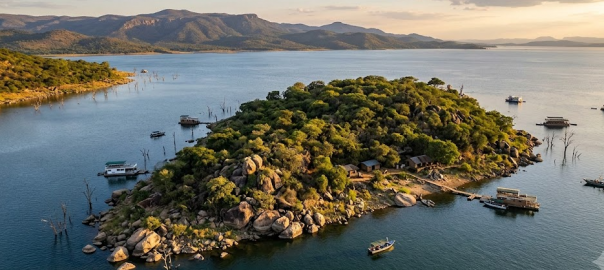
Thu, July 30 2026 /Mpelembe Media/ — This report documents and examines the ecological, social, and industrial landscape of Lake Kariba and the broader Zambian region, focusing on the tension between economic development and community welfare. One source highlights the area’s tourism and biodiversity, detailing the lake’s role as a massive man-made reservoir that supports both wildlife and hydroelectric power. In contrast, legal and technical reports address the displacement of rural populations and the necessity of protecting customary land rights through fair compensation and informed consent. Efforts to improve public health are also discussed, specifically through the creation of nutrient-dense fish-based food products to combat infant malnutrition. Finally, the sources document the importance of regulatory oversight, as evidenced by the closure of a major fish farm for violating environmental and sanitary standards. Together, these texts illustrate a complex regional effort to balance industrial growth with environmental protection and human rights.
The situation surrounding Lake Kariba in Zambia presents a complex intersection of historical trauma, modern commercial development, and ongoing human rights struggles over customary land.
Historical Legacy of Displacement
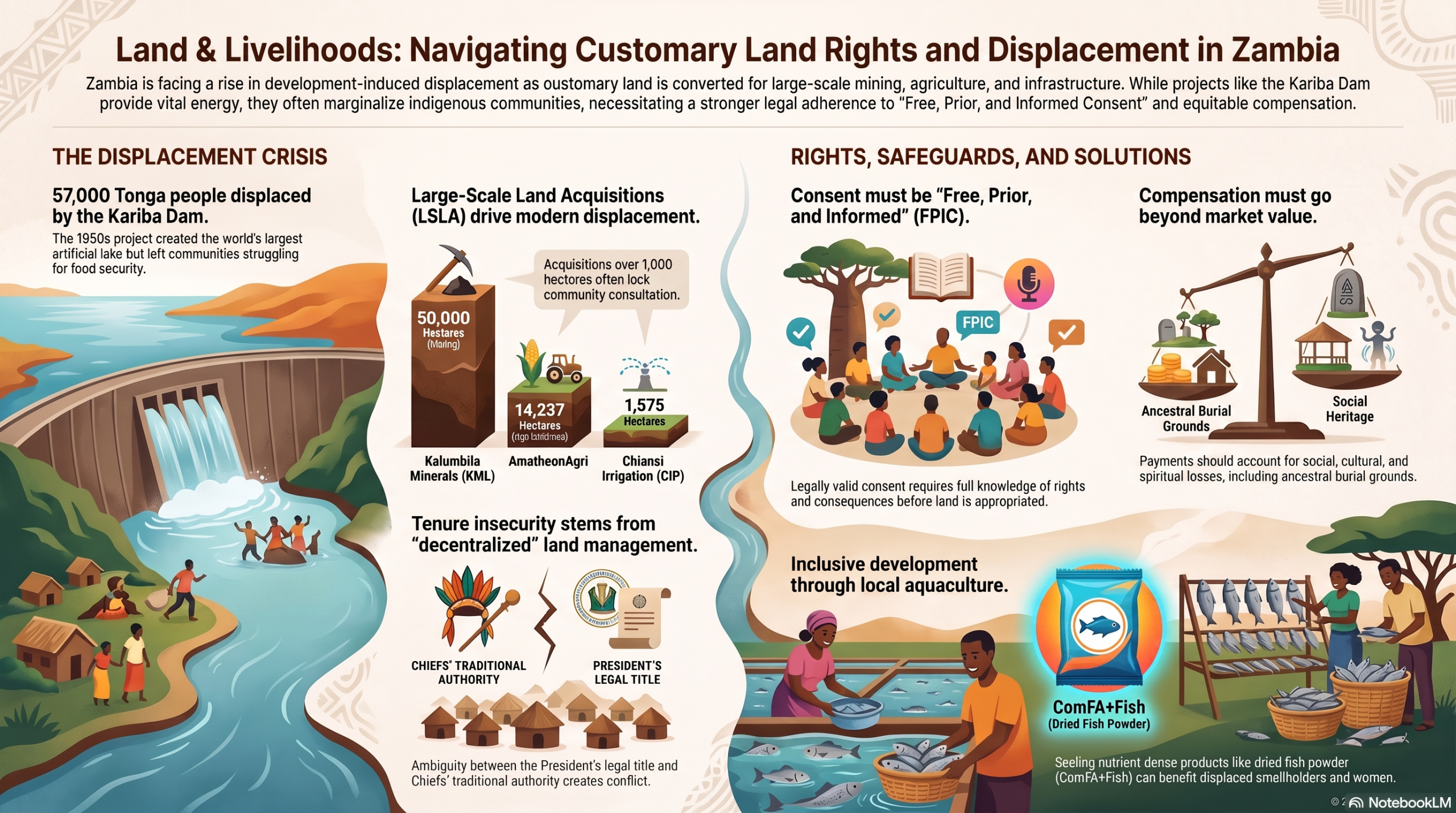
The creation of Lake Kariba in the late 1950s and early 1960s to generate hydroelectric power led to the forced displacement of over 50,000 native Tonga (Batonga) people. These communities were relocated from fertile riverine floodplains to dry, sandy inland areas, permanently altering their way of life and severing them from their primary agricultural livelihoods. While the colonial state launched “Operation Noah” to rescue thousands of wild animals, the displaced human populations were left to grapple with poor compensation and the loss of their ancestral lands.
The Jeremiah Island Evictions
This historical pattern of development-induced displacement is repeating itself today due to the rise of commercial aquaculture on the lake. On February 11, 2023, Zambian security forces violently evicted approximately 500 members of a fishing community from Jeremiah Island in the Siavonga District. The raid resulted in around 100 injuries, four arrests, and the destruction of personal belongings, cash, and fishing equipment. The displaced families were offered no alternative accommodation or financial compensation, and a strict maritime blockade now denies them access to their traditional fishing grounds. Tragically, enforcement of these boundaries has even led to fatalities, including the drowning of a local fisherman whose canoe was rammed by corporate security personnel when he tried to access the waters.
Corporate Enclosure and the Role of Zamfresh
The primary beneficiary of the Jeremiah Island enclosure is Zamfresh, a Chinese-owned commercial aquaculture enterprise that controls a near-monopoly (49% market share) on fresh tilapia production in the area. While Zamfresh is credited with creating around 500 direct and 1,000 indirect jobs, the company’s operations have sparked intense local conflict. Local Kapenta rig operators accuse Zamfresh of encroaching on vital deep-water fishing grounds, expanding beyond their legally allocated boundaries under the guise of “temporary trials”.
Furthermore, Zamfresh has a documented history of regulatory and environmental violations. In June 2021, local authorities temporarily shut down the company’s Siavonga facility due to severe public health breaches, including the discharge of raw sewage into the environment, use of untreated water in fish processing, non-functional toilets with fecal matter on the walls, and extreme overcrowding of workers. More recently, the company has faced public outrage and police investigations following a viral video depicting the physical manhandling of a female worker.
Vulnerability of Customary Land Rights
These conflicts highlight severe vulnerabilities in Zambia’s land governance framework. Under the Lands Act of 1995, customary land can be converted to statutory leasehold to attract private investment. This is frequently done without the free, prior, and informed consent of the local communities who depend on the land for their livelihoods. Without formalized land certificates, rural communities are virtually powerless against wealthy investors and state-backed development projects. However, recent judicial rulings, such as the 2022 Court of Appeal decision in the Molosoni Chipabwamba case, have begun to push back, affirming customary land rights by declaring conversions null and void when mandatory community consultations are ignored.
Nutritional and Environmental Threats
The displacement of local fishers directly impacts food security. Fish, such as kapenta, are a vital source of protein and micronutrients for vulnerable households, particularly for pregnant women and infants. As commercial entities monopolize the lake and push small-scale fishers out, local access to this nutritious food source diminishes. Additionally, Lake Kariba is facing severe environmental and structural challenges; dropping water levels driven by climate change and recurring droughts have brought the Kariba Dam to the brink of failing to generate sufficient electricity, crippling the regional economy.
Beyond the Dam: The Surprising Paradox of Land, Power, and Progress in Zambia
1. INTRODUCTION: The Ghost in the Grid
Lake Kariba is a monument to human ambition and a masterclass in regional irony. As the world’s largest artificial reservoir, it stands as a modern engineering marvel, its dam generating over 2,000 megawatts of power to fuel the grids of Zambia and Zimbabwe. Yet, the very name Kariba —meaning “little trap” in the local Tonga language—foreshadows a legacy of entrapment for the people it was built to serve. To create this strategic reservoir in the 1950s, the colonial government flooded the Zambezi valley, forcibly uprooting 57,000 Tonga people. These families were cast inland, some more than 100 kilometers from the river that provided their soul and sustenance.Seven decades later, the “ghosts” of this displacement have not been laid to rest; they have merely migrated. The historical trap of the 1950s is now a modern policy failure spreading through districts like Solwezi, Choma, and Mansa. While the national grid hums with electricity, the communities at its source remain in the dark, struggling for land and food. This investigation looks beneath the surface of “national development” to reveal a landscape where progress often functions as a predator, and the poor find themselves “street kids” in their own ancestral homes.
2. THE POWER GAP: Why “God-Given Inheritance” is Being Sold Off
Customary land in Zambia is supposed to be the ultimate safety net—a primary resource for the sustainable livelihoods of the rural majority and a haven for those who cannot afford the high stakes of statutory leasehold land. However, a profound “power gap” has emerged through the decentralized management of this land by Chiefs, indunas, and headmen. While the Constitution (Amendment) Act No. 2 of 2016 vests all land in the President, in practice, traditional authorities exercise nearly exclusive power over its administration.This has birthed a counter-intuitive crisis: some traditional leaders have begun to act as “owners” rather than custodians. Motivated by “greedy” sell-offs, land is being alienated indiscriminately to investors in places like Mpika and Mazabuka, often without the consent of the subjects residing on it. This creates a pattern of internal displacement where subjects are pushed from fertile, arable soil to barren, marginal patches.Former President Edgar Lungu signaled the alarm, stating that Chiefs “should not abuse their role but to preserve the God given inheritance for their subjects.” To address this, the ongoing Land Audit aims to make customary certificates “evidence with equal weight to state leasehold titles” in court. Until then, without transparency, the “God-given inheritance” remains a commodity for the highest bidder.
3. THE LEGAL TRAP: The Customary vs. Statutory Paradox
The insecurity of rural landholders is no accident; it is a “legal trap” codified by design. While the 1995 Lands Act explicitly recognizes customary tenure, it carries a lethal caveat: formal statutory law takes precedence whenever the two conflict. This supremacy is anchored in the Constitution (Amendment) Act No. 2 of 2016, which mandates that any customary practice inconsistent with the Constitution is void.This legal hierarchy creates permanent tenure insecurity for the poor. While Zambia is a signatory to international human rights treaties like the Convention on the Elimination of All Forms of Discrimination Against Women (CEDAW) and the International Covenant on Economic, Social and Cultural Rights (ICESCR), these remain largely “undomesticated.” Without being incorporated into national legislation, they offer no shield for a villager facing an investor armed with a state-backed permit. The law promises protection but provides a vacuum, leaving local farmers to fight modern legal battles with traditional tools that carry no weight in a magistrate’s eyes.
4. THE FISH PARADOX: Record Production vs. Local Hunger
Nowhere is the paradox of Zambian progress more visible than in the aquaculture hubs of Gwembe, Siavonga, and Sinazongwe. Through initiatives like “FishFirst! Zambia,” the country has become a regional giant. Operations like Aller Aqua (producing 50,000 tons of feed annually) and Yalelo have transformed Lake Kariba into a commercial powerhouse. Yet, this record production has birthed a “Fish Paradox”: higher yields are leaving local bellies empty.The culprit is a combination of economic desperation and a nutrition knowledge gap. Men, who dominate the fishing industry, often sell their entire catch—specifically high-value Kapenta—to urban markets for quick cash. They do so unaware of the extreme nutritional value of Kapenta compared to household staples like Nshima. While the money flows out, the children stay “stuck eating Nshima and yellow cucumber.”The human cost falls on women, who face “extreme time poverty.” Without mechanized equipment, they spend hours hand-grinding small fish into powder using a mortar and pestle. This led to the development of “ComFA+Fish” powder—a nutrient-dense blend designed to save infants from malnutrition in the very shadow of the world’s largest fish farms.
5. THE “INVISIBLE” VICTIMS: Why Women Bear the Brunt of Displacement
Development-induced displacement (DID) is a gendered crisis. When customary land is alienated for mining or agriculture, women are the first to lose their livelihoods and the last to be considered for compensation. They rely heavily on “secondary rights”—access to land or water granted through male relatives—which vanish instantly when land is converted to statutory tenure.Lacking the independent income to buy statutory land, women see their productivity plummet. The loss of fertile soil is not just an economic hit; it is a total social collapse. The specific risks faced by these invisible victims include:
- Landlessness: The loss of the only asset for food security.
- Homelessness: Lack of resources to rebuild shelters in unfamiliar territories.
- Food Insecurity: Transitioning from self-sufficiency to a reliance on markets they cannot afford.
- Social Disintegration: The shattering of support networks, and the loss of access to clinics and schools for their children.
6. THE MISSING MANUAL: A Country Without a Resettlement Policy
The most damning administrative failure in Zambia is the absolute vacuum of oversight regarding compensation. While a Resettlement Policy was adopted in 2016, there is no consolidated legislation to enforce it. Instead, oversight is fragmented between the Office of the Vice President (OVP), the Department of Resettlement (DoR), and the Disaster Management and Mitigation Unit (DMMU). They do not coordinate; they merely exist in the same government directory.Because domestic law is a hollow shell, investors refer to “World Bank Guidelines” for compensation. This is the ultimate “Legal Trap”—since domestic law favors statutory tenure, there is no legislative pressure to codify local rights. Rural communities often surrender their livelihoods for a pittance, signing away their future with a “thumb print” on documents they cannot read and without independent advice.This isn’t just an administrative oversight; it is a violation of the Rule of Law. In the case of Mpogwe Farms Limited v Attorney General , the courts were clear: the State must follow its own devised statutory procedures. Furthermore, the Wise v Attorney General case highlighted that the President’s power to alienate land for “public purposes” is often abused for a “clear profit motive.” Vague allusions to “employment generation” or “taxation” are insufficient justifications for the destruction of a community’s way of life.
7. CONCLUSION: A Future Held in Trust?
Zambia stands at a moral and legal crossroads. While the ongoing Land Audit offers a glimmer of hope for documenting customary rights, the fundamental question remain: Who is this progress really for? Everyone wants development, but if it is to be meaningful, it must be transformative rather than predatory.Chiefs and state officials must stop viewing local people as obstacles to be cleared and start seeing them as shareholders in their own land. If development continues to require the displacement and impoverishment of the very people it claims to serve, then it isn’t progress—it’s just a more modern version of the “little trap” that gave Kariba its name. The future of Zambia depends on whether the land is held in trust for the people, or sold out from under them.