25 Feb. 2026 /Mpelembe Media/ — A leaked draft of a $1bn health financing agreement between the US and Zambia has provoked widespread backlash and accusations of “shameless exploitation”. Under the proposed memorandum of understanding, Washington would provide health funding in exchange for severe and unprecedented conditions that advocates argue are vastly worse than deals struck with other African nations.
Key controversies within the agreement include:
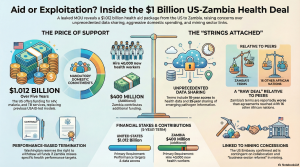
Data Exploitation: Zambia must grant the US access to its citizens’ health data for 10 years and commit to sharing data on new or emerging pathogens for the next 25 years.
Mining Concessions: The health aid is covertly tied to economic demands, requiring Zambia to open its mining sector to US commercial interests and participate in monthly trade briefings. Zambia’s health minister was notably fired shortly after publicly denying this linkage.
Harsh Performance Targets: Despite the US offering less health aid than in previous years, Zambia is required to hire 40,000 new health workers and invest an additional $400 million into its health services. If Zambia fails to meet these strict targets, the US can terminate the agreement, which advocates warn could collapse the country’s HIV programs and broader health system.
In response, local civil society groups and human rights advocates are fiercely opposing the deal. They are demanding the removal of all data-sharing clauses and are considering legal action to challenge the constitutionality of the agreement.
The $1 Billion Bargain: 5 Surprising Truths Behind the US-Zambia Health Deal
We are often told that international aid is a straightforward act of altruism—a hand extended from a wealthy neighbor to one in need. But in the high-stakes theater of modern diplomacy, “free” support is increasingly a myth. Behind the choreographed handshakes and sanitised press releases, global health funding is being rewritten as a cold, transactional contract with strings that reach far beyond the clinic walls and deep into a nation’s sovereign soil.A striking and deeply unsettling example is the proposed $1 billion health deal between the United States and Zambia. While the billion-dollar headline suggests a massive investment in human life, leaked documents obtained by The Guardian reveal a much darker reality. This isn’t a standard aid package; it is a meticulously crafted “raw deal” that critics and human rights advocates are calling “shameless exploitation.”As the Trump administration moves to dismantle traditional USAID models in favor of bilateral agreements that “demonstrably advance American national interests,” Zambia has become the testing ground for a new, predatory era of diplomacy. To understand how life-saving medicine became a high-stakes bargaining chip for copper and cobalt, we must look at the five surprising truths buried within the leaked Memorandum of Understanding (MOU).
Truth #1: The “Quid Pro Quo” for Mineral Wealth
The most startling revelation in the leaked MOU is the naked link between healthcare and mining. In December, the US embassy in Zambia confirmed that this health financing is explicitly contingent on “collaboration in the mining sector” and business-sector reforms designed to grant American companies preferential access to Zambia’s natural resources.This isn’t aid; it is a shakedown. The MOU actually commits the Zambian government to monthly briefings with the US embassy specifically to report on trade and investment efforts. This level of commercial surveillance suggests that the US is less interested in Zambian patients and more interested in using the health of a population as a lever to secure industrial advantages in the global race for minerals.”These terms are vastly worse than other deals. The US is conditioning life-saving health services on plundering the mineral wealth of the country. It’s shameless exploitation, which is immoral.” — Asia Russell, Director of Health Gap
Truth #2: 25 Years of Data Sovereignty Signed Away
Under the terms of the deal, Zambia is expected to surrender its digital and biological sovereignty. The MOU requires Zambia to provide the US with access to its citizens’ health data for 10 years. Even more alarming is a 25-year commitment to hand over information on any “new or emerging pathogens” discovered within its borders.The “Signing Away” of Citizen Rights This unprecedented data-sharing mandate has Josiah Kalala, director of the Chapter One Foundation, questioning the very constitutionality of the agreement. Zambia is being forced into concessions that its neighbors have deemed toxic. While Kenya is currently facing a fierce legal challenge over a similar deal that limited data sharing to just seven years, Zambia is signing on for decades. The terms are so extreme that Zimbabwe recently halted its own negotiations with the US, citing these exact concerns over sensitive health data. By moving forward, Zambia is effectively signing away the privacy rights of its citizens for a generation.
Truth #3: The Comparison Gap—A “Bait and Switch” on Funding
When the deal was first discussed in November 2025, former Health Minister Elijah Muchima touted a $1.5 billion figure. The leaked MOU reveals a massive “bait and switch”: the total commitment has plummeted to just $1.012 billion. Even more concerning is the actual annual spend. Last year, the US committed $367 million to Zambia for HIV services alone; under this new “billion-dollar” deal, the total health funding for 2026 drops to just $320 million.Zambia is being asked to do far more with significantly less. To unlock this shrinking pool of funds, the government must meet a gauntlet of mandatory and expensive targets:
Massive Recruitment: Hiring 40,000 new health workers despite a budget constrained by massive debt repayments.
Domestic Contribution: Contributing an additional $400 million of its own funds toward health services over five years.
Commercial Surveillance: Providing the aforementioned monthly briefings to the US embassy to expand American investment.
Truth #4: The Performance Trap and the April 1st Deadline
This agreement is structured like a high-stakes corporate contract where the penalty for a missed target is a death sentence for the program. If Zambia fails to meet specific benchmarks—such as HIV enrollment or maternal mortality rates—the US retains the unilateral right to terminate the agreement and withdraw all funding.This creates what activists describe as a “hostage” dynamic. There is a ticking clock: a clause in the MOU states that the entire process will be terminated if a final agreement is not reached by April 1st. This artificial urgency pressures the Zambian government to ignore the human cost. If the system fails to hit its numbers, the “first casualties” won’t be the politicians or the diplomats—they will be the patients.”I’m a person living with HIV. If the HIV programme in Zambia is distorted or it’s disrupted or it’s derailed, I’ll be the first casualty, as well as hundreds of thousands of other people.” — Julius Kachidza, Chair of Zambia’s Civil Society Self-coordinating Mechanism
Truth #5: The Political “Disappearing Act”
The lack of transparency surrounding this deal is perhaps the most damning evidence of its true nature. On February 15, then-Health Minister Elijah Muchima went on television to assure the public that the health financing was not linked to mining concessions. “If there are other external conditions attached, I am personally not part of that,” he claimed.Three days later, President Hakainde Hichilema fired Muchima without explanation. This rapid dismissal—coming immediately after a public denial of the deal’s controversial strings—highlights the intense political pressure to keep the “quid pro quo” hidden from the Zambian people. It suggests a government that is not negotiating a partnership, but rather managing a surrender.
A New Era of “National Interest” Aid
The US-Zambia deal marks a fundamental and chilling shift in global health strategy. We are witnessing the birth of a model where foreign assistance is no longer a tool for humanitarian development, but a primary instrument for securing geopolitical leverage. In this new era, vaccines are traded for minerals, and patient data is the currency of diplomacy.As the April 1st deadline looms, Zambia stands as a warning to the rest of the world. When the health of the vulnerable is treated as a bargaining chip for the “national interests” of the powerful, the very concept of aid is corrupted. We are left with a final, haunting question: If global health becomes a tool for geopolitical leverage, can we still call it aid?