Can You Learn Love From a Screen? The Case for Integrating Reality TV Into School Curriculums
Fri, July 24 2026 /Mpelembe Media/ — The contemporary reality television landscape has undergone a sophisticated transformation, shifting from a genre of “simple entertainment” into a high-stakes ecosystem where exploitation is frequently rebranded as social empowerment. What was once a voyeuristic exercise in watching “ordinary” people has evolved into a strategic platform for personal branding and influencer recruitment, leveraging the audience’s desire for authenticity to drive unprecedented levels of engagement. This evolution is defined by a move away from self-contained broadcast cycles toward a 24/7 interactive experience that blurs the lines between a contestant’s private life and their public performance.
Executive Summary of the Sources
The collected materials analyze Love Island not merely as a reality dating show, but as a sociological mirror and a powerful cultural vehicle that reflects, constructs, and reinforces contemporary gender roles, relationship ethics, and modern dating anxieties. Below is a synthesis of the core themes discussed across the academic dissertations, media reviews, and digital discourse in your sources:
1. The Construction and Performance of Binary Gender Roles
Sociologists and media scholars note that Love Island actively commodifies and aestheticizes highly traditional, binary gender scripts:
- Emphasised Femininity vs. Hegemonic Masculinity: The show heavily reinforces Raewyn Connell’s gender frameworks. Male contestants are expected to be athletic, physically dominant, and emotionally restrained, while female contestants are expected to prioritize flawless physical appearance, emotional expressiveness, and sexual desirability.
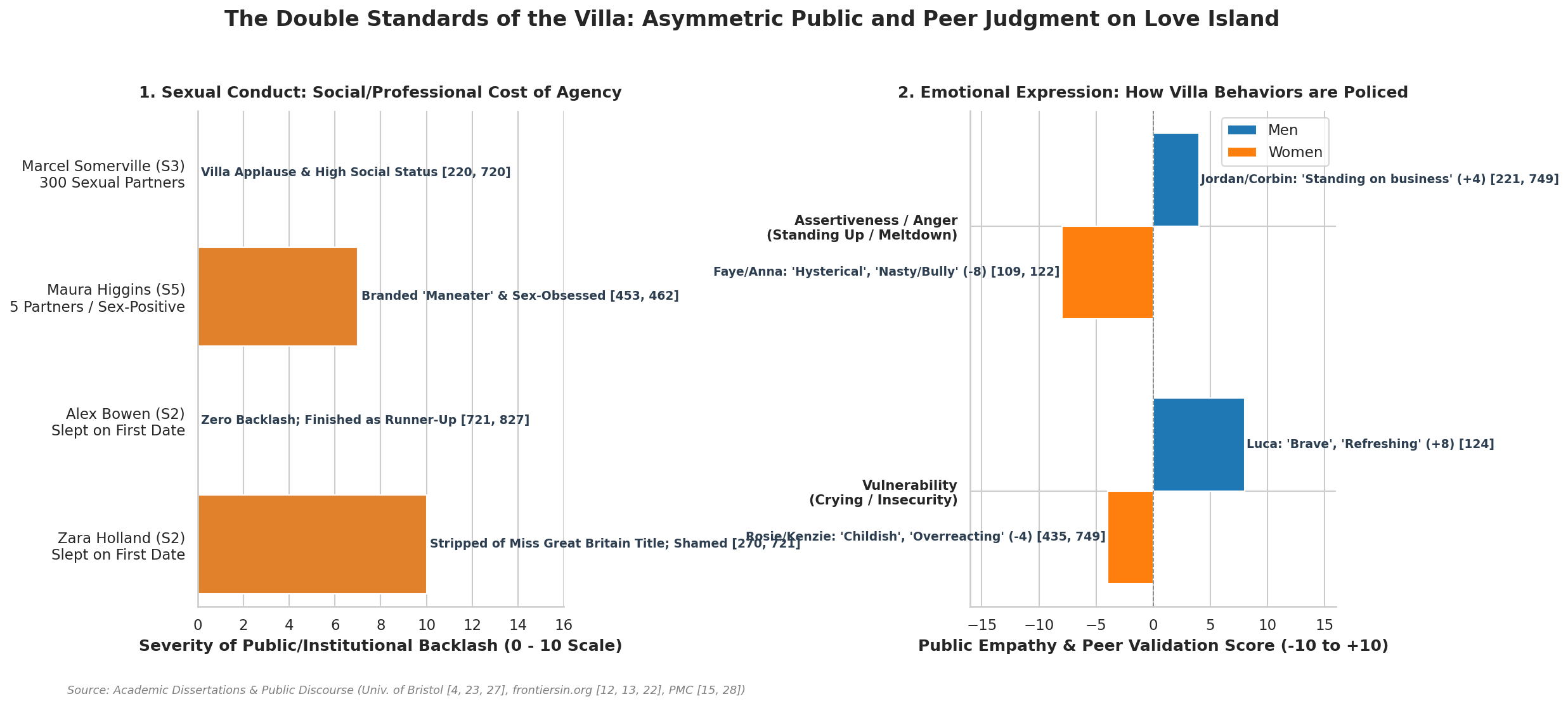
- The Valuation of Emotion: A severe double standard exists in how emotional expression is valued. When men show vulnerability, it is treated as rare, brave, and an “authentic breakthrough”. Conversely, women’s emotional distress is frequently dismissed as dramatic, hysterical, or “BGC” (Bad Girls Club) behavior.
- Passive Men and Aggressive Grafting: Recent seasons highlight a shift in dating dynamics, with commentators identifying a rise in “passenger princess” behavior among men who expect women to do the active “grafting” (pursuing/wooing), while women feel pressured to debase or adapt themselves to succeed under a patriarchal framework.
2. The Sexual Double Standard and Slut-Shaming
The sources identify heterosexual romance as an arena where regressive sexual double standards are fiercely enforced by the public, producers, and pageant institutions:
- The Miss Great Britain Controversy: A landmark moment of double standards occurred in 2016 when contestant Zara Holland was stripped of her Miss Great Britain title for having sex in the villa’s hideaway. While Zara faced immense public humiliation and was de-crowned for not being a “positive role model,” her male partner Alex Bowen escaped entirely unscathed and went on to finish as runner-up.
- Stigmatizing Sex-Positive Women: Female contestants who openly embrace their sexuality or assert their sexual agency (such as Maura Higgins or Megan Barton-Hanson) are routinely labeled as “maneaters” or “slut-shamed,” whereas men are celebrated for sexual prowess.
3. The Parasocial Panopticon and Online Harassment
With the rise of social media, the audience has transitioned from passive viewers to active, highly punitive “parasocial police”:
- The Culture of Hostile Surveillance: Fandoms demand moral purity from contestants and often seek disproportionate punishments for perceived “bad behavior”. This includes digging up past political leanings (as seen in smear campaigns against Kenzie) and extreme real-world harassment, such as falsely reporting a female contestant’s family to immigration services (ICE).
- “Cautious Passivity” in Gen Z: Knowing how previous casts have been eviscerated online, modern contestants have adopted a risk-averse stance of “cautious passivity”. They play it safe and avoid stepping on toes, which paradoxically leads to the audience complaining that the show is “too boring”.
4. Duty of Care and the Mental Health Crisis
The real-world consequences of reality television fame and cyberbullying are a central focus of media reform:
- Tragic Precedents: Extreme public scrutiny and social media trolling on the UK version of the show tragically preceded the suicides of former contestants Mike Thalassitis and Sophie Gradon, as well as host Caroline Flack.
- Systemic Compliance Changes: To combat this, ITV introduced robust duty of care protocols. These include mandatory therapy sessions (at least eight post-show sessions), relationship behavior guidance, and a landmark 2023 rule requiring contestants to pause and keep all social media accounts dormant during filming to protect their families from digital abuse. Critics argue, however, that this simply creates a massive “backlog of hate” waiting for them when they get their phones back.
5. Love Island as a Tool for Relationship Education
Despite its flaws, the series functions as an accidental but effective platform for public pedagogy:
- Charity Interventions and “Gaslighting”: Domestic abuse charities, notably Women’s Aid, have utilized Love Island to spark national conversations on relationship ethics. The charity famously intervened to flag “clear warning signs” of emotional abuse and “gaslighting” in contestant Adam Collard’s treatment of Rosie Williams in 2018. These public statements successfully normalized clinical terms of psychological safety in mainstream discourse.
- Classroom Integration: Research shows that workshops in schools use Love Island dynamics as a highly engaging starting point for Relationships and Sex Education (RSE) to help young people identify toxic versus healthy relationship traits.
Why Your “Girl’s Girl” Obsession is Hiding a Dark Reality: 5 Takeaways from the New Era of Love Island
Every summer, we congregate around a neon-lit, Fiji-adjacent panopticon to witness a sun-drenched ritual marketed as “romance.” Yet, for the modern digital native, Love Island has transitioned from a lighthearted escapist lark into a brutal, high-stakes social trial—a digital Colosseum where character is interrogated and “vibes” are litigated with surgical precision. We aren’t merely watching beautiful people find love; we are participating in a public interrogation of the neoliberal self.While the aesthetic remains breezy, the social dynamics reveal a disturbing evolution. Reality TV hasn’t actually changed its DNA; it has simply updated its software. The tools for marginalizing and surveilling women have been rebranded through a pseudo-feminist lens, allowing audiences to indulge in traditional misogyny under the sanctified banner of “empowerment.”
1. The “Girl’s Girl” Feminism Trap
The concept of “girl’s girl” feminism has shifted from a progressive ideal of female solidarity into a rigid, exclusionary social playbook. In the current Love Island landscape, this “watered-down” feminism functions as an inverted version of the fight for women’s rights. Rather than fostering support, it enforces a standard of “moral purity,” weaponizing solidarity to tear down any woman who fails to perform the correct script of female-centeredness.This dynamic serves a cynical function: it benefits male peers by shifting the gaze. When a woman is pathologized as a “pick-me” for her perceived failures, the structural sexism of the show’s format disappears from the conversation. We become so obsessed with policing individual “mean girls” that we ignore the architects of the game itself.”Reality TV hasn’t changed, but exploitation has been rebranded as empowerment.” — Cassidy Gays
2. The Rise of Parasocial Policing and Disproportionate Punishment
We have entered the era of “hostile parasocial surveillance.” Because digital audiences are invited to view the “dirty laundry” of contestants in real-time, they develop a deluded sense of intimacy—a conviction that they truly know these strangers. This perceived proximity is then used to justify extreme, real-world punishments for on-screen behavior.Look no further than the divergent fates of Kenzie and Sean—a case study in how we forgive men for their badges while crucifying women for their suspected ballots. Kenzie faced a relentless, manufactured smear campaign over a suspected political photo found before the show even aired. Despite her family’s defense, the “girl’s girl” contingent used her alleged politics to justify endless vitriol. Contrast this with Sean, a newly appointed police officer; while fans “cried” over his early exit, Kenzie was denied any such empathy. This surveillance culture reached a terrifying peak with Cierra, whose family was reported to ICE by “fans” seeking the ultimate disproportionate punishment for her past social media errors.
3. The Rigged Game: Why “The House Always Wins”
The Love Island app and its seductive voting systems offer fans an illusion of agency that the producers meticulously manipulate. Viewers believe they are the judges, but they are actually the battery. Producers consciously maintain “villains” on the show because online outrage is the most efficient fuel for engagement metrics.The “karaoke challenge” used to save Kenzie is a masterclass in this cynical logic. By orchestrating a challenge that played to her specific background as a competitive dancer, the “house” ensured she stayed in the villa despite being in the bottom of the public vote. This wasn’t an act of mercy for Kenzie; it was a calculated move to guarantee the continued cycle of “parasocial policing” that keeps the audience logged in, angry, and generating revenue.
4. The Return of the 16th-Century Scarlet Letter
There is a glaring paradox in modern fandom: we demand high-octane drama but reward the most “boring” personalities with moral purity points. When the show inevitably slows down, the audience complains, yet any woman who creates the required conflict is immediately branded with the 16th-century pejorative “lustful.”This puritanical resurgence is nonsensical on a show designed for sexual exploration, yet it is used to shame women for the very agency the format encourages. We see this in the Beyond the Villa spin-off, where Hannah was forced to issue a public apology for being a “mean girl.” It is a “damned if you do, damned if you don’t” dynamic where women are punished for performing the labor of the show. We are peddling a regressive moral necessity that rebranded traditional slut-shaming as a modern feminist requirement.
5. “Movie Night” and the Gendered Remorse Gap
The “Movie Night” segment serves as a structural microcosm of the villa’s inherent sexism. It creates a false equivalence between male and female behavior, but only the women are required to perform the labor of remorse. This season, Sincere’s archival reel of duplicity was met with the peculiar grace of “himpathy”—that inappropriate sympathy extended to male wrongdoers. Despite having double the footage of exploration and a trail of lies, Sincere’s defensiveness was excused.Kenzie, however, offered a sincere apology and genuine remorse, only to have that vulnerability weaponized against her by the men in the villa and the fans online. This dynamic forces women into victim-blaming tropes regardless of their honesty. We saw this again with Sydney during Casa Amor; when she groveled at KC’s feet and asked how she could change herself to fit his needs, fans immediately diagnosed her with a “male-centered” pathology. Instead of critiquing the structural sexism that forces a woman to debase herself to survive the game, the audience chose to blame the individual for her own desperation.”In practice, reality TV has become more about punishing women for being human than finding love.” — Cassidy Gays
From “TV Tinder” to a Provocative Future
Professor Andrew Selepak famously described Love Island as “TV Tinder”—a superficial landscape where lasting connection is a statistical anomaly (less than 12% of couples survive the real world) and the real prize is the accumulation of “influencer” status. The “narcissistic aspect” of the show is not just limited to the contestants performing love for visibility; it extends to the audience performing the role of the moral hangman.Reality TV doesn’t have to be a circus of sexism, but it currently serves as a mirror for our own digital rot. It begs a final, uncomfortable question for the viewer: Are you tuning in to watch the bloom of a connection, or are you simply there to participate in the parasocial policing of women for the crime of being human?